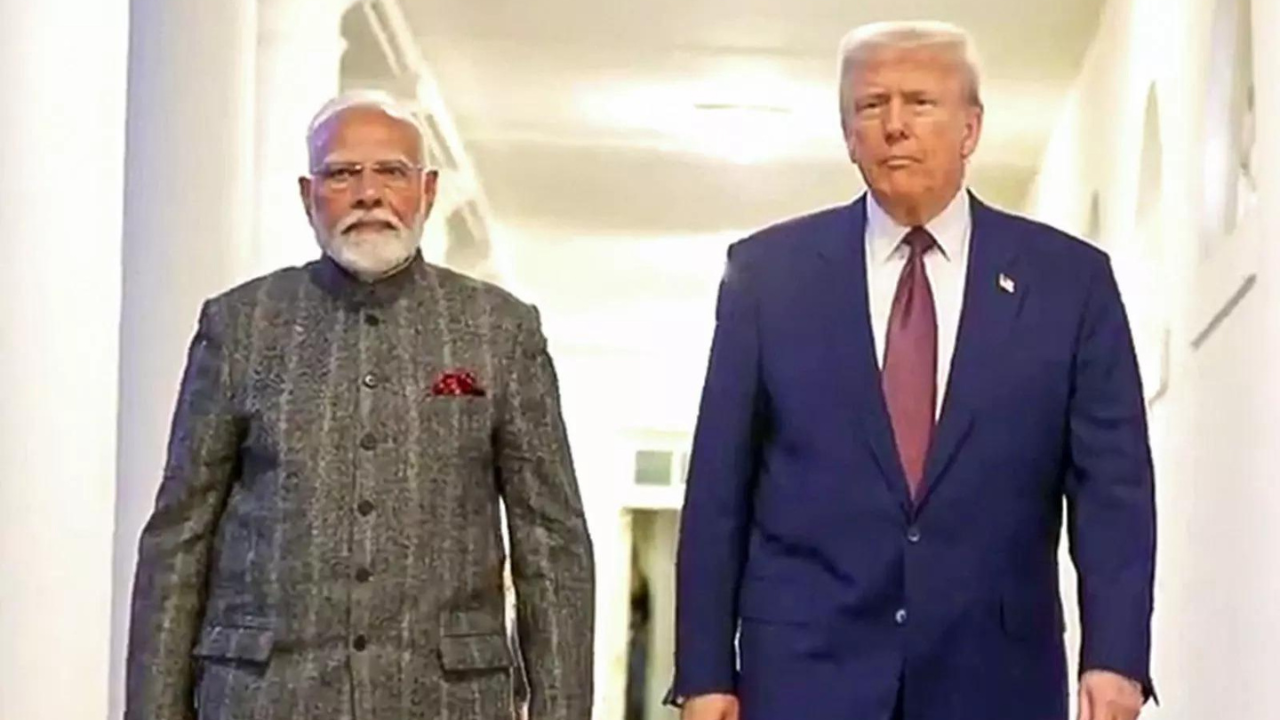
India and the United States have reached a pivotal trade understanding that marks not merely an economic reset, but a deeper inflexion point in their bilateral relationship. After months of strain—highlighted by punitive tariffs that at one stage climbed as high as 50 per cent on Indian exports to the US—both sides now stand at the threshold of a framework agreement that could reshape the contours of global trade and geopolitics.


The dispute was never simply about goods and duties. In essence, it was a test of strategic patience, economic sovereignty, and diplomatic dexterity. In August 2025, the United States, under President Donald Trump, escalated its so-called “reciprocal tariff” framework by imposing an additional 25 per cent duty on Indian goods, explicitly linked to New Delhi’s continued purchase of Russian crude oil. This came on top of an existing 25 per cent tariff, pushing the effective burden to 50 per cent across a wide range of Indian exports—from textiles and gems to leather and seafood.
For India, the issue was not transactional but structural. New Delhi consistently argued that its energy choices—particularly the purchase of discounted Russian oil following Western sanctions imposed after the Ukraine War—were dictated by national energy security imperatives rather than geopolitical alignment. India emerged as a major buyer of Russian crude largely because Western firms vacated the market, a reality New Delhi viewed as pragmatic economics, not political defiance.
Confronted with tariffs designed to cripple its export competitiveness, India responded with calculated diplomatic agility. The government accelerated a broad diversification strategy: deepening engagement with the European Union, strengthening economic ties with East Asia, and sustaining strategic dialogue across multiple multilateral platforms. The objective was twofold—to reduce over-dependence on any single partner, including the United States, and to reaffirm India’s strategic autonomy in a rapidly fragmenting global order.
It is in this context that New Delhi’s long-awaited India–EU Free Trade Agreement, often described by policymakers as the “Mother of All Deals”, assumes particular significance. Concluded in January 2026 after nearly two decades of negotiations, the agreement promises preferential access for Indian goods to European markets while substantially expanding opportunities for European exporters in India. Expected to enter into force by early 2027, the pact signals India’s strategic pivot towards deeper integration with the world’s largest economic bloc—serving as both economic diversification and diplomatic leverage amid trade frictions elsewhere.
At the same time, India’s diplomatic choreography was on full display through Prime Minister Narendra Modi’s engagements with President Xi Jinping of China and President Vladimir Putin of Russia in 2025. These meetings were not merely transactional; they were expressions of strategic autonomy. At the Shanghai Cooperation Organisation summit, Modi reiterated India’s commitment to managing border tensions with China while making clear that New Delhi’s partnerships are guided by national interest rather than alliance politics. With President Putin, Modi reaffirmed the “special and privileged” nature of India–Russia ties—rooted in history, trust, and defence-energy cooperation—even as India navigated tensions with Washington.
To some observers, these engagements appeared to signal hedging amid U.S. pressure. In reality, they reflected a long-standing principle of Indian foreign policy: resisting zero-sum alignments in favour of a multipolar balance. India has increasingly positioned itself as a strategic bridge—engaging competing power centres without being subsumed by any.
Against this backdrop of diversified partnerships, a recalibration with Washington was inevitable. Recent diplomatic engagement broke the deadlock. The framework trade agreement unveiled in early February 2026 reflects a pragmatic compromise: the United States agreed to roll back its punitive tariff regime, reducing duties on Indian exports from as high as 50 per cent to an effective rate of around 18 per cent, while removing the Russia-linked penalty. In return, both sides agreed to a roadmap for lowering trade barriers and exploring expanded cooperation in energy, technology, and selected agricultural sectors.
Yet beneath the celebratory headlines lies significant ambiguity.
President Trump has publicly claimed that India will curtail Russian oil imports in favour of American—and even Venezuelan—supplies. New Delhi, however, has been notably cautious, emphasising that energy sourcing decisions will remain guided by price stability, availability, and national interest rather than political signalling. The gap between public rhetoric and formal commitments remains conspicuous.
Equally sensitive are questions surrounding agriculture and dairy. Historically, India has treated these sectors as inviolable red lines, given their implications for farmer livelihoods and food security. There is little evidence thus far that India has agreed to zero-tariff access for U.S. dairy or agricultural products. Instead, the emerging picture suggests a carefully calibrated negotiation—liberalisation where feasible, protection where essential.
Viewed in a broader strategic context, the recent deal is neither an end nor a beginning but a recalibration — and one that aligns with the long arc of India–U.S. relations since the Cold War. The foundations of India–U.S. strategic cooperation were laid in the post–Cold War period, taking initial shape during the final years of the Clinton administration in parallel with Atal Bihari Vajpayee’s leadership in India. This trajectory gained decisive momentum with the George W. Bush–Vajpayee alignment in the early 2000s and was subsequently consolidated by successive Indian and American administrations, all of which recognised the enduring geostrategic value of a robust bilateral partnership. The subsequent expansion of cooperation under the Clinton, Bush, Obama, and early Trump years set the stage for deep engagement in areas from defence and civil nuclear cooperation to counter-terrorism, health and technology. This robust partnership survived macroeconomic tensions and policy disagreements because it was grounded in shared interests extending far beyond tariffs.
That trajectory has never been linear. The recent tariff shock exposed the fragility of economic ties when decoupled from the strategic context. Yet the present course—marked by revived trade engagement, sustained Quad cooperation, and deepening defence and security dialogue—suggests a renewed recognition in both capitals that the relationship is too consequential to be reduced to transactional bargaining.
Whether in managing Indo-Pacific security, countering transnational terrorism, or shaping global governance norms, India and the United States remain indispensable to one another. The latest trade deal, therefore, is not merely about tariffs and market access. It is a reaffirmation that, despite periodic turbulence, the partnership rests on strategic convergence rather than convenience.
If approached with realism rather than rhetoric, this moment of recalibration may well be remembered not as a disruption—but as the prelude to a more resilient and mature India–U.S. partnership in an increasingly uncertain world.
Disclaimer
Views expressed above are the author’s own.
END OF ARTICLE