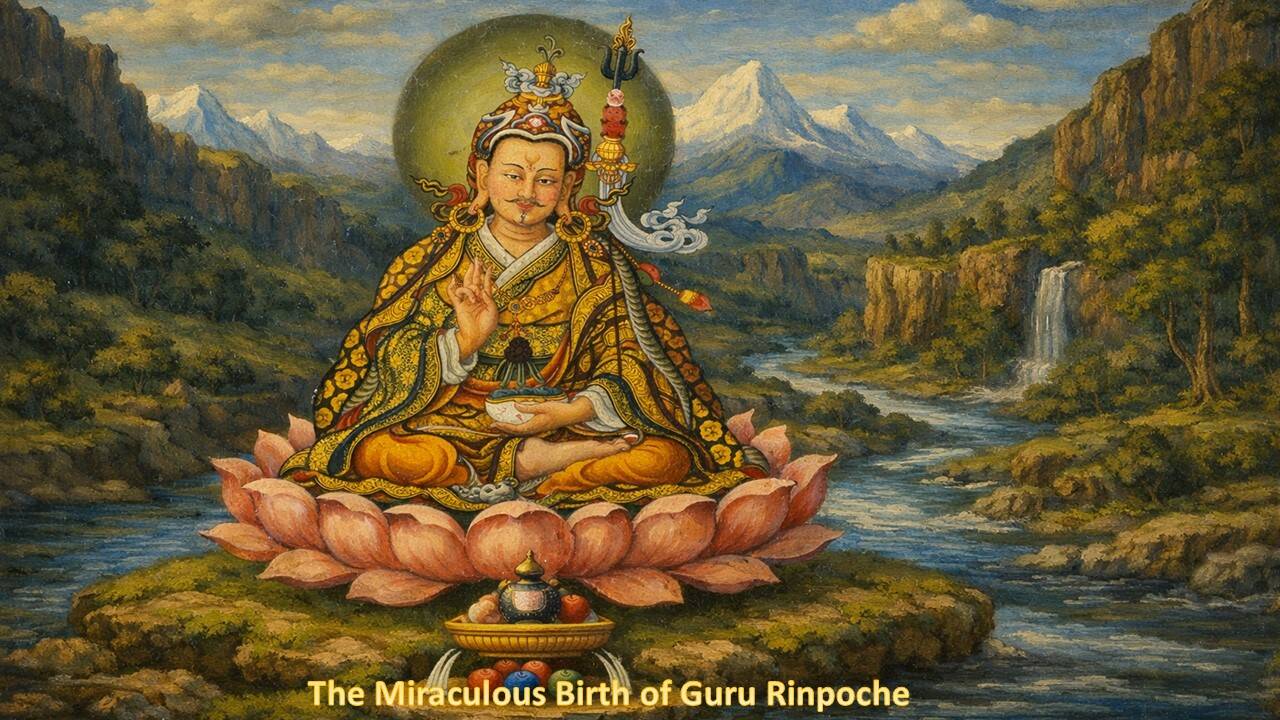
When Gautama Buddha left his physical body, it is said that he foretold that after 8 years, the ‘second Buddha’ would appear. In the 8th century, in the mystical land of Uddiyana, a fully enlightened child manifested, not through ordinary birth, but miraculously on a lotus in the lake of Dhanakosha. This divine child was Guru Padmasambhava.
King Indrabhuti, ruler of Uddiyana, discovered the radiant boy while on a hunting trip. Being childless and spiritually inclined, he adopted him, recognizing him as a divine blessing. Padmasambhava was raised as a prince, receiving a royal education in statecraft, philosophy, ritual sciences, and early tantric teachings. Even in childhood, he displayed fearlessness, wisdom beyond his years, and a natural detachment from worldly pleasures.


During his early youth, his behaviour began to diverge from that of a typical prince. He questioned material life and royal duties, preferred solitude, meditation, and mystical practices, and showed spontaneous mastery of mantra and ritual. One well-known story recounts that while performing a ritual dance with a Khatanga, he accidentally caused the death of a minister’s son. In Vajrayana understanding, this event is symbolic—a karmic turning point representing the cutting through of ego and illusion rather than a mere crime. As a result, he was exiled from the kingdom, a step that became crucial in his spiritual journey.
After exile, Padmasambhava entered one of the most intense phases of his life. He wandered into cremation grounds, places associated with impermanence, death awareness, and tantric transformation. There, he meditated on death and emptiness, performed rituals involving fierce deities, and directly confronted fear and illusion. These grounds are central in Vajrayana Buddhism, where negative energies are transformed into wisdom. By around the age of 16, he attained mastery over unseen forces, realised shunyata (emptiness), and developed siddhis, or spiritual powers.

In his later teenage years, Padmasambhava sought guidance from enlightened masters such as Prabhahasti and various dakinis (wisdom beings). He mastered advanced tantric initiations, secret mantras, rituals, and inner yogic practices. By the age of 18, he was no longer merely a seeker but a fully realised tantric adept, ready to begin his mission of spreading Dharma.
This ten-year period represents a profound transformation—from prince to exile to mystic to master. Loss and exile opened spiritual gateways that accelerated his realisation. It reflects a deeper truth: that true wisdom often develops outside comfort zones. By facing death and fear directly, he transformed them into fearlessness and emerged not just as a realised yogi, but as a world-transforming master.
After completing his training, Padmasambhava travelled across regions such as India, Uddiyana, and ancient Gandhara. He practiced in sacred caves and mountains, perfected advanced yogas like Mahamudra and Dzogchen (Great Perfection), gained mastery over inner energies and prana, and realised profound non-duality.
He later met Yeshe Tsogyal, a Tibetan princess who became one of the most important figures in his life. She was not only his spiritual consort but also his foremost disciple and eventually an enlightened master herself. Their relationship was a tantric partnership dedicated to realisation. She became the recorder of his teachings and his spiritual equal. Together, they practiced secret teachings and concealed terma (hidden spiritual treasures) for future generations.

King Trisong Detsen invited Padmasambhava to Tibet to establish Buddhism. However, the construction of monasteries repeatedly failed due to obstructing forces, understood as local spirits. Padmasambhava did not destroy these forces; instead, he subdued and transformed them into protectors of Dharma. This reflects a central Vajrayana teaching—that negative forces are not rejected but transformed into wisdom. He helped establish Samye Monastery, the first monastery in Tibet, along with Shantarakshita. It became a centre for teaching, translation of Buddhist texts, and monastic initiation, laying the foundation of Tibetan Buddhism. He is regarded as the founder of Tibetan Buddhism (Nyingma tradition), a spiritual guide across the Himalayan regions of Tibet, Bhutan, Nepal, and India, and a symbol of fearlessness, compassion, and wisdom.

Padmasambhava foresaw future challenges and hid teachings in caves, lakes, and even within the minds of disciples. These teachings, known as terma, were later revealed by destined treasure revealers (tertöns), ensuring that the Dharma would remain alive and accessible through time.
He is said to manifest in different forms depending on the need—peaceful guru, wrathful protector, royal teacher, and mystic yogi—showing that enlightenment is dynamic and compassion adapts to circumstances.
According to tradition, Padmasambhava did not die in an ordinary sense. He departed to the Copper-Coloured Mountain paradise and is believed to remain accessible to devotees through visions, dreams, and blessings.
His life exemplifies that outer demons are reflections of inner fears, and by subduing them, one masters the mind. His tantric insight teaches that nothing is rejected—everything is transformed. His ultimate teaching affirms that enlightenment is possible within one lifetime, even amidst chaos.

He is said to manifest in 8 forms, each expressing a unique aspect of enlightenment. These are not merely historical depictions but inner states of consciousness and spiritual tools.
- Guru Tsokye Dorje: the Lotus-Born Vajra, representing the divine child—the form in which he appeared on the lotus, symbolising pure awareness beyond karma and the innate purity of consciousness.
- Guru Pema Gyalpo: the Lotus King, representing the royal prince, reflecting his palace life and symbolising the ability to live spiritually within the world without renouncing it.
- Guru Nyima Özer: the Sunray Yogi, who radiates light and dispels ignorance, representing the illuminating power of awareness that dissolves confusion instantly.
- Guru Loden Chokse: the Seeker of Supreme Knowledge, embodying the disciplined seeker, symbolising curiosity, effort, and humility required on the path.
- Guru Shakya Senge: the Lion of the Shakyas, representing the ordained monk, embodying ethical living and the foundation of mental discipline through behaviour.
- Guru Senge Dradog: the Roaring Lion, the wrathful debater who destroys ego and wrong views, symbolising the power of truth and inner confrontation.
- Guru Pema Jungne: the Second Buddha, the compassionate teacher who guides others, emphasising the importance of sharing wisdom after realisation.
- Guru Dorje Drolo: the Wrathful Vajra Rider, the fierce transformer who subdues negativity, symbolising the transformation of fear and dark emotions into fearless action.
These eight forms correspond to stages of inner evolution—innocence, engagement, awareness, discipline, confrontation, compassion, and transformation—mapping the journey of consciousness itself. In daily life, one may invoke these qualities internally: clarity in confusion, strength in conflict, courage in fear, and humility in learning. This is practical Vajrayana—the transformation of every emotion into wisdom.

Guru Rinpoche’s teachings reveal a profound truth: you are not a fixed identity, but a dynamic field of consciousness capable of transformation. I feel profoundly blessed that Guru Padmasambhava is my Satguru (Eternal Spiritual Teacher), the eternal source and guardian of my soul. I pray to the Almighty that, as his disciple and child, I may grow, evolve, and be shaped in complete alignment with his divine intention in this very lifetime.
Disclaimer
Views expressed above are the author’s own.
END OF ARTICLE