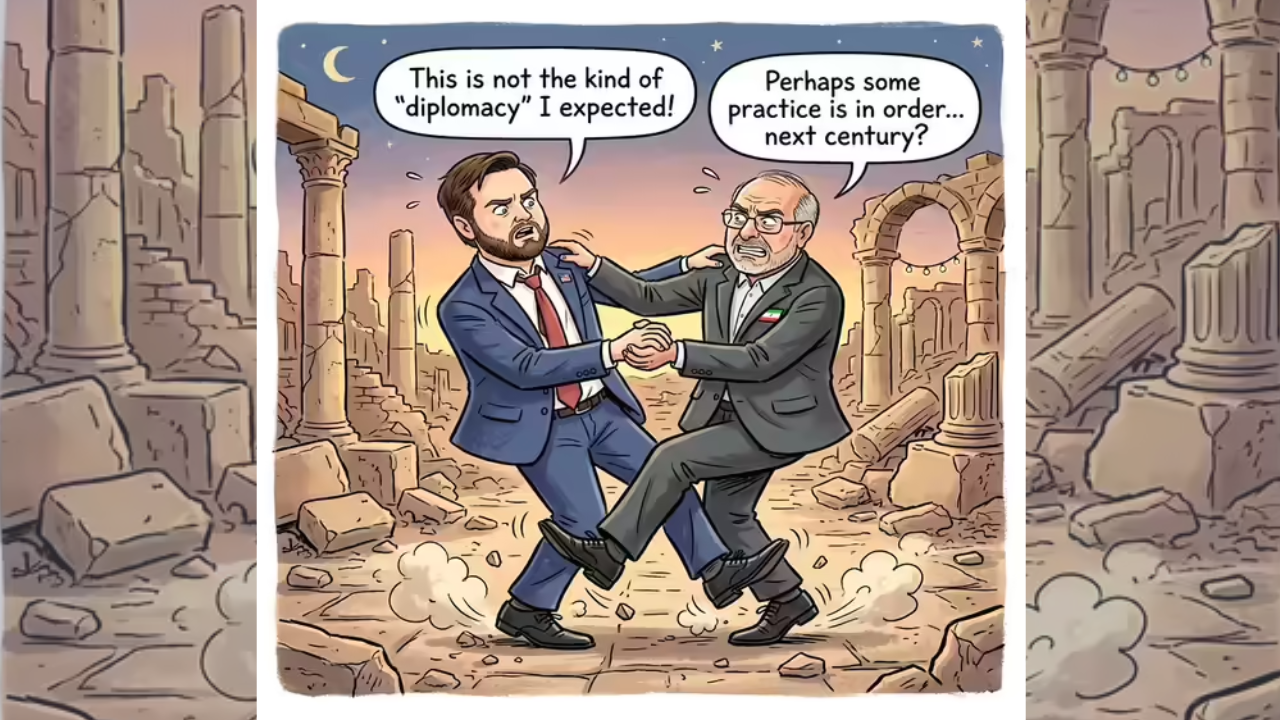
Even as the United States and Iran clasp hands over a fragile ceasefire, Lebanon remains in strategic limbo, with continued Israeli strikes on Hezbollah underscoring that such truces manage symptoms, not causes. Often reduced to labels like “terrorist group” or “Iranian proxy,” such shorthand obscures the deeper historical, ideological, and geopolitical layers that define Hezbollah’s evolution.
Hezbollah’s resilience lies in deeper historical, ideological, and socio-political roots.
It emerged in 1982 during Israel’s invasion. While the Israeli invasion was aimed at expelling the Palestine Liberation Organisation(PLO), the prolonged occupation transformed Lebanon’s marginalised Shia community—long shaped by exclusion, economic neglect, a legacy of persecution and historical injustice within Twelver Shiism—into a receptive base for militant mobilisation.
Structural inequalities persisted through the creation of Greater Lebanon (1920) and independence (1943), which institutionalised a Maronite–Sunni order that sidelined Shias despite their demographic weight, which comprises around 30% population.
The creation of Israel in 1948 severed long-standing socio-economic ties between southern Lebanon and northern Palestine, deepening further marginalisation. Subsequent upheavals—the influx of Palestinian fighters, the Lebanese Civil War (1975–1990), and Israeli invasions in 1978 and 1982 further entrenched deprivation and alienation.
Early mobilisation through the Amal Movement under Musa al-Sadr in 1974 proved inadequate, paving the way for more radical currents. The Invasion of Israel in 1982 proved opportune for figures like Ayatollah Husayn Fadlallah to channelise these radical currents into the formation of Hezbollah (the Party of God).
The Iranian Revolution of 1979 proved decisive for Hezbollah, offering both ideological inspiration and organisational direction. Under the influence of Ayatollah Ruhollah Khomeini, Hezbollah adopted the doctrine of Wilayat al-Faqih, aligning itself with Iran’s revolutionary vision.
Backed by Iran and facilitated by Syria, it evolved into a disciplined and ideologically driven force. These ties were not merely contemporary but rooted in deeper history: Lebanese Shia clerics from the Jabal Amil region played a key role in Safavid Iran’s transformation into a Shia state.
Prior to that, Iran was predominantly Sunni. Since then, these enduring scholarly networks linking Najaf, Qom, and southern Lebanon have continued.
Hezbollah’s defining moment came in 2000, when it compelled Israel to withdraw from southern Lebanon after nearly two decades of occupation.
Through sustained asymmetric warfare, Hezbollah achieved what Arab states had failed to accomplish conventionally, transforming itself from a marginal insurgency group into a powerful politico-military movement with wide legitimacy across the Arab world.
Hezbollah’s strength lies not only in its military capability but in its ideological coherence, framing global politics as a civilisational confrontation between Islam and the West.
It rejects Western civilisation as a universal model, portraying it as a “cultural invasion,” and critiques capitalism as inherently unequal. Western media and cultural industries are seen as tools of ideological control, turning culture into a political battleground.
Within this framework, Israel is viewed as the linchpin of a broader Western project to dominate West Asia—an expansionist project with ambitions of ‘Greater Israel’, making it an existential threat.
Moreover, the Israelis see themselves as God’s chosen people and treat all other religions as racially inferior. Thus making Hezbollah’s opposition both ideological and strategic.
Central to Hezbollah’s worldview is the distinction between “oppressors” and “oppressed,” inspired by Khomeini’s thought but framed in universal terms.
Oppression is not defined solely by poverty but by political, economic, and cultural subjugation resulting from state discrimination and injustice.
Thus, the category of the ‘oppressed’ extends beyond sectarian lines to include all those facing domination. Since Israel suppresses the Palestinians through its state policies, it is treated as the ‘oppressor’.
Hezbollah adopts a relatively restrained stance toward internal religious dissent: it does not automatically label other Muslims as unbelievers, unless they actively oppose Islamic principles or seek to impose secularism against Islam.
Thus, notwithstanding its distinctly Shia identity and Iranian alignment, Hezbollah portrays itself as a champion of the oppressed across religious, sectarian and national lines, framing its resistance in near-universal terms of justice -a rhetorical approach that echoes leftist themes, though rooted firmly in Islamist ideology rather than communism.
It has transformed lived experiences of exclusion into a coherent doctrine of resistance. It regards Jerusalem as a sacred trust of the Islamic ummah, beyond negotiation or compromise.
This doctrine has enabled Hezbollah to align closely with organisations such as Hamas and to position itself as a leading advocate of the Palestinian cause and a pan-Islamic movement.
Beyond its ideological and military roles, Hezbollah has built an extensive welfare network among Lebanon’s marginalised Shia and Sunni populations.
This dual identity—as resistance movement and socio-political actor—has entrenched its influence, enabling electoral participation and integration into state democratic institutions. Supporters see a model of “armed legitimacy,” while critics argue its autonomous military undermines sovereignty and the state’s monopoly over force, a tension central to Lebanon’s fragile political order.
Hezbollah’s regional role has further complicated its image. Its involvement in the Syrian Civil War, justified as a defence against extremism and protection of allied regimes, has reinforced criticism that it functions as an instrument of Iranian regional strategy.
Today, Hezbollah stands as one of the most formidable non-state actors, fusing military capability, political influence, and ideological depth into a resilient yet deeply polarising force.
Unlike Hamas, its close ties with Iran lead to a more rigid rejection of Israel’s legitimacy, while Hamas has shown some flexibility by indicating willingness to accept a Palestinian state along the 1967 borders.
While Hezbollah’s ultimate objective remains the full liberation of Palestine, its limited openness to incremental gains reflects tactical pragmatism within a fundamentally uncompromising framework.
Bridging this ideological-strategic divergence will be a defining challenge for any future negotiations, and a key determinant of whether diplomatic pathways can meaningfully advance.
In the direct high-level peace talks, for the first time after the 1979 revolution, the issue of Hezbollah could be one of the challenging tasks. Understanding its evolution is therefore essential to grasp why ceasefires in West Asia remain fragile.
Durable peace will require addressing not just immediate violence but the deeper historical grievances, ideological narratives, and structural inequalities that sustain the conflict.
Hezbollah is not merely a participant in this conflict—it is one of its most enduring outcomes and a central actor in shaping the durable peace that includes the Palestinian question.
West Asia’s crises are no longer regional—they are global in their consequences and human in their cost.
What is needed is not further entanglement in cycles of conflict, but a deliberate disentanglement anchored in dialogue, justice, and statemanship.
Disclaimer
Views expressed above are the author’s own.
END OF ARTICLE