I have come to understand karma not as something extraordinary, but as something unavoidable. Everything we do, from the simplest breath to the most deliberate choice, falls within its scope. Karma is not limited to profession, duty, or visible action. It includes movement of the body, direction of the mind, and intention of the heart.
Often, karma is narrowly understood as one’s occupation or responsibility. A person who performs duties sincerely is described as a karma yogi. While this is not incorrect, it is incomplete. Karma is not confined to what we do for a living. It includes every conscious and unconscious action, physical and mental, that shapes our inner and outer life.


The Gita offers clarity by distinguishing between karma, vikarma, and akarma. Karma refers to right action, action aligned with awareness. Vikarma refers to action that is forbidden or distorted by selfish intent. Akarma is not inaction in the literal sense, but action performed without attachment to personal gain. The distinction does not lie in the action itself, but in the consciousness from which it arises.
Two individuals may perform the same act, yet the nature of their karma differs entirely. A surgeon and a criminal may both use a blade, but one heals while the other harms. The difference lies not in the action, but in intention. Karma is shaped by motive more than movement.
This is why karma cannot be separated from dharma. Dharma provides direction; karma provides motion. When action flows under the guidance of dharma, it becomes constructive. When it breaks away from that guidance, it turns destructive. A river flowing within its banks nourishes life. When it overflows without restraint, it causes devastation. Karma follows the same principle.
Karma is not only physical. Thought itself is action. Even while sitting still, the mind acts, chooses, resists, desires. Awareness determines whether these movements bind us or free us. Conscious action refines karma. Unconscious action entangles it.
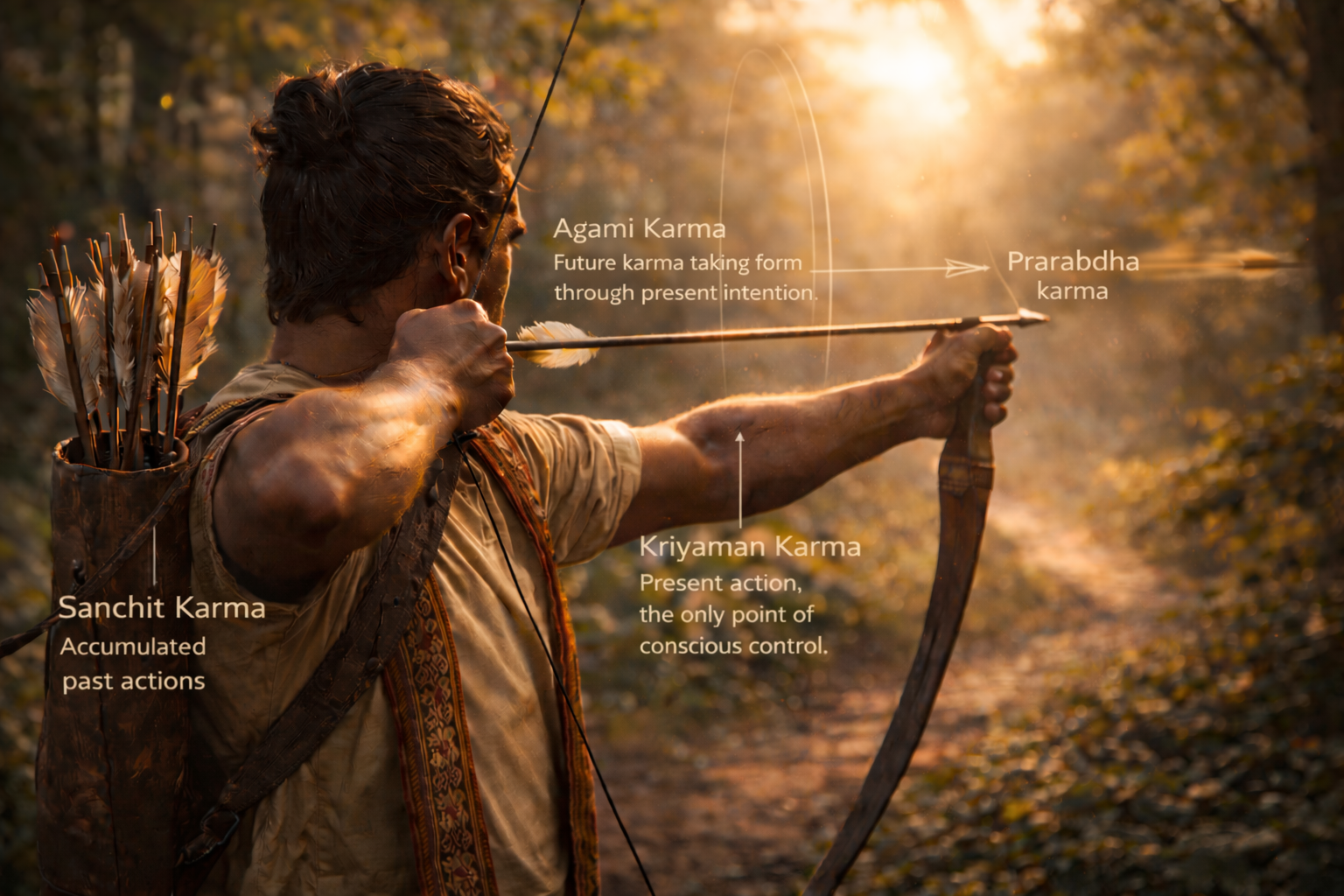
The scriptures further explain karma through its movement in time. Past actions accumulate as sanchit karma. From this reservoir arise prarabdh karma, which shapes the present circumstances of life. Current actions are kriyaman karma, and it is here that freedom exists. Future consequences, known as agami karma, emerge from present choices.
An old analogy describes an archer. The arrows stored in the quiver represent accumulated karma. The arrow placed on the bow is future karma taking form. The arrow released is karma already in motion. Only the arrow being aimed now is within the archer’s control. In the same way, kriyaman karma is the only space where conscious choice operates.
We cannot rewrite the past, but we are never without responsibility in the present. When present action is guided by dharma, intention becomes purified. Over time, the quality of accumulated karma changes, and life begins to reflect that shift.
Karma, then, is not a system of reward and punishment. It is a mirror of awareness. When action arises from clarity, it liberates. When it arises from ignorance, it binds. The path is not to escape karma, but to act with consciousness.
That alone transforms action into freedom.
Disclaimer
Views expressed above are the author’s own.
END OF ARTICLE