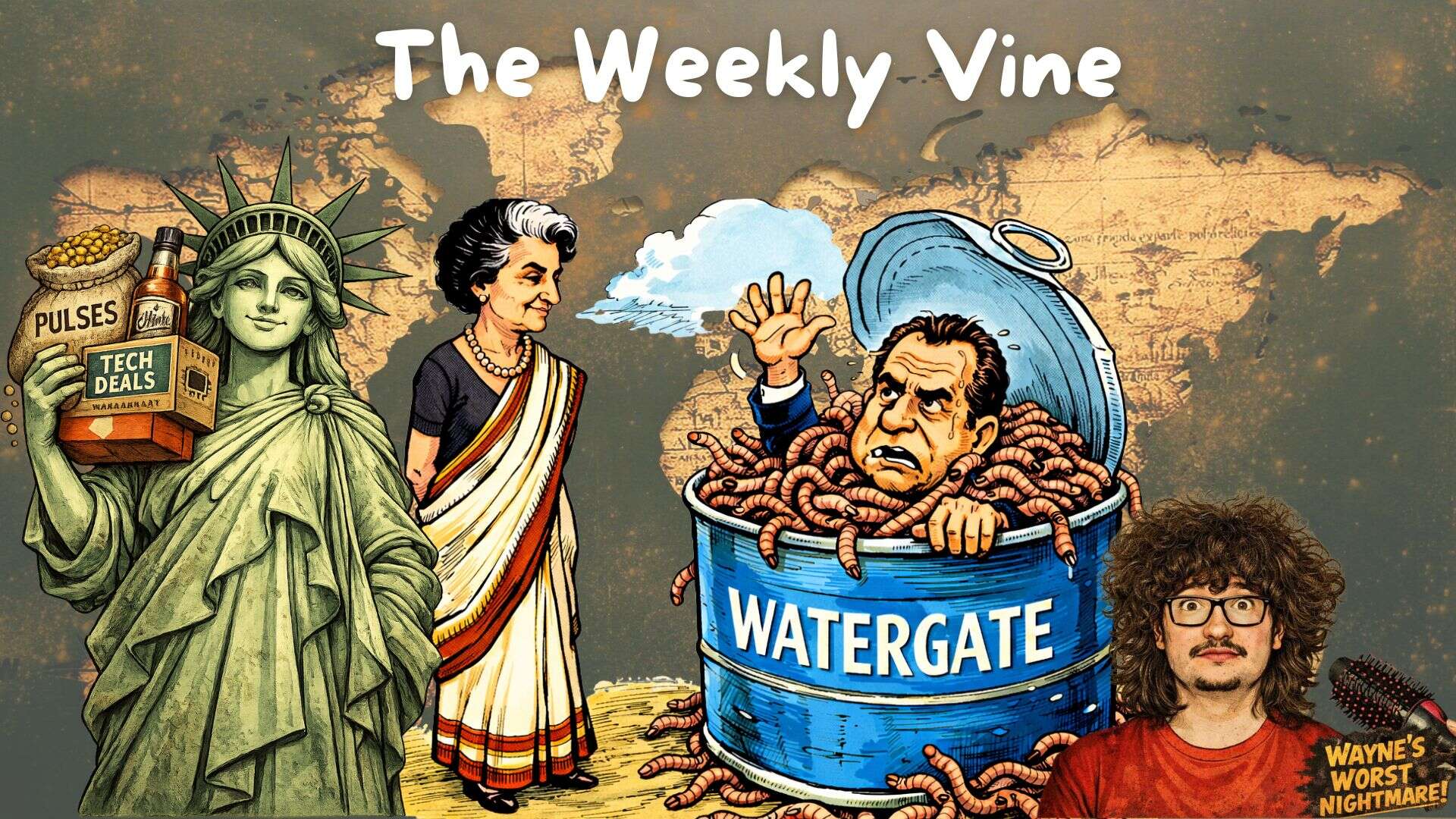


Hello and welcome to the 80th edition of the Weekly Vine. Now 80 is a fine number, an age when one becomes a youth icon in Indian politics. In this week’s edition, we look at some pulsating updates from the India–US trade deal, examine some new worms that have emerged from Watergate, consider the follicular plights of a Manchester United fan, and describe the modern version of feudalism, which now comes with a QR code.
India–US Trade Deal: The Dal Correction


When Donald Trump was announcing new tariffs, it was always with a Sunny Deol–like bang (tariff pe tariff). But now that we are finding out the details of the India–US trade deal, it appears that the finer points are being changed so discreetly that it would make George Smiley smile.
An earlier version of the factsheet put out by the US listed pulses among US agricultural exports. The new version drops the dal. The original version also claimed India was “committed” to purchasing $500 billion worth of US goods, a figure that had sent finance bros rushing to their Excel pivot tables. The wording has now been changed to “intends”, much like you intend to go to the gym every day.
An earlier draft also included agricultural products in the $500 billion worth of American goods, a product basket that has now been dropped. Also dropped are claims about digital services taxes. A phrase about tariff elimination has been diluted, and the language has shifted from firm commitments and definitive actions to “intentions, negotiations, and future discussions”.
The vaguer phrasing and wording, which would have Sir Humphrey Appleby’s approval, suggest that reality has caught up with the headlines. Agriculture has always been a red line in Indian politics, and the $500 billion figure was always too much.
The changes were made because the original factsheet ran ahead of what both governments could actually defend, implement, or sell at home. It was written as a political announcement, not as a trade document. Once the headlines landed, reality caught up.
In other words, the deal itself may not have shifted, but the language around it has sobered up. The slogans have been replaced by civil servant-like sub-clauses, the bravado by brackets. What began as a muscular announcement is slowly being rewritten into something more recognisable to trade negotiators and domestic politicians alike. The cat is still in the box, but someone has now taped a warning label on it: handle with care.
Worms of Watergate

Speaking of civil servants, Sir Humphrey Appleby once warned about the dangers of enquiry: “…there will have to be an enquiry, like Watergate. The investigation of a trivial break-in led to one ghastly revelation after another and finally the downfall of a president. The golden rule is: don’t lift lids off cans of worms. Everything is connected to everything else.”
And boy was he right about Watergate, whose worms are still coming out, 31 years after its main protagonist, Richard Nixon, shuffled off his mortal coil.
Nixon, and his prosecutors, decided that seven pages of sworn testimony were simply too dangerous to reveal, even to a full grand jury. Nixon warned his interrogator: “I would strongly urge the special prosecutor: don’t open that can of worms.” And, remarkably, the prosecutors agreed.
This raises the obvious question: why would men willing to prosecute a president over mafia links, illegal wiretaps, and constitutional abuse quietly agree to bury seven pages of testimony?
The answer lies in those seven pages.
- They showed that Richard Nixon, for all his villainy, racism, and misogyny, often directed at Prime Minister Indira Gandhi, had a peculiar sense of institutional loyalty, almost a conscience. The documents revealed that not only was the president spying on his opponents, but even the armed forces were spying on the president and his men.
- They showed that the “deep state”, long imagined by conspiracy theorists, existed in all its bureaucratic glory. The prosecutors decided to quietly bury this because its public disclosure would have turned the American people against their government at a time when public opinion was already at an all-time low during the Vietnam War.
- And the most startling revelation, one that likely kept the documents dead and buried, was Nixon stating on record that he wanted China to interfere in the India–Pakistan war of 1971: “The Russians were supporting India…Nobody was supporting Pakistan because there was an embargo on the shipment of arms. …But we were giving moral support to them, and also we gave to the Chinese an assurance privately that if India jumped Pakistan and China decided to take on the Indians, we would support them.”
It was a remarkable admission from a president, during the height of the Cold War, that the US would back Red China in a war against India. Of course, China, still emerging from the wreckage of the Cultural Revolution, wary of a stronger New Delhi and facing a Soviet-backed India, decided to sit the war out.
The Hairy Tale


Manchester United fans of a certain vintage loved to call rivals banter clubs. Liverpool was a banter club because they could not win the Premier League. Arsenal was a banter club for much the same reason. Spurs, well lads, it’s just Spurs.
But since Sir Alex Ferguson retired, it is Manchester United who have become the banter club, lurching from one boom-bust cycle to another, where memes and jokes have replaced trophies as the club’s claim to fame.
There has, however, been a breath of fresh air since former Manchester United midfielder Michael Carrick took over, winning four games on the trot. As the fifth win edged into view, all attention turned not to Carrick’s tactical tweaks or the sudden rediscovery of midfield control, but to something far more United in the 2020s: a haircut. Or rather, the absence of one.
For a club that lived and died by the hair-dryer, where David Beckham had to shave off his mohawk if he wanted to play, the main talking point has become a random fan’s hair.
That fan is Frank Ilett, who in 2024 made what seemed like a harmless vow during the bald days of the Ten Hag era: no haircut until Manchester United won five games in a row. It was meant to be a joke, a bit of gallows humour for a fanbase starved of consistency. Instead, it stretched on, game after game, becoming the United Strand, a strangely apt, follicular symbol of United’s inability to string together even the most basic run of results.
As Carrick’s side edged closer to a fifth straight win, the hair began to overshadow the football. What should have been a conversation about momentum, structure, and revival became a countdown to a trim. That alone tells you where the club now sits in the public imagination.
Wayne Rooney, never a man known for patience and hardly unfamiliar with hair-related headlines himself, finally snapped. The entire saga, he said, was “doing his head in”, an unnecessary distraction at a moment when United should have been talking about football again. It was a very Rooney reaction: blunt, irritated, and rooted in an older understanding of what mattered at this club.
Carrick, by contrast, handled it with polite distance. Yes, he admitted, he was aware of it. His kids had told him. No, it would not feature in any team talk. That small aside spoke volumes. At a club once ruled by the hair-dryer, the manager now has to actively shut out the noise just to keep the focus on winning.
Feudalism with a QR Code


There is something uniquely Indian about paying a super-premium price for a VIP ticket and still being made to feel like a gatecrasher at your own expense.
That was the experience at Anoushka Shankar’s Chapters Tour 2026 concert at Yashobhoomi, with tickets sold by SkillBox. The ticket promised “first come, first serve”. What it delivered was first come, first disoriented.
You arrived early, followed instructions, and behaved like a disciplined, law-abiding, middle-class citizen who still believes rules mean something. And then you walked into a hall where most of the good seats were already occupied.
Not by other early arrivals, but by handbags, shawls, and water bottles, carefully placed symbols of territorial ownership. Seats were being “held” for people who had not yet arrived and might never arrive on time.
In India, physical absence has never been a barrier to entitlement. The only VIP seats left were on the extreme edges of the stage, where the performance looked less like a concert and more like a distant cultural broadcast. You were present in body, but excluded in experience.
Very soon, the pattern became clear. Large sections had been quietly blocked for “friends and family”. That, in itself, is fair. Every artist deserves to accommodate their close circle.


Disclaimer
Views expressed above are the author’s own.
END OF ARTICLE