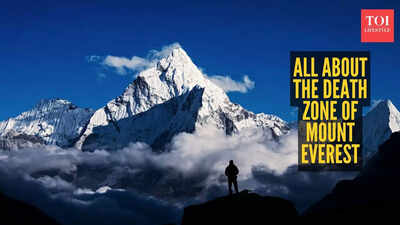

If you’ve ever seen photos of climbers near Everest’s summit, you’ve probably heard the term “Death Zone.” It sounds dramatic. It is dramatic. But it’s also very literal. The Death Zone is the stretch of altitude above 8,000 metres (26,247 feet) where the human body simply cannot survive for long. No amount of fitness or willpower changes the basic physics of thin air up there.Here’s what that means in plain terms, with facts only.
What exactly is the “Death Zone”?
Climbers use “Death Zone” to describe altitudes above 8,000 m on the world’s highest mountains. Everest has a long section in this range, from roughly the South Col (around 7,900–8,000 m) to the summit at 8,848.86 m (the officially measured height as of 2020). Once you step into this zone, your body is operating on borrowed time.At sea level, the air is rich in oxygen and pressure pushes plenty of it into your lungs and bloodstream. At 8,000 m, atmospheric pressure is about one-third of sea level. That means every breath delivers far less oxygen to your blood. Your cells can’t get what they need to keep organs running properly. You are slowly suffocating, even while breathing.
Why humans can’t live there
There’s a hard biological limit here. Above 8,000 m:Oxygen availability drops to roughly 33% of sea level.The body can’t fully acclimatise. Even with weeks spent higher and higher, your tissues continue to starve of oxygen.Your metabolism changes. The body starts breaking down muscle to survive.Weight loss becomes rapid and unavoidable.

Sleep becomes extremely poor.Healing slows to a crawl.Doctors and high-altitude physiologists agree on this: no human body can remain healthy in the Death Zone. Even elite climbers deteriorate there. It’s not a matter of “if” your body weakens, but how fast.That’s why Everest expeditions follow a strict pattern. Climbers spend weeks acclimatising on lower camps, then make a short, final push into the Death Zone and back down as quickly as possible.
What happens to the body in the Death Zone
The effects aren’t subtle. They stack up fast.1. Oxygen starvation (hypoxia)Your brain and muscles don’t get enough oxygen. Thinking becomes slow and fuzzy. Simple decisions feel hard. Reaction time drops. This is one reason accidents happen more often near the summit. People make bad calls when they’re hypoxic.2. Extreme fatigueEvery step feels like a sprint. Climbers often take one step, stop, breathe 5–10 times, then take another step. Even with supplemental oxygen, the body is under massive strain.3. Loss of coordination and judgementFine motor skills go first. Buckles, ropes, and carabiners become harder to manage. This is dangerous on steep, exposed ridges.4. High-altitude cerebral oedema (HACE)This is swelling of the brain caused by altitude. Symptoms include severe headache, confusion, loss of balance, hallucinations, and eventually coma. Without rapid descent, it can be fatal.5. High-altitude pulmonary oedema (HAPE)This is fluid in the lungs. People feel like they’re drowning while awake. They cough, struggle to breathe, and their lips may turn blue. Again, descent is the only real treatment.6. Frostbite risk skyrocketsTemperatures near the summit can drop well below -30°C with wind chill. Blood flow is already poor because of hypoxia, so fingers, toes, noses, and cheeks freeze easily. Many climbers who survive Everest lose fingers or toes.
Why climbers use bottled oxygen
Above 8,000 m, most climbers rely on supplemental oxygen. It doesn’t make the Death Zone safe, but it lowers the risk.With oxygen:Blood oxygen levels improve.Thinking becomes clearer.Muscles work better.The chance of HACE and HAPE drops (but does not disappear).Without oxygen:The body is under maximum stress.Every minute above 8,000 m takes a heavier toll.Mistakes are more likely.It’s important to say this clearly: even with oxygen, the Death Zone is still deadly. Bottled oxygen helps, but it doesn’t turn Everest into a normal environment for the human body.
How long can someone stay in the Death Zone?
There’s no fixed timer, but there are limits.Most summit pushes aim to keep climbers in the Death Zone for 12–20 hours total, including the climb up and back down.Spending multiple days above 8,000 m causes serious physical breakdown.Prolonged exposure leads to muscle wasting, mental confusion, and organ stress.That’s why expeditions have strict “turnaround times.” If you haven’t reached the summit by a certain hour, you’re told to turn back. Staying too long up high means running out of strength and oxygen for the descent, which is when many accidents happen.
Why people die in the Death Zone
Deaths near Everest’s summit usually come down to a mix of:Hypoxia (not enough oxygen to think or move properly)

Exhaustion (people simply don’t have the strength to descend)Altitude sickness (HACE or HAPE)Falls on narrow ridges and steep facesExtreme cold and frostbiteWeather changes, especially sudden wind and stormsOne harsh reality: rescue is almost impossible in the Death Zone. The terrain is steep, the air is too thin for helicopters to operate effectively, and other climbers are barely strong enough to save themselves. Carrying or dragging another adult human at 8,500 m is usually beyond what anyone can physically do.That’s why you’ll hear stories of climbers passing people who are still alive but unable to move. It’s brutal, but it reflects the limits of human strength at that altitude.
Why the summit area is especially dangerous
The final stretch to Everest’s summit includes long, exposed ridges and steep steps. There’s very little room to move, and climbers often have to clip into fixed ropes. Traffic jams can form on good-weather days, which means people stand still in the Death Zone, burning oxygen and energy while waiting their turn.Standing still up there is risky because:You keep losing heat.You keep burning oxygen.Your body keeps deteriorating.Every extra minute matters.
Why acclimatisation doesn’t “solve” the Death Zone
Acclimatisation helps your body cope with thinner air at lower high altitudes. It increases red blood cell count and improves how your body uses oxygen. But there’s a ceiling to this adaptation. Above 8,000 m, no amount of acclimatisation can fully compensate for the lack of oxygen pressure.That’s why climbers go up and down the mountain multiple times before a summit push. They’re preparing their bodies to survive briefly in the Death Zone, not to live there.
The Death Zone isn’t unique to Everest
Everest is the most famous example, but the Death Zone exists on all mountains over 8,000 m. There are 14 such peaks in the world, all in the Himalayas and Karakoram ranges. Everest just happens to have the longest and most crowded Death Zone because of its height and popularity.The Death Zone isn’t a myth or a dramatic nickname. It’s a real, measurable physiological boundary. Above 8,000 metres:The air doesn’t contain enough oxygen pressure to sustain the human body.The brain and organs slowly shut down.Strength fades, judgement slips, and mistakes become more likely.Rescue becomes close to impossible.That’s why climbers treat the summit push like a sprint, not a stroll. Go up, touch the top, and get out. The mountain doesn’t care how experienced you are. Physics and biology make the rules up there.