
Fossils are timeless treasures that give a peek into the lives of giant beasts that roamed across the Earth.Only through these gems do we get to know about their species and what all creatures were present during those periods of constantly changing atmosphere and ecosystems.While researchers keep learning and studying the discovered fossils, we only realise how much more there was to it than expected when a new discovery emerges.Recently, a new fossil discovery has changed yet again how we look at things, and it has a unique characteristic that has not been found in any species till now.
 Photo: Scientific Reports
Cricket pitch-sized necked dinosaur fossil discovered in Thailand
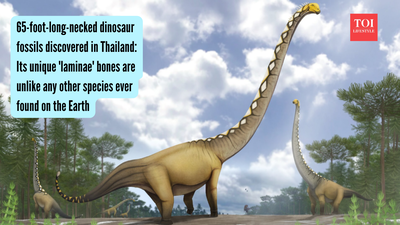
Palaeontologists in Thailand have identified a new species of long-necked, plant-eating dinosaur, adding to the country’s growing fossil record. The dinosaur, named Uragasaurus kalasinensis, is believed to have roamed present-day Kalasin province roughly 150 million years ago, during the Late Jurassic period.According to a study published in Scientific Reports, the dinosaur had an unusually long neck and grew up to 20 metres long, about the length of a cricket pitch. The lead author of the study, Dr Apirat Nilphanaphan of Mahasarakham University, told BBC Thai that the specimen came from a much larger fossil collection unearthed at a site first discovered back in 2008, when a local stumbled upon fragments that looked like serpent scales.That site, known as Phu Noi, has since then turned out to be a goldmine for researchers. According to the BBC, more than 90% of the fossils recovered there were dinosaur remains, along with the teeth and bones from other prehistoric animals.But it was one particular part – the dorsal vertebra, a bone from the dinosaur’s middle-to-upper back, that ultimately led
Extremely long-necked dinosaur species
According to the study, a CT scan of the vertebra confirmed that the dinosaur belonged to the Mamenchisauridae family, a group of sauropods best known for their extraordinarily long necks, which likely allowed them to browse vegetation at multiple heights without needing to move much.The neck of Uragasaurus made up around half of its total body length and contained between 17 and 19 vertebrae, considerably more than the 13 to 15 typically found in other sauropods. Its bones also had numerous air-filled cavities, similar to those seen in birds today, which would have made the long neck lighter and easier to lift and manoeuvre.Until now, most Mamenchisauridae fossils had turned up in China, making this the first confirmed discovery of the family in Thailand and in mainland Southeast Asia as a whole.
But how is this species different from the others?
What truly set this specimen apart was a Y-shaped arrangement of bony support structures called laminae, along with a distinctive internal air-cavity pattern. Dr Nilphanaphan told BBC Thai these features were “unlike any other dinosaur in the world… That’s what sets it apart.”The moment of realisation, he said, was overwhelming, and he admitted to smashing his keyboard out of sheer excitement once it became clear they had found a new species.