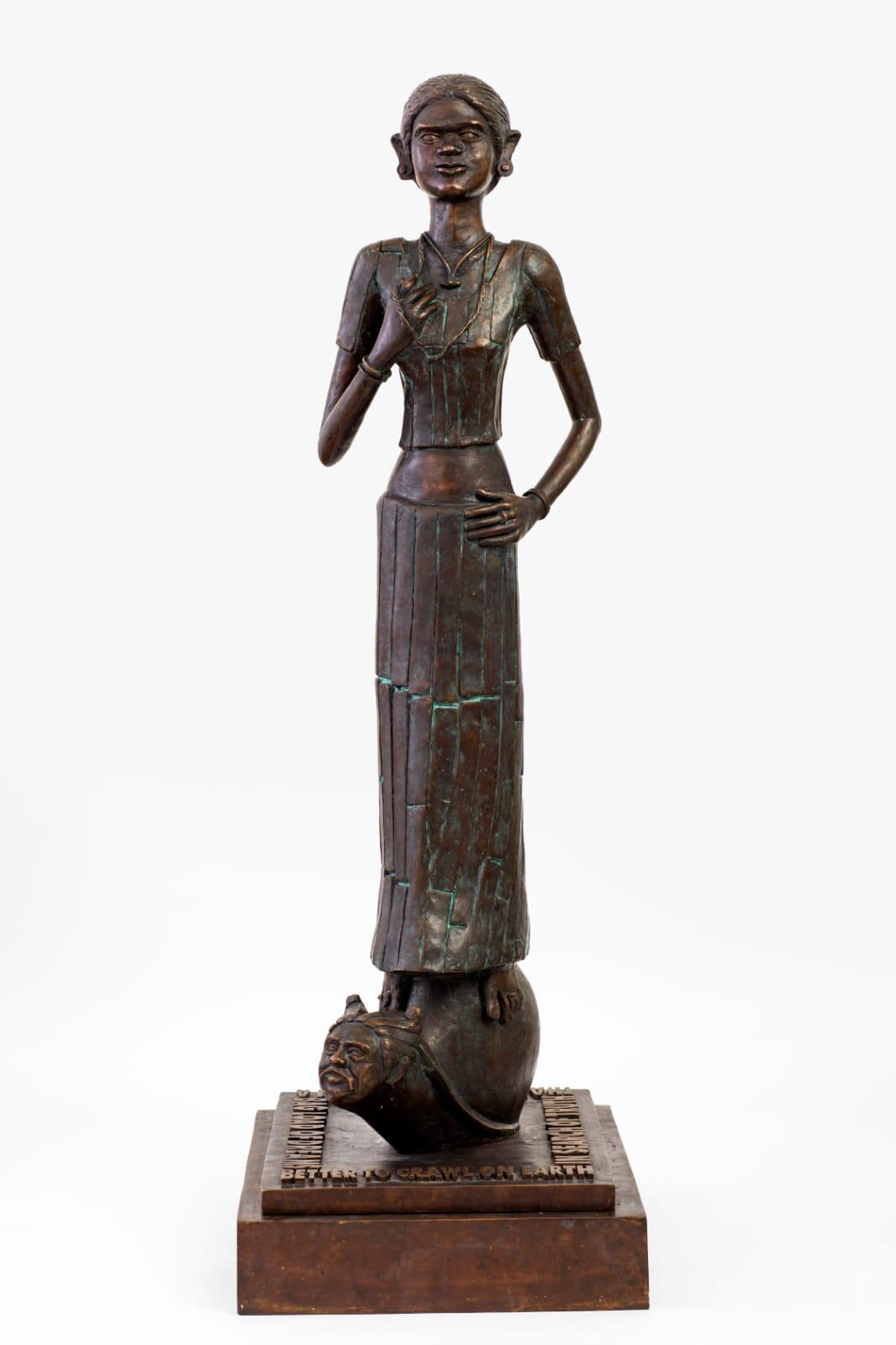
Roshini Vadehra , of Vadehra Art Gallery brings to London an Indian summer with a small suite of works by the master pedagogue and artist sculptor extraordinaire A. Ramachandran. Curated by the brilliant R.Sivakumar, A Singular Modernist is a treat for tired eyes. At Cork Street in London, Ramachandran’s suite of drawings, sculptures and paintings form an ensemble to create a medley of images that speak of his love for the rustic rhythms and rural vignettes of a place in Rajasthan called Obeshwar as well as Eklingji.


The colours, the odhinis and turbans, dhotis and lehengas and lush tropicana and insects and lotuses all celebrate fauna and flora in this month that hinges on sustaining world environments and habitats. At the gallery it is the summation of enchantment that unravels as an experience of beauty, within the endless possibilities of Indian art vernacular, the concreteness of things, and lives of tribal communities lived in symbiotic harmony with nature that stamps the human mind.


A pair of verdant studies
Paintings in this suite celebrate nature in all its zest. The village belle on the swing ( Girl on a Swing 2017 ) is a contemporary recreation of the Indian nayika. Ramachandran used to say that he studied Indian miniatures and found that the the nayika’s desire was not expressed by her gestures or movement but by the full blown seductive accents of the trees and flowering plants surrounding her, and their luxurious expression in contrast to her rather listless and sublimated figure.In this case the young lass on the swing reminds us of Ravi Varma’s Mohini but she belongs to the Bhil women he painted through the years.


London art lovers are looking closer at the many accents of lotus leaves.Dancing on a Full Moon Night 2013, is a lustrous canvas of men and maidens who are part of a festival that is the summation of mythic realms. The sun and moon are central figures in Bhil lore and visual arts. Ramachandran used the Bhils as his subjects, and his knowledge of their village festivities at Obeshwar with full moon nights and the tranquil atmosphere of the night sky served as common motifs in their storytelling. Between the men and women we see a hybrid human bird positioned on a seductive she goat .
The bird man in the self portrait of Ramachandran is both creator and observer.His gaze with his hair neatly combed as a parting is a moment of wit and satire.The tribal girls and women are painted with passion and panache.His self portrait was part of his lexicon, an inheritance from his Shantiniketan days. “ My art must be understood, I don’t believe in impressing but in engaging with my audience ,” he said to me at Vadehras. His paintings belong to Indian art history, to Indian miniatures, to Ajanta Ellora as well as the temple murals of Kerala on which he had authored a seminal book .


Lithographs
His pair of lithographs are lithe lined beauties.The human form was his elixir. This scholarly pedagogue turned artist was a consummate storyteller in any medium and material. How delighted he was when he realised my knowledge of authors like Dostoyevsky and Kerala’s Vaikom Mohammed Basheer was as deep as his. His appreciation to see me sitting cross legged on the floor next to his sofa at his home in Delhi years ago is a moment etched in memory. In more ways than one he translated his love for the rural narrative with its primordial aura onto his works in early days.
The languid lines of the portraits flow easily and rural rhythms have their own insignia of simplicity.The couples in his lithographs too have a cohesive signature of togetherness, a romanticism we seldom see in works of today.


Lotus Pond with water hyacinth 2020
The Lotus Pond with water hyacinth is a botanical beauty with birds and insects and lush leaves choreographed in the landscape of his favourite lotus pond at Obeshwar. Riveting and reflective , nature’s vignettes come into a four panelled stage of scented exotica.
The magic of this work lies in the conventions of Ramachandran’s presentation of the lotus pond in all its moss green toned splendour. pregnant with life and playful in its Leela. For Ramachandran the lotus pond born of the soil which lives and dies/dries with the elements – the dust, wind, rain, sand and sun is an emblem of the cycle of life.This eternal cycle became his language of embrace. Born in the womb of stillness we witness an oasis of creation in which sensual traditions of classical Indian art echo within botanical vivacity and vitality.The lotus pond becomes a mythos inspired looking glass held within the caprice of divinities.


Watercolours of lithe lines
Ramachandran often called drawing the ‘handmaiden to the arts’, and considered drawing a self-referential record-keeping – a birthing of himself . His drawings are diarist renditions of self-discovery, where reflective indices fragment into smaller images, over time transforming expression into vocabulary. If painting was his pulpit , drawing was his diary, Ramachandran wrote: ‘Just as a blind man comprehends his world through the sense of touch, I comprehend my world through the act of drawing.’ His watercolours reflect his sadhana, a discipline of concentration, his love for expression from observation.

Dhyana Chitra, 2008
These works, all singular portraits of women and men project his ideas of imagery, beauty and the relationship between human beings and nature. This historic exhibition reveals the ripples of Indian rustic rhythms in an order and symmetry of consummate grace and cultivates the idea of a free and poetic nature of creation.
For Ramachandran rural rhythms sculpted time . Dhyana Chitra, 2008 is a watercolour that mirrors a mural with his self portraits. It is a structuring of time, as a layered arrangement of audible temporal events that enchants. Rhythm was at the heart of all his arrangements be it drawings or watercolours , sculptures or paintings. On every scale, of the cycles of life and the living , we can savour the patterning of repeated sounds or movement and the “ measured flow ” that repetition creates.
Images : Vadehra Art Gallery
Disclaimer
Views expressed above are the author’s own.