
Imagine stepping into a cave 20,000 years old. There is no electricity. No sunlight reaches the chamber ahead. The deeper you go, the darker the world becomes until the only thing separating you from complete darkness is a flickering torch in your hand.And that dancing flame of your torch reveals projections on cave walls that appear to be moving. Shadows stretch and thin. Lines carved into stone appear to move. A horse looks as if it is galloping. For a moment, the cave comes alive.Now, archaeologists believe this may have been exactly how some Ice Age artists wanted their work to be seen, and the idea stems from something relatively small: a trace of soot discovered inside a prehistoric cave in France.How a trace of soot inside an Ice Age cave is helping archaeologists to rebuild a picture of prehistoric lifeAt first glance, soot may not sound particularly exciting, as it is simply a black residue left behind by fire. For decades, archaeologists largely focused on the paintings and engravings that covered cave walls. The black marks left by torches and lamps were often treated as little more than background evidence.A study published in the Open Research Europe journal on the Archaeology of the Light project suggests that traces of soot and charcoal can help researchers reconstruct the lives of Palaeolithic people. This has prompted archaeologists to ask more important questions: where did people stop and gather? Which parts of the cave did they illuminate repeatedly? How long did they remain underground, and what were they looking at in the darkness?The discovery that brought a new dimension to Ice Age artThe discovery of soot traces inside Ice Age caves encouraged archaeologists to look beyond the artworks themselves and investigate how they may have been viewed. If torches and hearths were regularly used in these spaces, could firelight have shaped the experience of cave art?
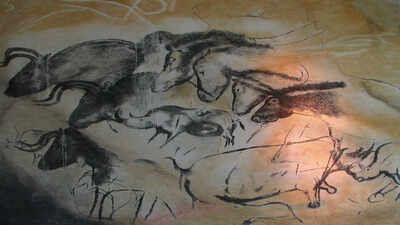
 Animals painted on the walls of the Lascaux Cave in Southwestern France, where Ice Age artists transformed stone walls into a canvas of moving animals. Image Credits: Wikipedia
In a study published by PLoS One, researchers examined engraved stone plaques from Montastruc in southern France to understand how the carvings appeared under flickering firelight. Using a combination of microscopic analysis, 3D modelling, virtual reality and experimental archaeology, the team recreated the lighting conditions that Ice Age people may have experienced thousands of years ago. The result was striking. Under roving flame, static engravings could seem to shift, pulse, and come alive. The researchers concluded that the objects were likely used near hearths in low ambient light, where perception would change with every movement of the flame.While the study does not prove that every cave image was deliberately designed to create an animation, it highlights the powerful role light can play in shaping human perception. The research also suggested that flickering firelight may have made images appear more animated, as the brain can interpret changing patterns of light and shadow as movement. What makes this archaeological find so meaningful?The soot matters less as residue than as evidence of the people who left it behind. The findings suggest that fire was not only a practical tool for navigating the dark but also part of how Palaeolithic art was made and viewed.Therefore, the evidence is expanding what researchers know about prehistoric caves. Researchers now see them as spaces where people gathered, moved and interacted rather than as ancient art galleries.