Wars often reveal far more than the reasons for which they are fought. The recent US–Israel–Iran confrontation has understandably revived concerns over nuclear facilities, uranium enrichment and the possibility of regional escalation. Yet, beneath these familiar headlines lies a more profound strategic shift. The defining lesson from this conflict is not merely about nuclear deterrence; it is about the changing character of power itself. The next arms race has already begun, and increasingly it will be fought through algorithms, artificial intelligence, cyber capabilities, quantum technologies and autonomous systems as much as through missiles and nuclear bombs.
For nearly eight decades, the architecture of global arms control has been built around one central objective—preventing nuclear catastrophe. Treaties, verification regimes and confidence-building measures evolved during the Cold War to regulate warheads, missiles and fissile material. Their success lay in making the world’s most destructive weapons more predictable. Yet they were designed for an era in which military capability was largely measured in hardware rather than software.
Today, strategic competition has expanded much beyond nuclear arsenals. Artificial intelligence can assist in target identification, intelligence processing and battlefield decision-making. Cyber operations can disrupt military command systems and critical infrastructure. Autonomous weapon systems may operate with limited human intervention. Hypersonic missiles compress decision-making timelines, while space assets have become essential components of military operations. Quantum computing is emerging as a transformative technology capable of accelerating cryptanalysis, optimisation, sensing and military decision-support. Together with Post-Quantum Cryptography (PQC), it is likely to redefine both offensive and defensive aspects of strategic competition.
The US-Israel-Iran conflict illustrates this transformation. Military operations are increasingly supported by cyber activities, satellite intelligence, electronic warfare, real-time data fusion and artificial intelligence-assisted targeting. Even where nuclear facilities become the focus of international concern, the technologies shaping modern conflict are often digital rather than nuclear.
This does not mean that nuclear weapons have become irrelevant. On the contrary, nuclear deterrence remains central to international security. Iran’s nuclear programme, concerns regarding proliferation and the possibility of regional escalation continue to influence global diplomacy. However, traditional arms control mechanisms were designed primarily for missiles, warheads and delivery systems. Those mechanisms are far less capable of addressing algorithms, software and autonomous systems.
The difficulty lies in verification. Nuclear facilities can be inspected, warheads can be counted and missile launchers can be monitored. Algorithms cannot be inspected in the same manner. Cyber weapons may remain dormant until activated. Artificial intelligence systems can be modified rapidly, often without clear international oversight. Attribution itself becomes difficult when cyber attacks occur across multiple jurisdictions.
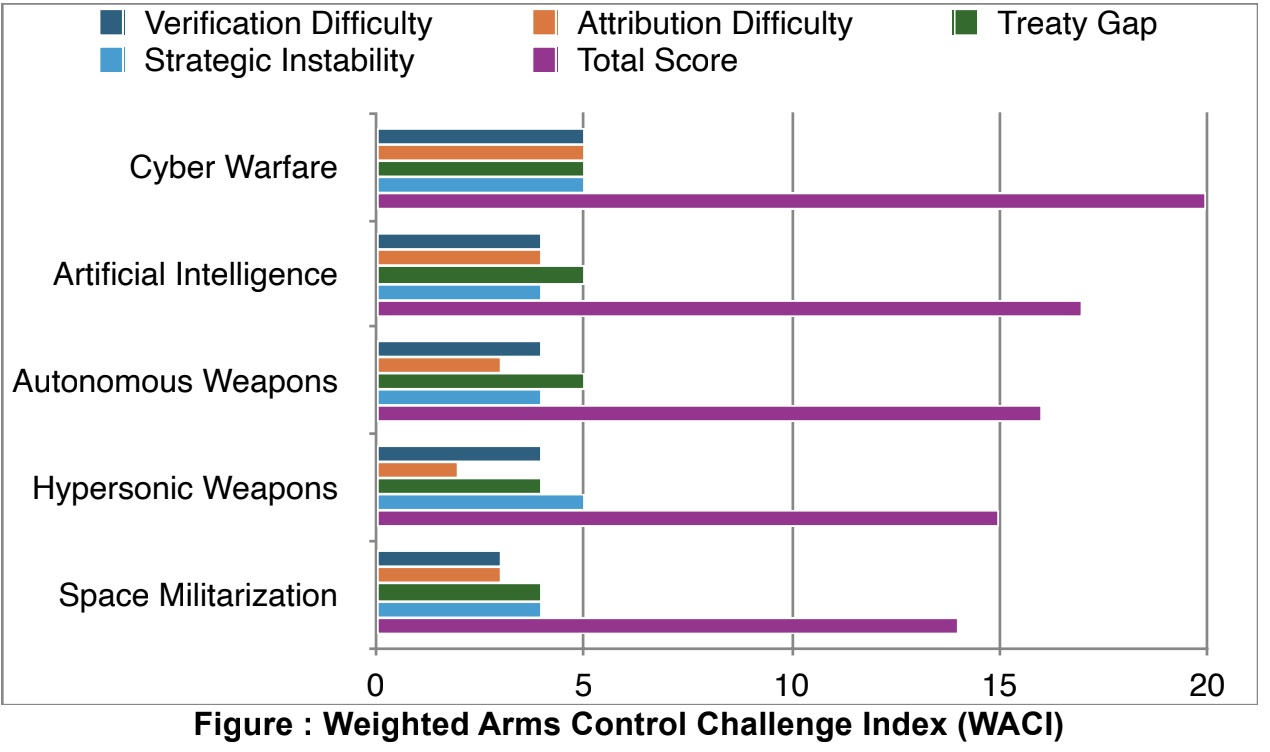
The weight carried by the above argument becomes clearer when viewed through the lens of arms control itself. The figure below compares emerging military technologies against four parameters that have traditionally determined the success or failure of arms control regimes—verification, attribution, treaty coverage and strategic stability. It depicts a novel, Weighted Arms Control Challenge Index (WACI) for each technology as a sum total value (out of 20) of numerical weights (out of 5) across these four parameters.


Cyber warfare emerges as the most difficult domain to regulate because it combines maximum challenges across all four dimensions. Artificial intelligence, autonomous weapons and hypersonic systems closely follow. Quantum computing, although not depicted as a separate category, functions as a cross-cutting enabler that is likely to increase the complexity of each of these domains while simultaneously driving the transition towards Post-Quantum Cryptography.
For India, this debate is significant. We occupy one of the world’s most demanding strategic environments, where two nuclear-armed neighbours are investing in artificial intelligence, cyber warfare, space capabilities and hypersonic weapons. Our doctrine of Credible Minimum Deterrence and No First Use has contributed significantly to strategic stability. But future deterrence will depend not only upon nuclear capability, it will increasingly depend upon the resilience of digital infrastructure, secure communications, cyber defences and eventually quantum-secure networks.
India’s traditional approach to nuclear policy has been characterised by credible minimum deterrence and No First Use. This posture has contributed to strategic stability and has reinforced India’s reputation as a responsible nuclear power. Yet the emergence of new technologies demands a broader understanding of deterrence.
Future crises may involve cyber attacks on command-and-control systems, disruption of satellite networks, artificial intelligence-assisted military operations or autonomous systems operating at high speed. Such developments could increase uncertainty, reduce decision-making time and raise the possibility of escalation.
The ongoing debates surrounding Iran’s nuclear programme also provide important lessons. Negotiations have traditionally focused on uranium enrichment levels, inspections and nuclear facilities. Future negotiations may need to address cyber attacks against nuclear infrastructure, artificial intelligence applications in military planning and autonomous capabilities that influence strategic stability. They will also need to anticipate the disruptive implications of quantum computing. The eventual ability of sufficiently powerful quantum computers to undermine widely deployed public-key cryptographic systems could affect strategic communications, nuclear command-and-control security and verification mechanisms. Consequently, Post
Quantum Cryptography should become an integral component of future arms control confidence-building measures rather than remaining merely a cybersecurity issue.
India has an opportunity to contribute constructively to these discussions. New Delhi has consistently supported universal and non-discriminatory disarmament. It can now expand this position by advocating international norms governing artificial intelligence, cyber warfare and autonomous weapons. India’s National Quantum Mission and growing investments in quantum technologies provide an opportunity to shape global norms before technological competition outpaces regulation. Rather than viewing quantum technologies solely through the prism of economic competitiveness, India should integrate quantum diplomacy, PQC standards and quantum-secure strategic communications into its broader arms control agenda.
India’s growing digital capabilities, expanding technology sector and experience in responsible nuclear stewardship place it in a unique position. Rather than viewing arms control solely through the lens of nuclear weapons, India can support a broader agenda that integrates emerging technologies into international security discussions.
This does not imply abandoning traditional nuclear arms control. Existing treaties remain important. Nuclear deterrence will continue to influence relations among major powers. The risk of proliferation remains serious, particularly in volatile regions such as West Asia.
However, policymakers must recognise that strategic competition is evolving. Future arms races may involve computing power, machine learning models, autonomous systems and cyber capabilities as much as missiles and warheads. The states that establish rules and norms for these technologies will shape the future international order.
The lessons from the US-Israel-Iran confrontation are therefore broader than the immediate crisis. Nuclear negotiations remain essential, but they are no longer sufficient. Arms control in the twenty-first century must move beyond counting bombs and begin addressing algorithms.
The twentieth century taught the world to count warheads. The twenty-first century will increasingly put focus on governing the algorithms. Nuclear weapons will remain central to deterrence, but they will no longer be the sole determinant of strategic stability. Artificial intelligence will influence strategic and military judgement, offensive cyber operations will contest national resilience and quantum technologies will redefine the processing as well as the security of information itself. The countries that begin shaping these rules today will influence the strategic order of tomorrow. India has intellectual prowess, technological capability and the strategic credibility to help lead that effort.
Disclaimer
Views expressed above are the author’s own.