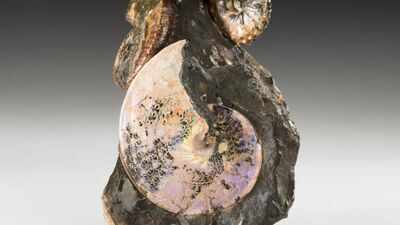

South Dakota is one of the most landlocked states in the United States. It is more than 1,000 miles away from both the Pacific and Atlantic oceans. It is hard to imagine that this dry landscape was once covered by water.But more than 70 million years ago, the area looked completely different. Much of what is now South Dakota lay beneath a vast inland sea called the Western Interior Seaway. The sea stretched through the middle of North America and split the continent into two. Its waters were home to giant marine reptiles, sharks and ammonites, sea animals related to today’s squid and octopus.Even though the sea disappeared millions of years ago, it left behind remarkable clues. Some of the best-preserved fossils from those waters are now on display at the Smithsonian’s National Museum of Natural History in Washington, DC, according to museum’s Smithsonian magazine.The exhibition, called ‘From these lands,’ features hundreds of fossils and artefacts from across the United States, including colourful ammonite shells that still shimmer today.
The vast inland sea
The ammonite fossils displayed at the museum are around 69 to 72 million years old. They lived during the final years of the dinosaurs, when pterosaurs still flew in the sky and giant marine reptiles ruled the oceans.The Western Interior Seaway existed for more than 30 million years. Around 100 million years ago, during the Cretaceous period, sea levels rose and ocean water spread into the middle of North America. This created a huge inland sea that stretched from the Arctic Ocean to what is now the Gulf Coast.

North Carolina’s state fossil is the teeth of the mega-toothed shark Otodus megalodon, commonly known as “megalodon.” ( Smithsonian’s National Museum of Natural History)
Although it was much shallower than today’s oceans, the seaway was full of life. Scientists have found fossils of giant marine reptiles in Kansas and huge reef-building clams in Utah. As the Earth’s climate cooled near the end of the Cretaceous period, polar ice formed and sea levels dropped. Slowly, the sea disappeared and the two halves of the continent became joined once again.The ancient sea also left behind something that still benefits people today. Over millions of years, rocks from the seaway broke down and formed fertile soil. That soil later helped make the American Midwest one of the country’s most important farming regions.
Why shells still shine
One of the most striking things about the South Dakota fossils is that they still shine with colourful patterns. The ammonite shells were partly made of nacre, also known as mother-of-pearl. It is the same material that gives pearls their shine.During fossilisation, the layers of mother-of-pearl became even more visible than they were when the animals were alive. That is why the shells continue to reflect light millions of years later.Ammonites came in different sizes. Some grew to about six feet across, but they mostly fed on tiny sea creatures such as plankton.

This fossil sea star, Hudsonaster narrawayi, lived 457–449 million years ago (Smithsonian’s National Museum of Natural History)
Fossils across US
The exhibition also shows that marine fossils are not found only in coastal areas. One of the fossils on display is a sea star from Minnesota that lived around 457 to 449 million years ago, when warm, shallow seas covered much of the region.Scientists say this is possible because Earth’s surface has changed many times over millions of years. Continents moved, sea levels rose and fell, and new rocks formed. As a result, fossils from ancient seas can now be found far from today’s coastlines.Researchers have also discovered traces of some of the earliest animal life in Utah, ancient reefs in Ohio and fossil shark teeth in South Carolina that are around 20 million years old. Evidence of ancient oceans can also be found in places like Ohio. Rocks beneath Ohio were formed hundreds of millions of years ago, when plants had only just started growing on land. Fossils of brachiopods, clam-like animals that have lived on Earth for more than 500 million years, and crinoids, relatives of today’s sea stars, can still be found there.Ohio is also known for fossils of an ancient shark-like fish called Cladoselache. Many fossils were uncovered during the construction of Interstate 71 in the 1960s, and scientists are still studying them today.