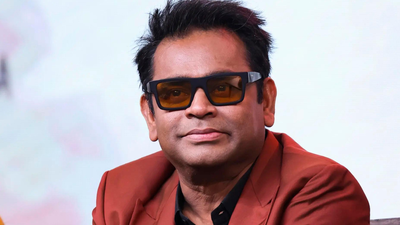

There are moments in music when a performance becomes more than entertainment. It becomes a reminder of what humanity and genius can achieve when cultures do not compete for dominance but instead find harmony through understanding. AR Rahman’s electrifying performance with the National Symphony Orchestra at Wolf Trap arrived at precisely such a moment, on the heels of America’s 250th anniversary celebrations, offering a powerful reminder that the language of music transcends borders, politics, and geography.Rahman has long represented a rare artistic genius: an individual capable of seamlessly bringing together the complexity of Eastern musical traditions with the precision and structure of Western orchestration. Time and again, he has demonstrated that these traditions are not opposing forces but complementary expressions of human creativity. His ability to synchronize Indian classical influences, Western symphonic arrangements, contemporary sounds, and spiritual themes creates something that feels both ancient and entirely new.What makes Rahman’s brilliance distinctive is not simply his technical mastery. It is his deep understanding of what sound resonantes the soul to its core . He does not merely combine instruments or melodies; he creates conversations between cultures.. A Western orchestra does not overpower Indian rhythms. Instead, each element finds its place in a larger musical story. In this performance the vocals of the brilliant singers merged into the symphony as easily as the Bansuri flute.To appreciate AR Rahman’s genius is to understand that he is not simply composing music. He is orchestrating civilizations. Few musicians possess the depth of musical knowledge required to weave the grandeur of a Western symphony together with the intricate jathis of Bharatanatyam and Kuchipudi , the mathematical precision of Indian rhythm, the expressive beauty of swaras, and the profound spirituality that lies at the heart of Indian classical tradition. I have seen the Kuchipudi tarangam(brass plate) performed by the greatest of dancers but never with the National Symphony.Each of these disciplines demands a lifetime of mastery on its own. Rahman moves effortlessly among them, allowing orchestral strings, Indian percussion, classical dance, devotional expression, and contemporary sound to coexist as though they were always meant to belong together. He crosses languages, musical systems, rhythms, and artistic forms without ever making the transitions feel deliberate. The audience does not experience a fusion of East and West but a single, richly woven tapestry where every note, every movement, and every silence serves a larger artistic vision. That ability to unite complexity with simplicity, tradition with innovation, and spirituality with universal human emotion is what separates a gifted composer from a musical visionary. The Wolf Trap performance was a testament to this philosophy. Rahman did not make the evening about himself alone. One of the most remarkable aspects of his leadership was the way he created opportunities for the exceptional performers , all from the US (but one)around him to shine. He introduced musicians and vocalists with extraordinary talent and allowed them moments of individual expression. Great artists often reveal themselves not by standing alone in the spotlight, but by knowing when to share it.That spirit reflected the larger message of the evening. Diplomacy is often discussed through the lens of governments, treaties, and negotiations. But the most powerful diplomacy frequently occurs without a single word being spoken. Music reaches places that political language cannot. It creates emotional connections before intellectual agreements are ever reached. In an increasingly divided world, Rahman demonstrated that harmony is not merely a musical concept; it is a human aspiration.The performance also showcased Rahman’s ability to incorporate the elegance of classical dance movement into a symphonic setting. The choreography did not feel like an addition layered onto the music. Instead, movement became another instrument, another voice within the composition. The grace and simplicity of the dancers reflected the emotional architecture of the music itself, allowing the audience to experience rhythm not only through sound but through motion.One of the most profound moments of the evening was the excerpt from the Ramayan project with Hans Zimmer. The brilliance of that composition was its restraint. It captured the essence, spirituality, and emotional depth of the Ramayan without unnecessary ornamentation or theatrical excess. The power came from its simplicity. The music allowed the story to breathe, demonstrating that great art does not need to overwhelm the senses; it needs to reveal something timeless.The Ramayan has endured for thousands of years because it speaks to universal themes: duty, sacrifice, courage, compassion, and the struggle between good and evil. Rahman’s interpretation recognized that universality. Rather than attempting to recreate every detail, he distilled the emotional core of the epic and translated it into a language that audiences across cultures could understand. The dancers condensed this epic into a few succinct adavus( postures) and mudras (hand gestures) with simplicity and precision. At a time when the world often emphasizes differences, Rahman’s performance offered a different vision. It showed that identity does not have to be preserved through separation. Instead, cultures become richer when they engage, exchange, and inspire one another.America’s story itself has always been shaped by this idea of convergence: different languages, traditions, and perspectives coming together to create something new. Rahman’s performance at Wolf Trap reflected that same spirit. It was not simply an Indian artist performing for an American audience. It was a global artist demonstrating that creativity belongs to everyone.The loudest form of diplomacy is not always spoken from podiums. Sometimes it comes from a stage, through a melody, carried by instruments and voices that remind us of our shared humanity.On this evening at Wolf Trap, AR Rahman did exactly that. He did not just conduct music. He conducted connection.The performers along with the National Symphony
- AR Rahman – Headline Artist
- Kevin Doucette – Management & Soloist (Piano)
- Clint Valladares Global Management
- Abdul Haiyum – ARR Personal Assistant
- Jonathan Marius – Lighting Director
- Rohith Jayaraman – Vocalist & Vocal Coordinator
- Aditya Rao – Vocalist
- Nivi Saishankar – Vocalist
- Kiran Saishankar – Vocalist
- Pragathi Guruprasad – Vocalist
- Heer – Vocalist
- Visveshwar Nagarajan – Bansuri / Indian Flute
- Yamini Kalluri – Dancer
- Harini Nilakantan – Dancer
(By arrangement with American Bazaar)