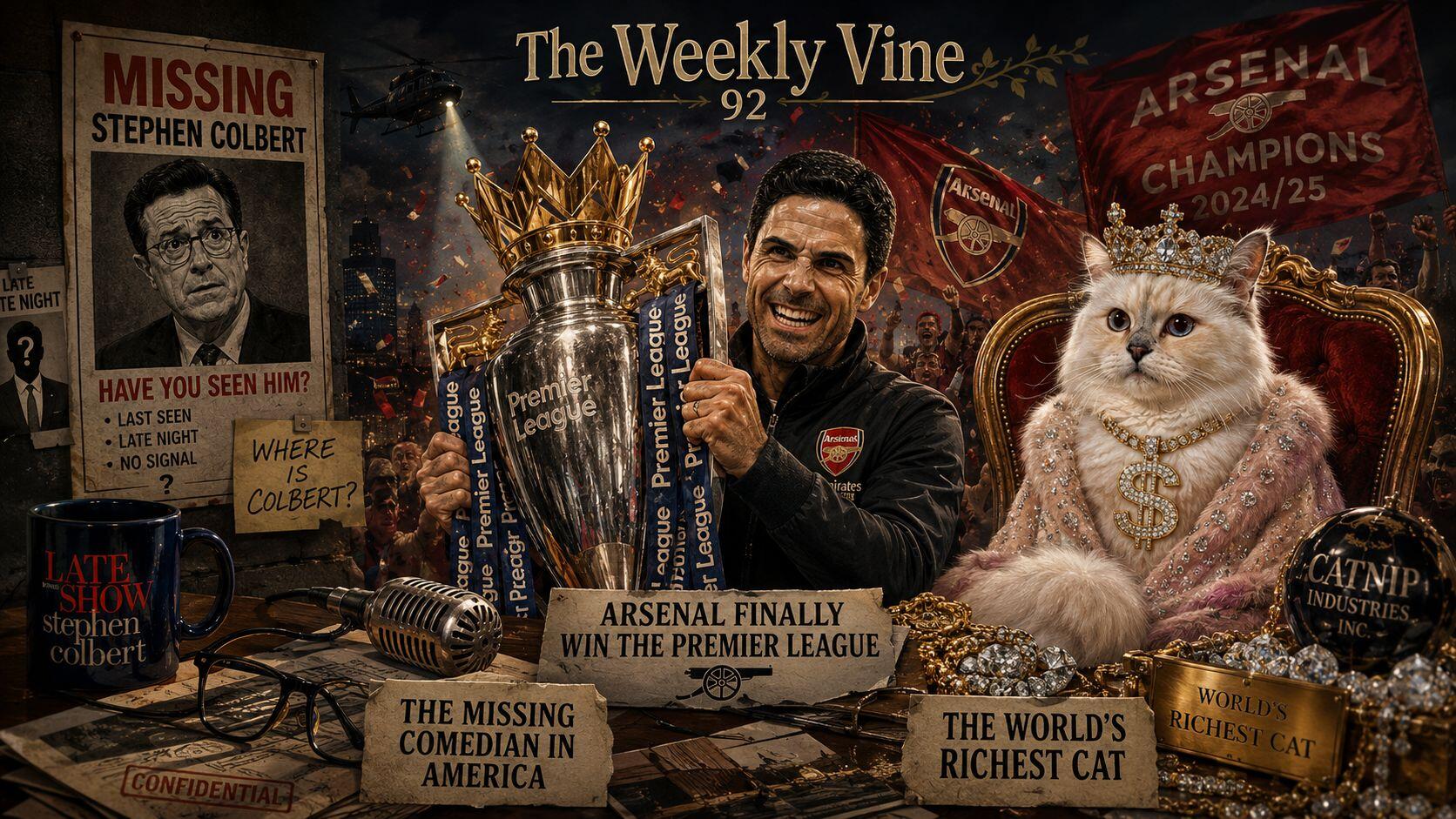


Hello and welcome to the 92nd edition of the Weekly Vine. In this week’s edition, we look at Arsenal winning the Premier League, elucidate why the late-night comedian has gone missing in America, explain why Bengaluru is urban utopia, and discuss the life of the world’s richest cat.
No More Banter Club
It pains me greatly to write in my 92nd edition that Arsenal are officially Premier League champions. For those who aren’t deracinated enough to follow the post-colonial banter, here’s a small update: Arsenal have won the Premier League for the first time since 2004.
Why do we care?
For millennials (and later Gen Z and whatever cumbersome Latin alphabets come after that) growing up in India, supporting European football clubs was a post-liberalisation rite of passage of having become part of the global economy. That meant that we had to cast our lot with teams in the Premier League, La Liga or Serie A.
Now the Premier League, thanks to favourable TV timings, a growing audience in countries like India and China, the boom of satellite television and later the internet, and the aspirational middle-class propensity to fit in, found a global footprint.


My coming-of-age coincided with Manchester United’s coming-of-age, thanks to a group of lads known as the Class of ’92 that included the likes of David Beckham, Ryan Giggs, Paul Scholes et al. They were all youth team members called up to join the first team of Manchester United, whose main rival at that time was Arsenal, led by Arsene Wenger, whose propensity for signing young talented players was often met with a chant that would have been more appropriate for Jeffrey Epstein.
Most of us who started watching football in that era picked either of the two clubs and would form instant bonds based on their rivalries. Remember Ryan Giggs’ slaloming run in the 1999 semi-final? Remember 8-2? What about when Robin van Persie signed for Utd because he thought Arsenal could never win the league?
For us, a pizza party meant the time someone threw a slice at Sir Alex Ferguson in the Old Trafford tunnel, and “see you out there” was a call to action to take up arms before a fight in the grand tradition of Messrs Vieira and Keane.
Football, to borrow a line from Dani Rojas, was life, and the Arsenal-United rivalry was what kept the flame burning.
That soon changed as the success of the Premier League started attracting Russian oligarchs and petrodollar dictators who needed football to sportswash their image.
The Gunners’ last title came in 2004, when they went the entire season unbeaten. In the meantime, Arsenal became something of a banter club whose jollies we took for schadenfreude’s sake, a fate that would also befall Manchester United after Sir Alex Ferguson, who, with the benefit of hindsight, feels like he made a deal with the devil at the crossroads, retired. I mean, how else do you explain winning the league with a midfield that consisted of Anderson, Darron Gibson, the Da Silva twins, John O’Shea and Ji-Sung Park?
Arsenal became known as the team that played beautiful football and lost or, to borrow a line from football’s wordsmith Ian Holloway, “played some of the best football I’ve ever seen and yet they couldn’t have scored in a brothel with two grand in their pockets”.
Not that the banter has been missing this season, where Arsenal, who finished second in the last three seasons, have been accused of playing haramball, a term common on Football Twitter for uninspiring gameplay that gets results.
For the last three seasons, Arsenal have been knocking at the door only to find Pep Guardiola already standing there with a clipboard and a wry smile to mock his former apprentice: Mikel Arteta. In 2022-23, they finished five points behind City after spending 248 days on top, the longest any English side has been on top without winning the title. The year later, they fell two points short, and the year after that, seven points short of Liverpool.
And this season, Arsenal totally embraced their dark side, creating a set-piece mechanism that delivered like a perpetual motion machine, scoring 24 goals from set pieces, including 18 corners, and eking out 1-0 wins. Still, there were times when it looked like they would fall short, like when they lost to Man City. Their chase for the quadruple was ridiculed as they fell short in the FA Cup and Carabao Cup, eventually managing to cross the line with Artetaball that might be blasphemous to those who worship at the altar of Wengerball. And they could do one better and register their first triumph in Europe if they win against PSG.
In the old days, whenever Mohun Bagan lost the match, a popular headline in Bengali newspapers would read: “Bhalo kheliya parajito (Defeated after playing well).” It has been the curse of Arsenal fans for years, but now their football might not be beautiful, but life certainly is after winning the league.
The Missing Comedian

What do the graphic novel Watchmen, Bollywood and America have in common? They all have to deal with the mystery of the missing ‘comedian’. For the uninitiated, between his acts of making imperialist propaganda with CGI abs and the trials and travails of caped crusaders battling film critics, Zack Snyder made Watchmen, a graphic novel retelling masquerading as a movie, whose plot revolves around the untimely demise of a misogynist psychopath called the Comedian.
The same issue plagued Bollywood, not the misogynist psychopaths, though they might have been there, but missing comedians. Earlier, Bollywood plots had clear compartmentalisation: the hero bragged about his relationship with his mother, the mother looked stoic and sad, the heroine danced, the villain drank Vat 69 while usurping poor people’s land, and the comedian made the audience laugh. All that changed with Dharmendra’s comic turn in Chupke Chupke and Amitabh Bachchan swapping the angry young man for a swaggering jester in Amar Akbar Anthony.
A process that started in the 1970s eventually reached its conclusion by the 1990s, when Chi-Chi arrived onscreen and the demarcation between hero and comedian had collapsed like a wave function the moment it was observed. This was rather hard on professional comedians who lived and died by the audience’s laughter: the Johny Walkers, Mehmoods, Keshto Mukherjees, Asranis, Jagdeep Sahabs and Paintals of the world, men who once existed as separate comic planets but increasingly found themselves orbiting heroes who had learned to do their own jokes. It was the pre-AI equivalent of a product manager making coders extinct by vibe-coding with Claude.And now America finds itself on the same precipice with the same problem statement: the missing comedian, which is odd given America is the nation that worships at the altar of the First and has the Second to back it up.
But it says something when the visiting king is funnier than most late-night TV hosts, which brings us to the current predicament where CBS is set to pull the plug on Stephen Colbert’s Late Show.
The World’s Richest Cat

There are many ways to measure civilisation, but one of the more reliable methods is to examine what it does with cats. Ancient Egypt understood this early. In Bastet, the cat became divinity with whiskers, motherhood with claws, domesticity with a murder weapon attached. Cleopatra may have had palaces, perfume and political intrigue, but even she might have paused before Choupette, the blue-cream Birman who turned Karl Lagerfeld into a full-time staff member in his own home.
The British, being less mystical but equally ridiculous, gave a cat a government job. Larry the Cat of Downing Street has watched prime ministers arrive, collapse and leave with the quiet contempt of a creature who knows mice are easier to manage than backbenchers. But Larry is a civil servant. Choupette is royalty.
She arrived in Lagerfeld’s life in 2011 and conquered it with Napoleonic efficiency. She ate from proper dishes, had personal maids, travelled like couture, appeared in campaigns, and had her daily habits recorded in such detail that several minor European monarchs would look under-documented by comparison. Lagerfeld once said she had earned millions from advertising work. After his death in 2019, the world naturally asked the most serious legal question of our age: had the cat inherited the money?
The answer is wonderfully modern: legally complicated, financially foggy and mythologically perfect. French law does not allow animals to inherit directly, but reports have placed arrangements for her care at anywhere from $1.5 million to $4 million. At even the lower end, Choupette is worth many times the typical American household.
That is the genius of the story. Choupette may not technically own millions. She may not understand money. She has no use for status. Yet she sits at the centre of a global conversation about luxury, inheritance, celebrity and inequality.
Which is exactly what a cat would do.


Postscript: Urban Utopia

I have always believed that utopia, if it exists, will not announce itself with a master plan, a TED Talk, or a municipal vision document printed on recycled paper. It will arrive slightly late, mildly damp from an unexpected drizzle, stuck somewhere between Basavanagudi and Indiranagar, apologising for the traffic while insisting the dosa was worth it. That, to me, is Bengaluru. Not Bangalore exactly. Bangalore was the city of old advertisements and pensioned calm. Rain trees, convent schools, filter coffee, cantonment clubs and men who, I imagine, said ‘actually’ before disagreeing with you. Bengaluru is what happened when that city discovered venture capital, co-working spaces, Japanese cheesecake, cloud kitchens, craft beer, and the phrase ‘let’s catch up sometime’ as a complete social arrangement.
Post Postscript
Book of the Week: Tinker Tailor Soldier Spy

There are spy novels, there is peak literature, and when the two genres collide, there is John le Carré’s Tinker Tailor Soldier Spy. The antithesis of James Bond in every single way, le Carré’s protagonist George Smiley is the epitome of what the British Empire expected from its denizens: emotionally repressed, intellectually lethal, outwardly shabby, and capable of treating personal humiliation as a minor administrative inconvenience. He is not built for casinos, car chases or carnality. He is built for corridors, silences, files, betrayal, and the slow dissection of a collapsing institution that still insists on calling itself civilised.
It is also the first and finest movement of what became known as the Karla Trilogy, followed by The Honourable Schoolboy and Smiley’s People. Across these three novels, Smiley’s great adversary is Karla, the near-mythic Soviet spymaster who understands that human weakness is the only ideology that truly travels. Their duel is not fought with gadgets or gunfire but with memory, patience, loneliness and the ruins of belief. By the end, the trilogy becomes less about East versus West than two tired empires staring at each other across a moral fog, each wondering who betrayed whom first.
Word of the Week: Schadenfreude

The Germans, having already given the world philosophy, sausages and over-engineered cars, also found a word for the small, shameful joy of watching someone else slip on life’s banana peel. Schadenfreude literally means “harm-joy”, which is both brutally efficient and alarmingly honest. It is the emotion we pretend not to feel when a rival fails, a hypocrite is exposed, or Arsenal bottle the league (but sadly not this year).
Meme of the Week: MELODI


At times, the internet behaves like a college common room, which is apparent every time PM Narendra Modi meets the Italian Prime Minister Giorgia Meloni, a phenomenon that has been dubbed MELODI. And it would appear that the world leaders are in on the joke, as PM Modi presented the Italian PM with the candy that every millennial is familiar with: Melody.
But what was interesting was the knock-on effect: retail investors rushed to buy shares of BSE-listed Parle Industries, ostensibly mistaking it for Parle Products, the FMCG company behind brands like Parle-G, Melody, Monaco, and Hide & Seek. The Melody candy was also sold out on several quick-commerce stores, and there’s an interesting reason for this.
Jonah Berger, in his book Contagious: Why Things Catch On, framed this as a trigger, where an environmental cue makes an idea, brand, or product suddenly top of mind, which then ends up affecting behaviour. The example he used was that in 1997, NASA’s Pathfinder mission to Mars put the name of the planet all over the news, which acted as a trigger for Mars bars, and sales rose despite the company not changing its advertising, pricing or promotions.
As the jingle goes, Melody itni chocolaty kyun hai? Because sometimes all it takes is one trigger for the internet to unwrap a candy, empty a shelf, and send the wrong stock to the moon.
Disclaimer
Views expressed above are the author’s own.
END OF ARTICLE