The ancient name of Bhutan in the local Dzongkha language is Druk Yul, land of the thunder dragon. It is a land of spirituality, pristine natural beauty, and a remarkably well-preserved culture, often celebrated as the Kingdom of Happiness.
During the seventh century, the Tibetan king Songtsen Gampo is believed to have built temples in Bhutan, laying the foundation for the spread of Buddhism. In the eighth century, Guru Padmasambhava arrived and introduced Tantric Buddhism. He meditated at several sacred sites, including the legendary Paro Taktsang, transforming Bhutan into one of the most important Buddhist countries in the Himalayas. In 1616, Zhabdrung Ngawang Namgyal arrived from Tibet and unified the warring valleys of Bhutan. He established a dual system of governance that combined religious and civil authority. In 1907, Bhutan became a hereditary monarchy with the coronation of Ugyen Wangchuck, the first King of Bhutan. Thimphu, the capital and largest city of Bhutan, lies at an altitude of about 7,650 feet in the Wang Chhu Valley. It has a relaxed Himalayan atmosphere, enriched by traditional Bhutanese architecture, monasteries, and cultural institutions.


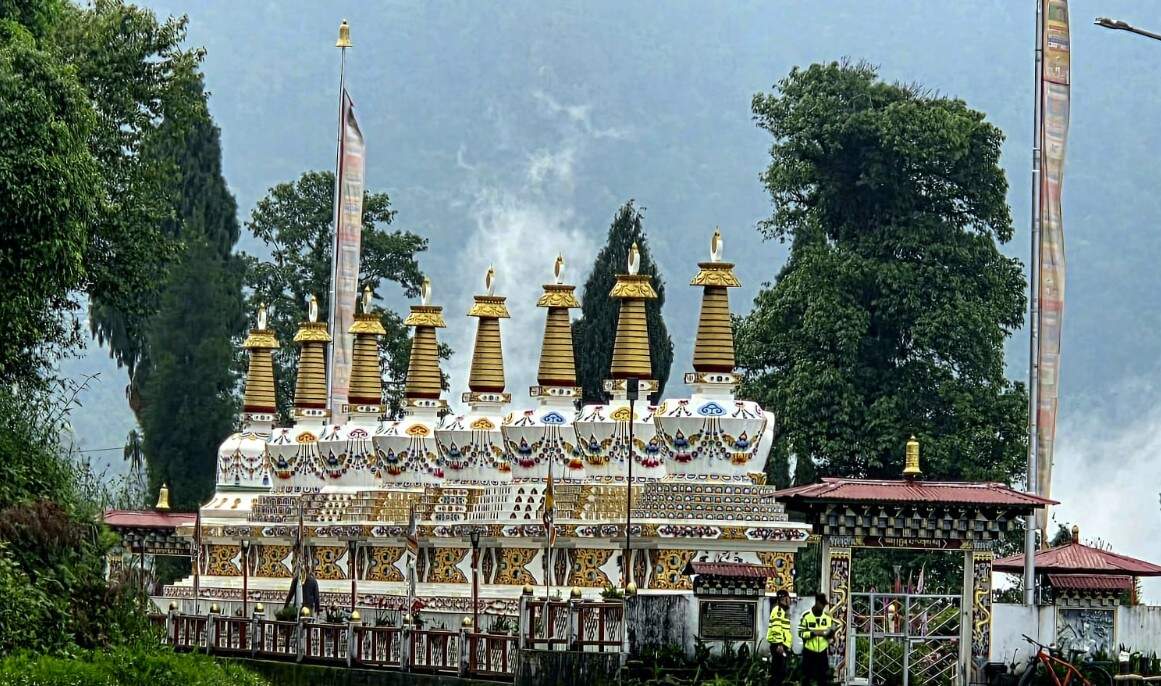
My journey from Phuentsholing to Thimphu offered a wonderful introduction to Bhutan’s landscapes and spirituality. The first major stop was Kharbandi Monastery. Several viewpoints around Gedu, roughly midway to Thimphu, revealed spectacular mountain scenery and cloud-filled valleys, best viewed from the roadside. Numerous waterfalls cascaded down the mountainsides, adding to the scenic beauty of the drive. Further ahead, I crossed the gateway at Chuzom, the confluence of the Paro Chu and Thimphu Chu rivers, marked by three distinctive chortens built in Bhutanese, Tibetan, and Nepalese architectural styles. After a picturesque five-hour journey covering approximately 160 kilometres, I reached my hotel in Thimphu. There were two checkpoints along the route where the Sustainable Tourism Fee (STF) payment was verified. Since I was travelling as a guest of the Bhutan Government’s Department of Tourism, I just needed to register my entry.
The following morning, I visited Buddha Dordenma, popularly known as Buddha Point. Towering 169 feet (54 metres) above the city, this magnificent gold-gilded bronze statue of Shakyamuni Buddha overlooks the entire Thimphu Valley and offers breathtaking panoramic views. Perched atop a hill within Kuenselphodrang Nature Park, the monument was completed in 2015 to fulfil an ancient prophecy and bestow peace and prosperity upon the world.


The construction of Buddha Dordenma fulfilled ancient prophecies dating back to the eighth and twelfth centuries, which foretold that a giant Buddha statue would arise in the region and bless the world with peace, harmony, and spiritual well-being. The monument was also commissioned to commemorate the sixtieth birth anniversary of Bhutan’s Fourth King, Jigme Singye Wangchuck.
Far more than a monumental statue, Buddha Dordenma is a vast multi-level spiritual complex. The colossal Buddha sits majestically atop an enormous throne that houses a sprawling meditation and prayer hall. Within the hollow interior of the statue are more than 100,000 bronze Buddha statues measuring eight inches in height and another 25,000 measuring twelve inches, each individually gilded in gold like the main statue itself. The project reportedly cost approximately US$100 million and was funded largely through donations and private sponsorships. Buddha Dordenma is one of the largest seated Buddha statues in the world and among Bhutan’s most significant religious monuments. It is called the Vajra Buddha because he is holding a Dorjee to protect humanity. The giant statue depicts Shakyamuni Buddha seated in meditation upon a lotus throne. Its serene expression embodies perfect wisdom, compassion, inner peace, and enlightenment, while its golden surface symbolizes purity and the radiant brilliance of awakened consciousness.


In Mahayana and Vajrayana Buddhism, creating Buddha images is regarded as an act of immense spiritual merit. The 125,000 Buddha idols symbolize the infinite presence of the Buddha’s wisdom and compassion, the dissemination of blessings in all directions, the aspiration for countless beings to attain enlightenment, and the multiplication of spiritual merit for donors, pilgrims, and all sentient beings. The symbolism is profound: one giant Buddha containing thousands upon thousands of Buddhas, expressing the belief that Buddha-nature exists everywhere and within everyone.
The enormous lotus throne beneath the statue serves as a vast meditation and prayer hall where pilgrims gather to offer prayers, light butter lamps, meditate, and receive blessings. The complex also houses sponsor memorials and sacred offerings. The interior walls are adorned with traditional Bhutanese Vajrayana artwork featuring elaborate mandalas representing the enlightened universe, images of Buddhas, Bodhisattvas, and protective deities, sacred geometric designs, lotus motifs, and intricate ceiling paintings. Brilliant shades of gold, red, blue, green, and white symbolize different enlightened qualities and showcase some of Bhutan’s finest religious artistry.


At the centre of the hall stands the image of Buddha Nangzey, known in Tibetan as Nampar Nangzad and in Sanskrit as Vairocana, one of the most important Buddhas in Vajrayana Buddhism and a central figure in Bhutanese Buddhist tradition. The name Vairocana means “The Illuminator,” “The All-Pervading Light,” and “The Radiant One,” while Nampar Nangzad translates as “One Who Completely Illuminates Everything.” He represents the Dharmakaya, the ultimate, formless Truth Body of all Buddhas.
Vairocana occupies the central position among the Five Wisdom Buddhas and embodies the Wisdom of Ultimate Reality. Facing east is Akshobhya, representing Mirror-like Wisdom. In the west is Amitabha, embodying the Wisdom of Equality. To the south is Ratnasambhava, representing Discriminating Wisdom, while to the north is Amoghasiddhi, symbolizing All-Accomplishing Wisdom. Vairocana is regarded as the source from which the wisdom and enlightened qualities of the other four Buddhas emanate.


Guru Padmasambhava appears in numerous manifestations throughout the complex, reflecting his immense importance in Bhutanese Buddhism. Images of Avalokiteshvara (Chenrezig), Manjushri, and Vajrapani are also prominently displayed. Murals of wrathful protective deities appear throughout the halls, their fierce expressions symbolizing the destruction of ignorance, obstacles, and negative forces.
The ceilings and walls are adorned with magnificent mandalas representing the enlightened universe, the celestial palace of Buddhas and deities, and the spiritual journey from ignorance to enlightenment. Sacred symbols appear throughout the complex, including lotus flowers symbolising purity, Dharma wheels representing the Buddha’s teachings, endless knots denoting interdependence, conch shells signifying the spread of Dharma, victory banners symbolizing the triumph of wisdom, and golden fish representing freedom from suffering. Together, these form the revered Eight Auspicious Symbols of Buddhism.


From Buddha Dordenma I proceeded to Changangkha Lhakhang, a twelfth-century temple overlooking Thimphu and particularly popular among local families seeking blessings for their children. The Folk Heritage Museum was equally fascinating, offering a vivid glimpse into traditional Bhutanese rural life and culture. I also visited Simply Bhutan Museum, an engaging interactive museum showcasing Bhutanese customs, traditional dress, and cuisine.
Later, I wandered through the Thimphu Craft Bazaar and the bustling local market. As evening descended, the magnificent Tashichho Dzong, the seat of Bhutan’s government and central monastic body, stood beautifully illuminated against the darkening sky, visible from my hotel. It was a fitting conclusion to a memorable day in Bhutan’s enchanting capital and a promise of yet another captivating day awaiting me in and around Thimphu.
Disclaimer
Views expressed above are the author’s own.