It was unsurprising that BJP rushed the swearing-in of Bengal’s new CM — even as Assam will have the same ceremony next week — and held it on Saturday on Rabindranath Tagore’s birth anniversary. BJP’s sweeping victory in West Bengal was built on several planks.
One was a marked shift during election campaigning to combat the idea of the party being an outsider or bohiragoto and hostile to Bengali culture and ethos.


This was partly to challenge TMC’s narrative that it was a party of the soil and defender of Bengaliness and Bengali pride. While this might not have really mattered to the masses, it probably did for some elites and the so-called bhadralok class. Much of BJP’s positioning also had to do with assuaging fears that the party, if elected, would interfere in Bengali lifestyle and food habits.
During the campaign we saw the stereotypical symbol of Bengaliness — fish — become a potent weapon. In response to Mamata Banerjee’s allegation that BJP, if elected, would not allow fish, meat or eggs, the latter pushed back aggressively. A few BJP candidates resorted to campaigning, holding up fish in both hands, while one filed his nomination papers clutching one.
Even PM Modi, who is avowedly vegetarian, got into the act by accusing TMC of not making Bengal self-reliant in fish despite being in office for 15 years. The symbolism did not stop at fish. The PM’s brief halt at a roadside stall during campaigning to eat jhalmuri (spicy puffed rice), a favourite street food, became viral to the extent that BJP supporters across India celebrated the party’s win by having the snack.
During his victory speech, Modi, who has a penchant for dressing up to suit the locale and occasion, wore a dhoti and kurta. He used a few Bengali words, as he had done throughout the election campaign. Unsurprisingly, Shyama Prasad Mookerjee, the founder of the Jana Sangh, figured prominently in his speech as did a host of other Bengali icons such as Bankim Chandra Chattopadhyay, Aurobindo Ghose and Subhas Bose.
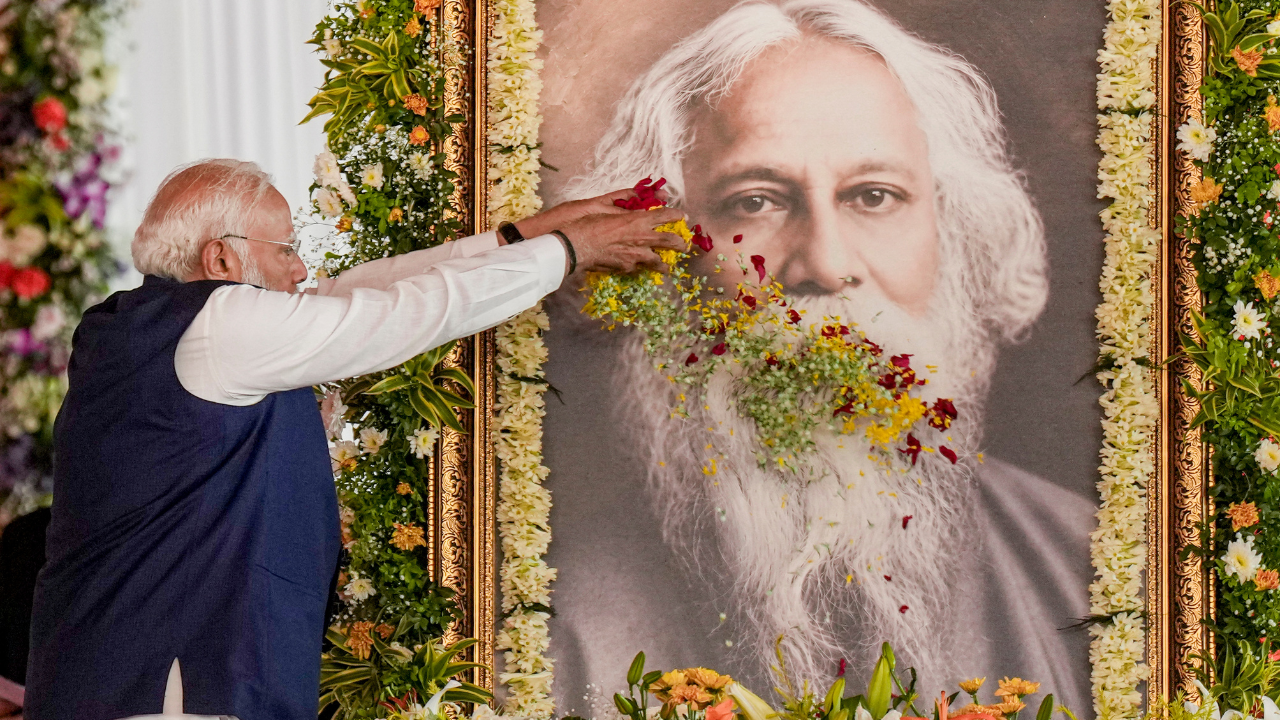
Tagore too found mention and Modi quoted from the poet’s famous poem, ‘Where the Mind is Without Fear,’ to assert that a new era was being ushered in. Hence, holding the swearing-in ceremony on Tagore’s birthday made political sense. One of the first things Mamata had done, after becoming CM, was to have Rabindra sangeet played from loudspeakers in Kolkata’s streets.
However, just as Tagore lives on in the hearts and minds of many Bengalis, he is also someone whose ideas are at odds with Hindu nationalism. For instance, in the ongoing celebrations around the 150th anniversary of Bankim’s Vande Mataram, Tagore’s contribution in giving tune to the song and popularising it has been noted. At the same time, its shortening, done at the behest of the Congress, has been likened by many BJP leaders to a division of the nation.
However, Tagore’s critical role in shortening the song has been elided. When the Muslim League was protesting against Vande Mataram in the 1930s, both Nehru and Bose had written separately to Tagore to resolve the controversy. Tagore was aware of the Muslim sentiments against Vande Mataram and Bankim’s novel, ‘Anandamath’, where the song occupies a critical place.
Tagore’s solution, which he conveyed in a letter to Nehru, was to keep only the first two stanzas. He wrote that the “spirit of tenderness and devotion expressed in its first portion, the emphasis it gave to beautiful and beneficent aspects of our motherland,” could be separated “from the rest of the poem and from those portions of the book of which it is a part.”
Tagore, a member of the reformist Brahmo Samaj, noted that the poem’s second part and Bankim’s novel militated against his “monotheistic ideals.” He suggested an abridged version that would not “offend any sect or community.”
Yet another instance of Tagore’s disagreement with one of the central symbols of Hindu nationalism was his unease with identifying the nation with the mother goddess. This was powerfully articulated in his 1916 novel ‘Ghare Baire’ set against the backdrop of the Swadeshi movement.
It was during the 1905 protests that he had led a procession in the streets of Kolkata during the rakhi festival, singing one of the emblematic songs of the period before going on to tie rakhis to Muslims, including those inside the city’s Nakhoda Masjid. In the novel, speaking in the voice of the progressive zamindar Nikhil, Tagore is unable to “accept the spirit of Bande Mataram” and to “worship” his country “as a god.”
Tagore also had public but civil disagreements with Bankim and other contemporary intellectuals like Chandranath Basu over their interpretations of Hinduism and history, usually coming down on the side of reasoned interpretation.
Much of this is either not known or is brushed aside by those who seek to appropriate Tagore and also those for whom he is a demigod.
Sen is a senior research fellow, Institute of South Asian Studies, National University of Singapore
Disclaimer
Views expressed above are the author’s own.
END OF ARTICLE