Pichai’s Stanford sangfroid reminds everybody that free speech also pays business dividends
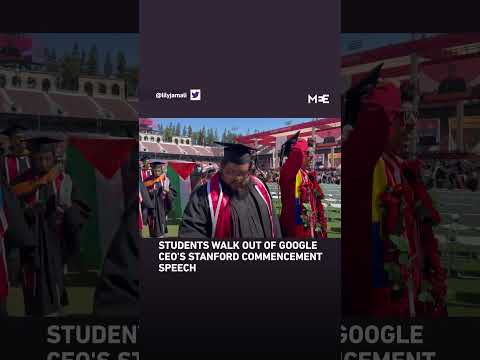
In his commencement address to Stanford’s Class of 2026, Sundar Pichai remarked, “What I see in front of me is how graduations should be.” Whatever he may have meant, the line’s acquired a life of its own after 100s (out of 1000s) of students booed him, and walked out. Their protest was directed largely at Google’s AI-related work with Israel, and at Israel’s military campaign in Gaza. What really deserves attention in other parts of the world, is that the students aren’t facing disciplinary action. Neither Pichai nor Stanford admin appear even ruffled. Silicon Valley’s seen this movie before. In fact, free speech and dissent are woven into its origin story.
The Valley’s intellectual DNA owes tonnes to 1960s’ counterculture movements. This is what others who have tried, and failed, to replicate its extraordinary success at generating one wave of tech innovation after another, overlook. Its distinctive set of liberal values. Students were walking out of Berkeley and Stanford ceremonies to protest war back then too. That war was Vietnam. But the foundational proposition was the same: More speech, not less.
And this ethos has extended to people. Silicon Valley became unusually welcoming to outsiders – immigrants, eccentrics, college dropouts – who would have struggled to find a place on Wall Street or traditional manufacturing. That openness paid spectacular dividends. Immigrants have founded or co-founded 59% of US’s privately held billion-dollar startups. This is an only-in-America story. Maybe the Valley’s regressing in Trump era, but its embrace of figures like Andy Grove (Hungarian refugee), Jerry Yang (Taiwanese immigrant), Sergey Brin (born in USSR), and Pichai, will always remain triple starred. The lesson extends beyond technology. Italy’s prolonged World Cup drought is linked to its football team rebuffing migrants, and remaining almost entirely white. The Valley’s “move fast and break things” temper, by contrast, disrupts inherited hierarchy.
A healthy democracy, of course, depends on citizens being free to clash on the battlefield of ideas, rather than attempting to silence one another. But as economist Adam Millsap argued in a widely discussed 2016 essay, the same principle applies to economies. Free-speech norms do more than protect liberty. They accelerate innovation. And yes, this has been empirically established. A 2024 study covering 157 countries between 1900 and 2015, found that improving academic freedom by one standard deviation increases patent applications by 41%. Wherever govts, business leaders, teachers…are more comfortable suppressing speech than tolerating what they personally don’t like, the innovative spirit wanes. The freedom to argue, dissent, and challenge orthodoxy is a great civic blessing. And it’s an equally precious economic asset.

Disclaimer
Views expressed above are the author’s own.