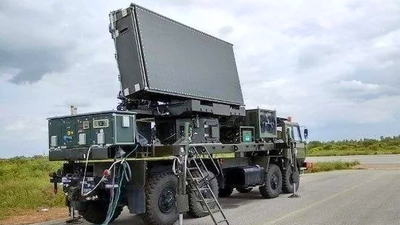

NEW DELHI: India’s indigenous air-defence radar capabilities have drawn renewed attention amid discussions over how modern surveillance systems detect stealth aircraft. At the centre of this conversation is Arudhra, a medium power radar developed by the Defence Research and Development Organisation (DRDO), which forms a key part of India’s expanding air-surveillance network.Designed to enhance the Air Force’s ability to monitor and track aerial threats, Arudhra represents one of the country’s most advanced indigenous ground-based radar systems. Its induction is part of a broader effort to strengthen India’s layered air-defence architecture and improve situational awareness across diverse operational environments.
What is Arudhra radar ?
Designed and developed by DRDO, Arudhra is a 4D multi-function phased-array radar with electronic steering in both azimuth and elevation. It is intended for surveillance, detection and tracking of aerial targets and incorporates target identification through a co-located Identification Friend or Foe (IFF) system.In 2023, the ministry of defence signed a ₹2,800-crore contract with Bharat Electronics Limited (BEL) for the procurement of Arudhra Medium Power Radars for the Air Force.According to DRDO, Arudhra has a detection range of up to 400 kilometres and can detect aerial objects with a radar cross-section (RCS) of 2 square metres at distances of up to 300 kilometres. The system can monitor targets flying at altitudes ranging from 100 metres to 30 kilometres, enabling it to detect both low-flying and high-altitude aerial threats.The Indian Air Force is also set to deploy a mountain-adapted variant of the radar to strengthen surveillance coverage in high-altitude regions, including Jammu and Kashmir and the Northeast. The variant is intended to address terrain-related surveillance gaps and improve monitoring in mountainous areas.
India’s expanding indigenous radar network
Arudhra is part of a growing family of indigenous radar systems developed to strengthen India’s surveillance and air-defence capabilities.Among them is the Ashwini Low-Level Transportable Radar (LLTR), an active electronically scanned array (AESA) radar developed by DRDO’s Electronics and Radar Development Establishment. The system is designed to track a wide range of aerial targets, from high-speed fighter aircraft to slower-moving helicopters and unmanned aerial vehicles.Another key system is the Rohini 3D Radar, developed by DRDO and manufactured by BEL. Mounted on a mobile platform, Rohini functions as a medium-range surveillance radar operating in the S-band. It is capable of Track-While-Scan (TWS) operations and can monitor airborne targets at ranges of up to 150 kilometres.Together, systems such as Arudhra, Ashwini and Rohini are becoming an important component of India’s surveillance and early-warning infrastructure. Their induction reflects the country’s push for self-reliance in defence technology while strengthening the layered radar network required to monitor evolving aerial threats.