
The mystery of the Colorado River’s missing water has finally been solved by scientists from the University of Washington, revealing a critical shift in the American West’s hydrological cycle. For the past several decades, hydrologic managers have used winter snowpack measurements to predict how much water will be available in reservoirs during the summer months, but since the year 2000, managers have consistently overestimated stream flow predictions based on winter snowpack measurements. The new research conducted by scientists revealed that warmer and drier springs are responsible for this phenomenon. Spring precipitation is critical in helping to deliver water from melting snow to the river, but when no spring precipitation occurs, mountain vegetation will draw from the snowmelt before it gets to the river. This physiological siphoning effect has been enhanced by clearer skies and enhanced solar radiation, which together account for almost 70 per cent of the water deficit being experienced in the basin. Capturing this ecological interception of water from the Colorado River basin is critical for the 40 million people living and working in the basin who are dependent on the diminishing water supply.
Mystery of the Colorado River’s missing water solved
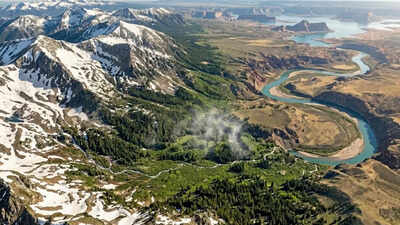
The contrast between plentiful snowfall in the winter and dry riverbeds during the spring and summer used to be blamed entirely on evaporative losses. The new research from Geophysical Research Letters now shows that the main reason for this phenomenon is that plants are using up a large amount of the melting snowpack before it reaches large downstream reservoirs such as Lake Mead and Lake Powell.As the monthly amounts of spring precipitation decrease, plants (from wildflowers to those in high elevation forests) become ‘thirsty’ earlier in the season. With increased sunshine and less rain, these plants use up more of the melting snowpack as a food supply.
Why rising temperatures are permanently reducing river flows
The loss of this water is due primarily to the structural transition from drought to aridification known as the ‘Millennium Drought’ that began in 2000. According to data from the United States Geological Survey (USGS), the region is currently experiencing a state called aridification, which means that rising temperatures are permanently reducing river flows and that changes are occurring despite the quantity of precipitation received. The warming atmosphere increases the amount of moisture that can be held, and this leads to an increase in the vapour pressure deficit, causing the plants to pull even more on the soil moisture and snowmelt.
Why 100 per cent snow no longer guarantees full streamflow
Research shows there has been a decrease of approximately 7 per cent in spring rainfall throughout the Upper Colorado River Basin. Low-elevation basins have been affected the most significantly due to an earlier thaw from the snow and therefore provide a longer period of time for the vegetation to extract water during its growing season. Research funded by the National Science Foundation further demonstrates that even if the winter snowpack is at 100 per cent of normal, a dry, sunny spring can result in a large ‘runoff deficit’ whereby only 50 per cent of the anticipated amount of water makes it to the river.
Traditional snowpack metrics are insufficient for predictive modelling
Current management practices, which are primarily based upon April 1st snowpack reports, are often governed by the ‘Law of the River.’ The Bureau of Reclamation and NOAA have now been requested to innovate their modelling capabilities to include not only plant phenology but also forecasting methods for spring weather. If 70 per cent of the water is lost to these ‘biologic pumps,’ the states and Mexico that share the river will continue to face increasingly inaccurate allocation of water and shortages of available supply.