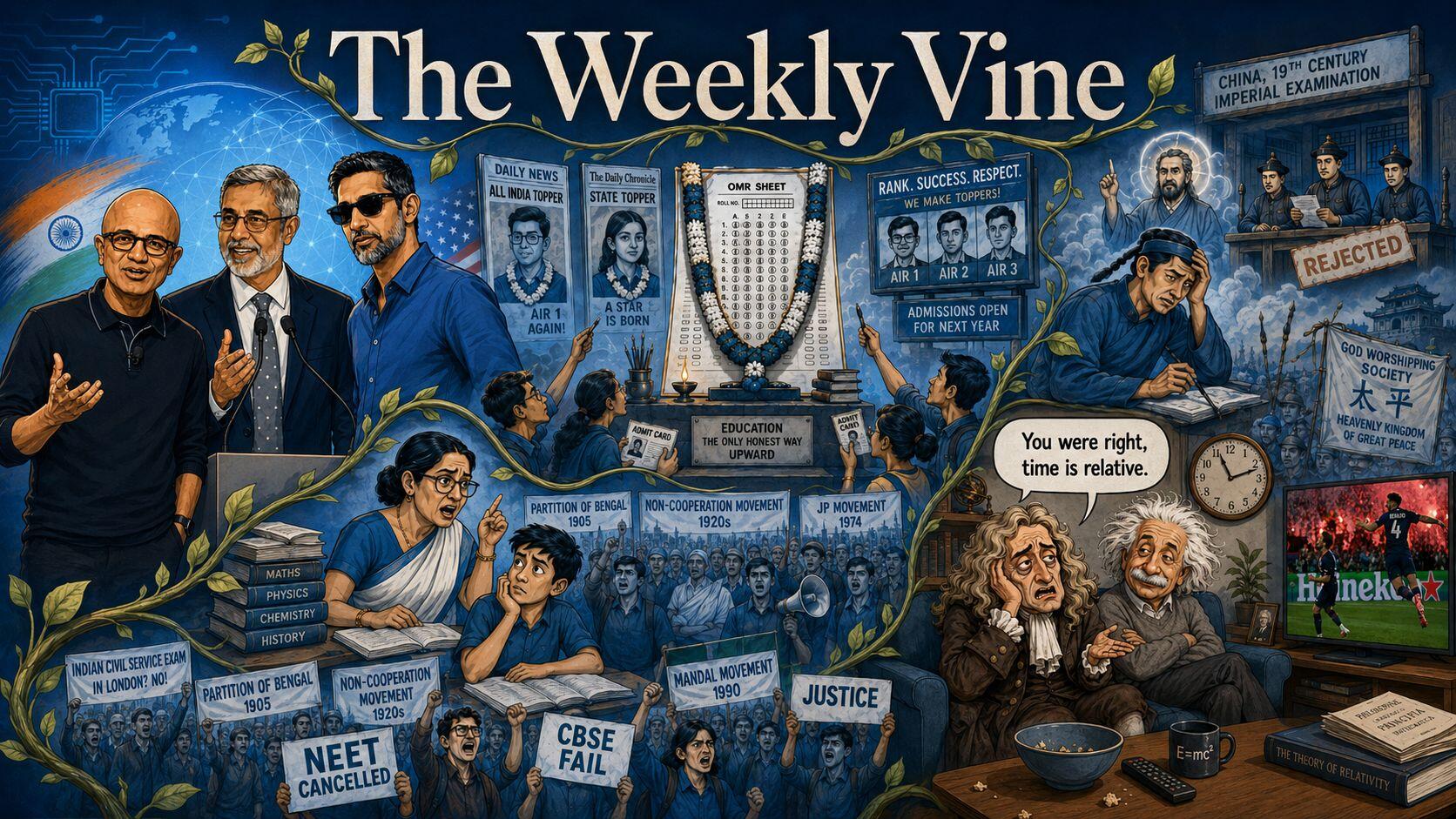


Hello and welcome to the 94th edition of the Weekly Vine. In this week’s edition, we look at the why hell hath no fury like a student scorned, explain why in 2026 for Silicon Valley AI stands for “actually Indians”, look at the boring Champions League final between PSG and Arsenal, and ponder the ontological reasons for the existence of Premium Economy.
Exam Worries

Growing up in a Bengali middle-class household, one often heard the refrain: Lekha pore kore je, gari ghoda chore se (Those who study hard ride cars and horses). Perhaps that explains why, much to my mother’s chagrin, I never studied, because I didn’t want to drive a car or ride a horse. Though, to be fair, I did attempt to learn horse-riding in boarding school, but I was so gravitationally challenged back then that the poor stallion could do little more than waddle around.
Now, whatever your view of education in India, there’s no denying that it’s the surest way of upward mobility that doesn’t involve any criminal enterprise. And in our country, education means exams, which come in all forms and shapes. And we are a nation that worships exams, as evidenced by the faces of toppers plastered on every newspaper and billboard, with good cause.
Some can make you the head of a trillion-dollar company. Others let you shut down stadiums to walk your dog and come closest to divinity feasible in one’s human form.
But things can go awry when the examination system goes for a toss. Take 19th-century China, where the imperial examination system under the Qing dynasty tested your knowledge of Confucian classics, writing ability, philosophy and governance, and decided whether you became part of an elite bureaucracy.
A young man named Hong Xiuquan tried several times and failed to crack the code, which made him so seriously ill that he suffered vivid hallucinations that he was Jesus’ younger brother. So, he started a rebellion against Confucianism, traditional religion and the Qing dynasty, and proposed a new monotheistic system called the God Worshipping Society. His followers called themselves the Heavenly Kingdom of Great Peace and captured several cities, defeating Qing forces.
Not that one has to go to 19th-century China to see what happens when students are scorned. Numerous movements in India can be traced to student agitations, including protests against the decision to conduct the Indian Civil Service exam in London, which became the bedrock of the first Indian nationalist movement. Since then, the Partition of Bengal and Gandhi’s Non-Cooperation and Quit India movements were all powered by angry students. Post-independence, we had the Nav Nirman movement in Gujarat, the JP movement that laid the foundation for the Emergency, and the Mandal protests, all of which created the grounds for today’s political landscape.
And while we may be in a post-Mandal world, recent upheavals, from the NEET cancellation to the CBSE fiasco, see the current regime face one of its biggest challenges. We are a nation that worships at the altar of education, where exams are a symbol of hope and the idea that the one chance of social mobility is corrupted might have far-reaching political consequences that can make or break empires. Hell, hath no fury like a student scorned: just ask the Qing dynasty.
AI = Actually Indians

In 2024, Y Combinator co-founder Paul Graham, riffing on a speech by Airbnb founder Brian Chesky, argued that founders are often given terrible advice once their companies grow large: hire good people, delegate authority, stop interfering and let professional managers run their departments.
Graham argued that this turns companies into black boxes. The founder is told that getting too involved is “micromanaging”. The org chart becomes sacred. Everyone starts speaking in alignment decks. Somewhere in the middle of all this, the original instinct of the company quietly dies in a meeting room.
That is Founder Mode: the refusal to let managers turn instinct into process. It means staying close to the product, cutting through layers, asking uncomfortable questions and keeping the obsessive intensity of the start-up alive. It is the Silicon Valley ideal associated with Steve Jobs, Jensen Huang and Elon Musk: temperamental, unbearable, but capable of seeing what committees usually miss.
Manager Mode has its uses too. It gives a company stability, scale, order and predictability. Founder Mode gives it urgency, instinct and the occasional evolutionary leap. The danger begins when Manager Mode becomes bureaucracy and Founder Mode becomes narcissism with a product roadmap. One suffocates a company with process. The other burns it down because one man mistakes his mood for vision.
That is where Satya Nadella, Sundar Pichai and Sanjay Mehrotra complicate the binary.
They are not Founder-Showmen in the classic Silicon Valley sense, though Mehrotra did co-found SanDisk. Nor are they Manager Mode creatures floating above the machinery with consultant-speak and approved emails.
They are Operators: technical men who understand the machine, patient climbers who spent years in the trenches, and translators who can speak engineering, management, policy, investors and infrastructure without sounding like passengers.
In the age of AI, Operator Mode matters more than ever. Microsoft must turn Azure into an AI distribution engine without losing enterprise trust. Google must rebuild Search around AI without killing advertising. Micron must supply the memory that lets AI systems move oceans of data.
The founder builds the temple. The manager keeps the queue moving. The Operator makes sure the gods, wires and plumbing all work.
Haramball Final

Until a goofy-looking German working in a Swiss patent office came around, all of us took an Englishman’s word for how the universe functioned. The received wisdom was that time flew linearly at the same pace for everyone and space was a grand stage that stood still.
But then the patent clerk showed that not only was time not absolute, but it depended on two things: motion and gravity. We call it relativity. The closer one approaches the speed of light, or the stronger the gravity, the more time slows down. But the genius didn’t know there was another way to slow down time to a point where one wonders if time has passed at all: watching Arsenal in the Champions League final against Paris St-Germain in Budapest.
Now as Natasha Romanov kept telling Hawkeye in the MCU, we will all remember Budapest very differently.
PSG fans will be thrilled to win back-to-back Champions Leagues, becoming the second team to defend the Big Ears in Europe after Zinedine Zidane’s Real Madrid. Arsenal fans will wonder how things could have gone if Gabriel could have just kept the ball a little lower in the penalty shootout. And neutrals will wonder what karmic crimes we have committed in our previous lives to watch a final so bereft of action that in 120 minutes there were only a total of five shots on target, where PSG had 75% possession and Arsenal made only 69 passes in the first half.


Postscript by Prasad Sanyal: The Row 6 dilemma

There is a particular kind of disappointment that only middle age, airline loyalty programmes and a modest amount of disposable income can produce. It usually arrives somewhere around Row 6. Not Row 1, where people are drinking juice from proper glasses and discussing board meetings they may or may not actually have attended. Nor Row 28, where expectations have been sensibly calibrated to the realities of modern aviation. Row 6 occupies that curious stretch of territory where ambition pauses to examine its own life choices.
I found myself there recently on a domestic flight, staring thoughtfully at the seat in front and wondering whether Premium Economy might be the most Indian product ever invented. Not because it is especially good or especially bad, but because it captures, with remarkable precision, the story of an entire generation that has spent three decades upgrading itself one EMI, one credit card and one aspirational purchase at a time.
Post Postscript
Word of the Week: Bhadralok

Book of the Week: Exodus by Leon Uris

Leon Uris’s Exodus is the blockbuster 1958 novel that turned the birth of Israel into an epic of refugees, resistance, nationalism and historical trauma. Centred on Ari Ben Canaan and the ship Exodus, it follows Holocaust survivors trying to reach Palestine under the British Mandate, while tracing the emotional and political forces that led to the creation of the Jewish state.
It is part historical fiction, part propaganda novel, part old-fashioned adventure saga. Subtle it is not. But few books did more to shape the popular Western imagination of Israel as a nation born out of suffering, defiance and impossible odds.
Disclaimer
Views expressed above are the author’s own.