
For a long time, cooperation in the animal world was viewed largely through the lens of competition’s opposite: a useful alliance that helps two species gain something neither could achieve alone. Yet a deeper question has remained surprisingly difficult to answer. How do animals from entirely different species know when to trust one another, when to cooperate and when to walk away?A new review published in ScienceDirect, titled “The ecology and evolution of cues and signals in animal interspecies cooperation”, brings together evidence from dozens of cooperative relationships across the natural world, arguing that information exchange sits at the centre of these partnerships. According to the authors, animals rely on a wide range of cues and signals to identify suitable partners, coordinate behaviour and reduce the risk of being exploited. The review draws examples from insects, fish, birds, mammals and even humans, revealing that cooperation across species is often built on communication systems that are far more sophisticated than they first appear.
How animal communication builds trust and cooperation across species
Sharing a goal is not enough. Animals from different species often perceive the world in completely different ways, respond to different stimuli and face different risks. A hunting partner could become a competitor. A potential helper could turn into a predator.A new review published in ScienceDirect, that many cooperative relationships succeed because animals exchange information that helps remove uncertainty. These signals may take the form of sounds, body movements, colours, vibrations, scents or repeated behavioural patterns. What matters is not the form itself but the information it conveys.Animals often use these signals to answer basic questions before cooperation begins: Who is this individual? Is it willing to cooperate? Can it be trusted? The answers influence whether an interaction moves forward or ends before it starts. Different species, different communication tools
How cleaner fish, eels, and honeyguides communicate across species
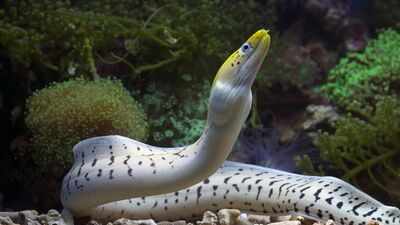
On coral reefs, cleaner fish advertise their role through distinctive colour patterns that help other fish recognise them as partners rather than threats. Client fish frequently adopt specific body postures that effectively signal a willingness to be cleaned.Coral trout and groupers have been observed using conspicuous body movements to recruit hunting partners, such as eels or octopuses. By working together, they can flush prey from hiding places that would otherwise remain inaccessible.In African honey-hunting traditions, greater honeyguides and humans engage in one of nature’s most remarkable partnerships. The birds produce characteristic calls while guiding people towards wild bee nests, and humans often respond with vocal sounds of their own. The exchange continues throughout the search, allowing both sides to coordinate their movements until the nest is found. According to the review, such interactions demonstrate how communication can support cooperation between species separated by millions of years of evolution.
How animal communication evolved from simple cues to signals
One of the review’s more intriguing ideas concerns the origins of communication itself. The authors distinguish between cues and signals. A cue provides useful information, but was not necessarily shaped by evolution for communication. A signal, by contrast, has evolved specifically because influencing another individual’s behaviour brings benefits.The boundary between the two is not always clear. What begins as an incidental clue may gradually become a dedicated communication tool if responding to it repeatedly benefits both parties. Over generations, natural selection can strengthen these interactions.The review points to several cooperative systems where researchers suspect such transitions may have occurred. In some cases, behaviours that originally served one purpose appear to have been adopted for cooperation later. In others, animals may simply have learned to interpret existing behaviours in ways that improve coordination. The authors argue that understanding how cues become signals could reveal important clues about the evolution of communication more broadly.
Animal communication helps prevent cheating between species
Cooperation is rarely risk-free. Whenever two species interact, there is always the possibility that one side gains more than the other. Many of the communication systems described in the review appear designed to reduce this problem. Signals can help animals monitor partners, discourage cheating and maintain mutually beneficial outcomes.Cleaner fish relationships offer one example. Client fish sometimes react aggressively when cleaners behave dishonestly, such as taking tissue instead of parasites. These responses can act as a form of punishment that encourages future cooperation. Other partnerships rely on chemical or vibrational signals that help maintain protection agreements between insects and ants. In these systems, communication is not merely about initiating cooperation; it also helps preserve it over time.