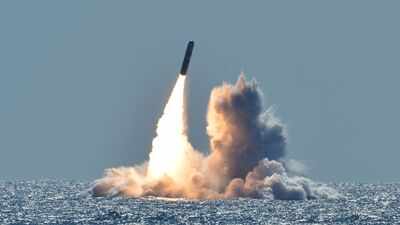

Launching a ballistic missile from a submarine is among the most complex and dangerous operations in naval warfare. If a missile’s powerful rocket engine were to ignite inside the launch tube, the extreme heat and pressure could severely damage or even destroy the submarine carrying it.To eliminate this risk, the world’s leading naval powers, including India, the United States, France, Russia and China, use a technique known as cold launch for their submarine-launched ballistic missiles (SLBMs). It has become the global standard for safely launching strategic missiles from beneath the sea.What is cold launch?The concept of cold launch emerged during the Cold War as the United States and the Soviet Union expanded their submarine-launched ballistic missile programmes to strengthen their nuclear deterrence capabilities.The first SLBMs were not launched using this technique. In 1955, the Soviet Union carried out the world’s first ballistic missile launch from a submarine using the R-11FM missile. However, the submarine had to surface before firing, making it vulnerable to detection and attack.As nuclear deterrence became a central pillar of military strategy, both Washington and Moscow sought a method that would allow submarines to launch missiles while remaining submerged. Engineers concluded that igniting a missile’s rocket motor inside a submarine was too dangerous because of the immense heat and pressure it would generate.A cold launch is a missile launch technique in which a missile is first ejected from the submarine using high-pressure gas generated by a gas generator, rather than igniting its rocket engine inside the launch tube.Once the missile has been expelled from the launch tube and has travelled through the water, its rocket motor ignites only after it has safely cleared the submarine and emerged above the surface. This separation between missile ejection and engine ignition is what makes the cold launch system significantly safer than a hot launch.Today, virtually every modern SLBM relies on cold-launch technology. Missiles such as the Trident II D5 used by the United States and the United Kingdom, France’s M51, Russia’s Bulava, China’s JL-3 and India’s K-4 all use this method, reflecting its proven safety, reliability and effectiveness in strategic submarine operations.
 How cold launch works
How does cold launch work?A cold launch begins inside the submarine’s missile compartment, where the ballistic missile is stored vertically inside a sealed launch tube. Before launch, the submarine reaches its designated launch depth and stabilises its position.The launch tube is then flooded with seawater to equalise the pressure inside the tube with the surrounding ocean. This prevents sudden pressure differences that could damage the submarine or interfere with the missile’s ejection.Once the launch command is issued, a gas generator, sometimes referred to as a steam or gas-pressure generator, is activated at the bottom of the launch tube. Instead of igniting the missile’s rocket engine, the generator rapidly produces a large volume of high-pressure gas.The expanding gas acts like a powerful piston, pushing the missile upward and out of the launch tube without exposing the submarine to rocket exhaust. Throughout this phase, the missile’s rocket motor remains completely inactive.The missile then travels upward through the water using only the force generated by the gas ejection. During its ascent, the launch canister and stabilisation systems keep the missile correctly aligned. This is one of the most critical stages of the launch because the missile must emerge from the water in a stable, nearly vertical position.After the missile breaks through the sea surface and reaches a safe height above the submarine, onboard sensors and computers confirm that it has completely cleared the vessel. Only then does the missile’s first-stage rocket motor ignite.The engine accelerates the missile into powered flight, after which it follows its programmed trajectory towards its target using onboard guidance and navigation systems.Because the rocket engine is never ignited inside the submarine, the launch tube, missile compartment and submarine hull are protected from extreme temperatures, pressure waves and exhaust gases.Why is cold launch important?Cold launch technology has become a cornerstone of modern submarine warfare because it enables ballistic missiles to be fired safely from beneath the sea without exposing the submarine to the destructive effects of rocket ignition.Beyond improving safety, the technology also strengthens a country’s nuclear deterrence by allowing ballistic missile submarines to remain submerged and difficult to detect while carrying out strategic patrols.The ability to launch missiles without surfacing enhances the survivability of both the submarine and its crew, making cold launch one of the defining technologies behind modern sea-based nuclear deterrence.