India surprised the world by building Digital Public Infrastructure (DPI) at population scale. Aadhaar transformed identity. UPI transformed payments. DigiLocker transformed access to public documents. Together, they showed that digital infrastructure, designed as a public good, can transform governance.


The next governance revolution will come from combining AI with this digital infrastructure to address one of India’s greatest long-term challenges: raising a healthier generation.
India’s demographic dividend will depend not only on education and jobs, but also on whether today’s children grow into healthy, productive adults. Yet childhood obesity is rising even as undernutrition persists. Children are sleeping less, exercising less, spending more time on screens and consuming more ultra-processed foods. Mental health concerns are increasing. Most non-communicable diseases that strain India’s health system originate in behaviours established during childhood. Preventing them is one of the country’s most important investments in future human capital.
Schools are uniquely placed to lead this transformation. They reach almost every child, almost every day, for more than a decade. Yet student well-being is still addressed through isolated campaigns, occasional lectures and annual observances. Information alone rarely changes behaviour. Healthy habits are built through repeated practice, reinforcement and supportive environments.
What if we approached children’s well-being the way we approached digital governance?
Nearly every teacher and parent today has a smartphone. AI can now provide personalised support at negligible cost. Instead of expecting teachers to become experts in nutrition, mental health and healthy lifestyles, they can be supported by an AI assistant that offers five-minute classroom activities, answers questions and seamlessly integrates well-being into everyday teaching.
This is not about adding another subject. It is about embedding healthy habits into daily school life.
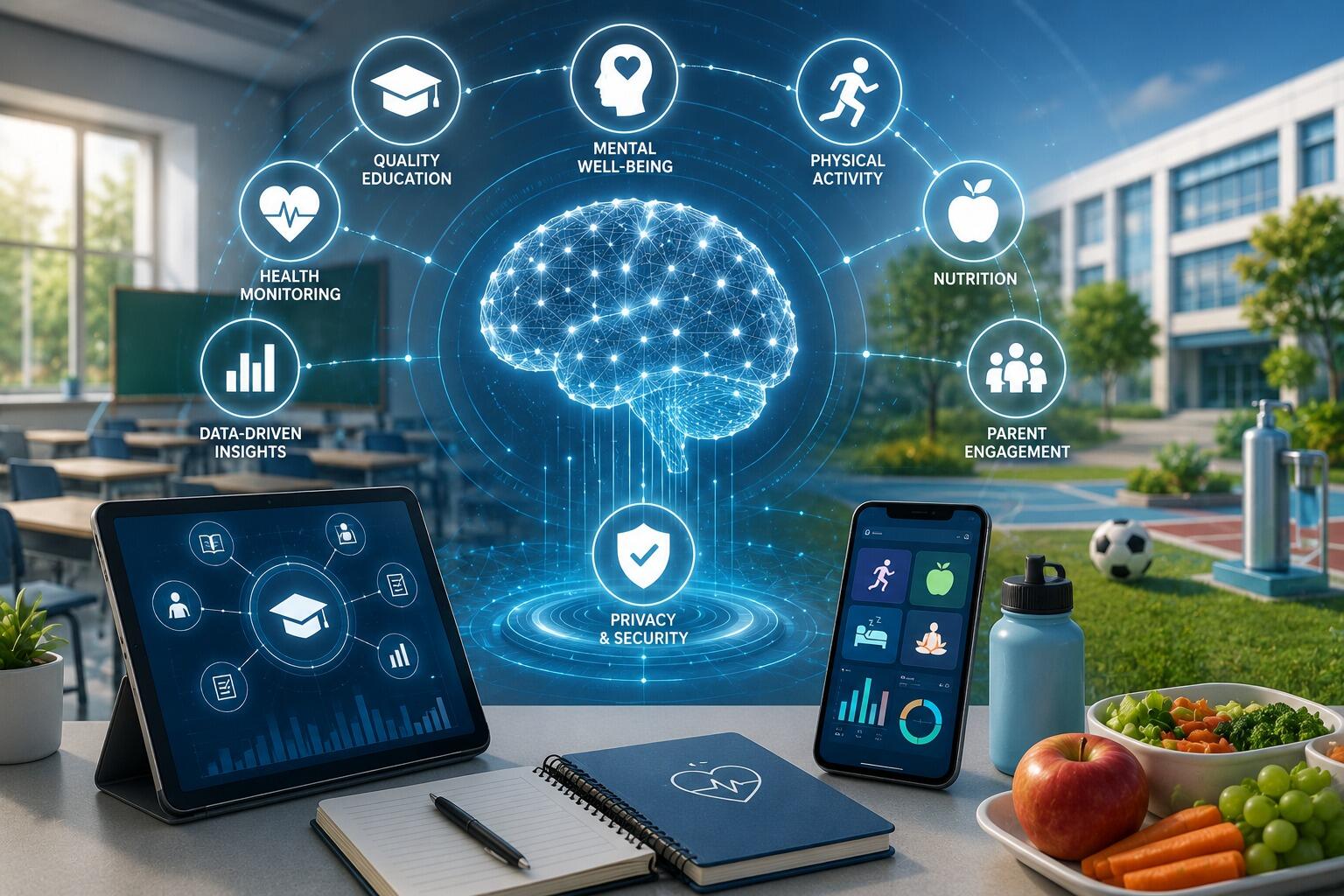
Such a Digital Public Infrastructure should be designed as a human-centred school well-being ecosystem enabled by technology. Teachers remain at the heart of behaviour change. Parents remain children’s first educators. Schools remain the environments where lifelong habits are formed. AI simply serves as an enabler by personalising learning, generating age-appropriate activities, tracking progress, providing timely insights and reducing administrative burden.
Children could practise healthy habits rather than merely learn about them. Simple habit trackers, parental feedback and periodic reflections would create continuous improvement instead of one-time assessments. Schools could strengthen drinking water, food environments, physical activity, sleep, mental well-being and sustainability through simple digital tools. A School Well-being Score could recognise progress and encourage continuous improvement rather than compliance.
Governments would also gain something public health has long lacked: timely intelligence. Instead of waiting years for periodic surveys, anonymised and privacy-protected data could reveal emerging trends in diet, physical activity, obesity, mental well-being and school environments. AI could identify risks early, recommend targeted interventions and continuously improve programmes based on evidence.
This is not about replacing teachers with technology. It is about giving every teacher the knowledge of an expert, every parent practical guidance, every child personalised support, every school a roadmap for improvement and every policymaker timely evidence for better decisions.
India has already shown how Digital Public Infrastructure can transform governance. The next logical step is a Digital Public Infrastructure for School Well-being, a shared national ecosystem that empowers teachers, engages parents, supports schools and enables governments to move from episodic interventions to continuous prevention.
Just as NIPUN Bharat recognised that improving foundational literacy required an integrated ecosystem of teacher support, structured pedagogy, continuous assessment and monitoring, children’s well-being also requires a systemic approach.
India’s first digital revolution connected people to services. The next should connect every child to a healthier future. If AI and Digital Public Infrastructure can help schools nurture healthy habits as deliberately as academic excellence, India’s next digital revolution could become its most enduring investment in the nation’s future.
Disclaimer
Views expressed above are the author’s own.