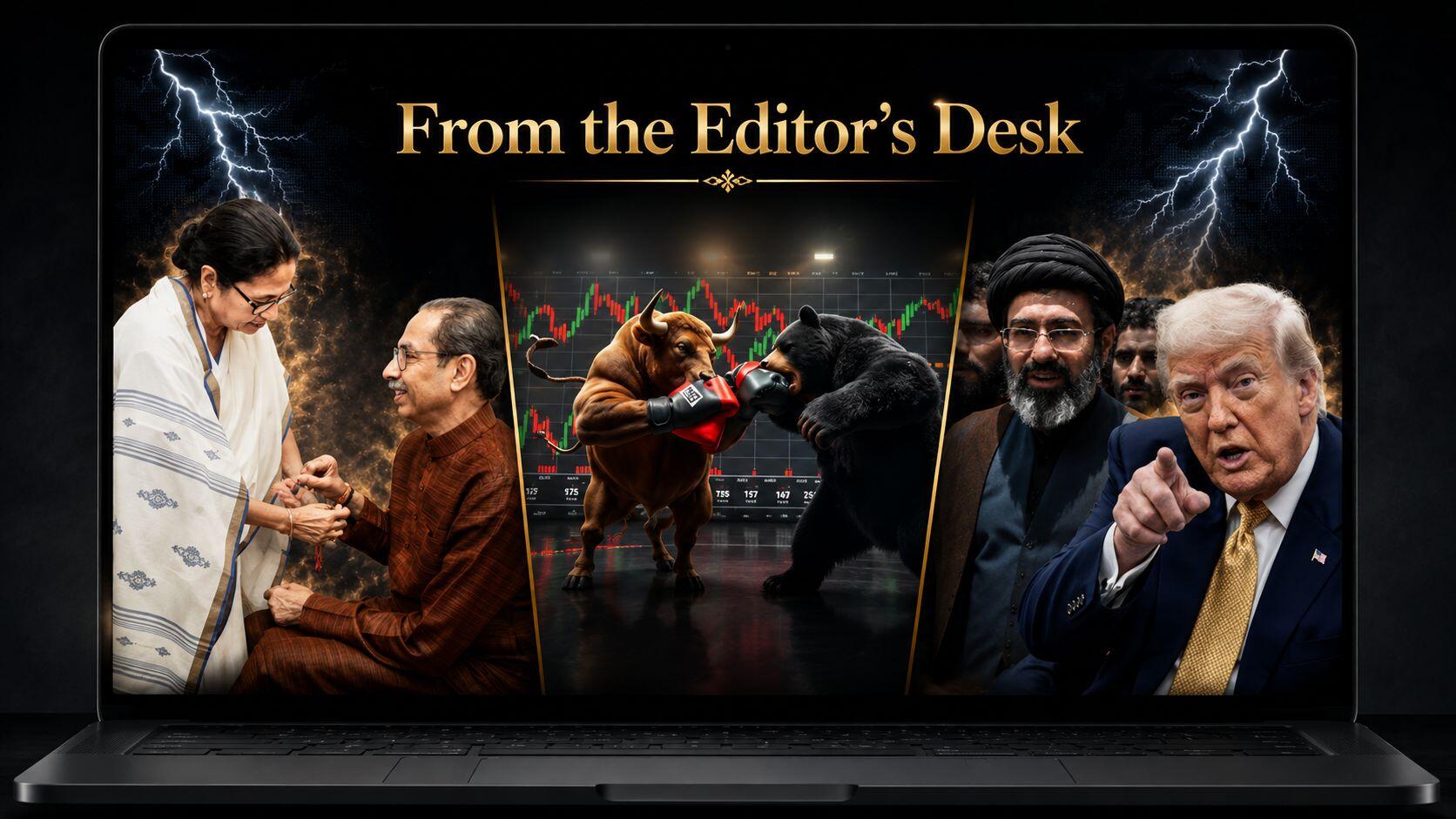


- Indian politics’ shift from defections to battles over party ownership.
- Iran’s “victory” narrative after a costly, weakening war.
- America’s Pacific rename and what it signals to India and China.
- FIFA’s expanded World Cup, from corporate excess to Messi magic.
- NSE’s IPO and the market becoming a stock itself.
It’s ‘party time’: They don’t just defect anymore
For a long time, Indian politics had a familiar phrase for political defection: “Aaya Ram, Gaya Ram.” It captured the wandering politician, the leader who switched sides when power, protection or opportunity demanded it. The act was personal. A few MLAs or MPs left one party and joined another.
Now, leaders no longer simply leave a party. They try to take a large enough group with them to claim protection from the anti-defection law. In some cases, they go even further. They do not just say they have left the party. They claim they are the real party.
That is why Indian politics increasingly feels like “party time.” Not a party as a celebration, although winners certainly celebrate. Party as property, party as brand and party as symbol.
This “party time” is under way in Delhi right now. Uddhav Thackeray’s Shiv Sena (UBT) is trying to prevent its Lok Sabha MPs from moving into the Eknath Shinde camp and claiming a two-thirds “merger” that could shield them from disqualification. Whips have been issued, letters have gone to the Speaker, and lawyers have been brought in.
At the same time, Mamata Banerjee’s Trinamool Congress is watching a strange drama unfold, with 20 of its 28 MPs claiming a merger with the little-known Nationalist Citizens Party of India. The NCPI’s own founder members appear unsure about who is now leading their party.
When party becomes property
In theory, a political party is a bridge between voters and power. It gathers public demands, builds a manifesto, selects candidates, creates discipline and offers continuity. In practice, many parties have slowly become personal assets. They can be inherited within a family or divided when internal power struggles erupt.
Regional parties built around one leader, one family or one emotional legacy are especially vulnerable. Succession is rarely a calm internal process. Who owns Bal Thackeray’s legacy? Who carries the Pawar name? What happens to the Trinamool Congress after Mamata Banerjee? These are not merely family questions. They determine symbols, offices, parliamentary strength and even the formation of governments.
The Aam Aadmi Party shows that this problem is not limited to family parties. AAP was not born as a dynasty. It came from a movement, then gathered around a leader, and later hardened into a tight command structure. That journey matters because it shows that parties do not need families to become leader-centric. A movement can also become a high-command party.
Vox Populi, Vox Dei
Voters, though, aren’t just watching from the sidelines. They keep score. A defector gets punished in one election and rewarded in the next, depending on whether the breakaway faction looks more useful or more energetic than the one it split from – or whether people simply stay loyal to whoever lost the symbol, regardless of what the Election Commission decided.
That’s the part politicians tend to forget. The law can define what counts as defection. The EC can hand out the symbol. The Speaker can rule on recognition. None of that settles legitimacy the way an election eventually does.
Vox Populi, Vox Dei: The voice of the people, the voice of God. It’s slow, it’s messy, and it doesn’t always arrive on schedule. But it’s still the verdict every politician is quietly afraid of.
How India quietly ‘vanished’ from America’s map
Eight years ago, Washington added a single word to its military map of Asia. This week, it quietly rubbed it out.
On June 16, the US department of war said it was reverting US Indo-Pacific Command to its old, pre 2018 title: US Pacific Command, or USPACOM. Geography, we’re told, is unchanged. The command still runs “from the waters off the West Coast of the United States to the western border of India.” The mission stays the same.
But dropping the word “Indo” sails very differently in New Delhi than it does in Washington.
To see why, you have to go back to 2018. That’s when then–defence secretary Jim Mattis stood in Hawaii and announced that “US Pacific Command” would become “US Indo-Pacific Command.” The new name, he said, reflected “the increasing connectivity between the Indian and Pacific oceans.” He added that the command now stretched “from Bollywood to Hollywood, and from penguins to polar bears.”
Symbolism, yes. But carefully chosen symbolism. India was being written into the map.
This week’s framing is very different. The Pentagon says restoring “USPACOM” “honours the command’s deep historical roots,” going back to its 1947 creation by Harry Truman. It points to the Cold War, the Korean and Vietnam wars, humanitarian operations, and “enduring regional partnerships.” It repeats, almost to the point of overkill, that the area of responsibility and “fundamental mission” are unchanged.
That may all be true. But for India, the timing makes the move harder to ignore. Over the past 18 months, US-India trade has gone through one of its roughest patches in years. The relationship has become more transactional and more openly strained than at any point in the past decade.
In that context, taking “Indo” off the marquee of America’s largest geographic command does not feel like harmless nostalgia. At minimum, it suggests Washington sees symbolism as cheap and reversible.
China will read the move as well. When the US adopted the “Indo-Pacific” language, Beijing understood it as part of a wider attempt to build a loose counterweight to Chinese power. Removing “Indo” does not mean America is handing the region to China. Its military presence remains enormous. Its alliances with Japan, South Korea, Australia and the Philippines remain central. Taiwan and the South China Sea remain major concerns.
Still, language shapes mental maps. “Pacific” is a narrower frame than “Indo-Pacific.” It reduces India’s symbolic centrality. For Washington, that may be administrative housekeeping. From New Delhi, it feels like a message.
No more ‘Death to America’: Iran may have won a pyrrhic victory
There are no two ways about it. It was a war started by US President Donald Trump, at the request of Israeli PM Benjamin Netanyahu. But, surprisingly Iran has trumped them both.
The regime is still standing. Trump and Bibi failed to make Iran Ayatollah-free. Tehran is back at the table – not as a defeated state, but as a player whose approval is needed to calm oil markets, reopen Hormuz, and keep the Middle East from sliding into a wider war.
But, this is for now. The scenario may look totally different in a year or so.


Survival isn’t the same as victory, and Iran isn’t coming out of this war stronger. It’s coming out battered, poorer, more exposed, and more dependent on a deal with the very country it spent decades calling the enemy – not because it pushed forward, but because it didn’t collapse.
For decades, “Death to America” wasn’t just a slogan – it was close to a reason for the regime’s existence. That makes a deal with Washington an awkward thing to call victory. Hardliners who spent years insisting America could never be trusted, and who cheered every show of defiance, are now being asked to live with compromise. If Iran won, they’re asking, why is it negotiating at all?
Iran’s nuclear programme – once sold as a symbol of sovereignty and national pride – now looks less like a trophy than a chip to be traded away.
To paraphrase Henry Kissinger, by making a deal with the US, Iran has decided to be a nation and give up the cause – Islamic revolution.
Anti-regime Iranians are unhappy for the opposite reason. Many had hoped the war would weaken, even topple, the Islamic Republic. Instead they’re watching it survive, negotiate, and possibly receive funds to rebuild – with little to show for the suffering it took to get here.
Trump can walk away. Tehran can’t.
Donald Trump can sell this deal however it suits him. If it holds, he calls it proof his pressure worked; if it collapses, he blames Tehran and threatens more strikes. He has room to rewrite the story. Tehran doesn’t.
So has Iran won? It’s won the right to negotiate the terms of its own damage – which is a long way from winning.
FIFA’s cup of contradictions: From Messi magic to Ronaldo’s decline
The World Cup was always going to feel different in America. FIFA’s expanded 48-team format has 104 matches now, the biggest and most expensive edition the tournament has ever run. Bigger cities, bigger screens, bigger data operations – the scale fits the host.
Hospitality is another matter. The US might not be able to beat Tehran on a battlefield, but tournament organisers are apparently doing their bit to make life hard for Iranian footballers off the pitch.


On the pitch, though, the football keeps bailing out the packaging around it.
Lionel Messi, at 38, produced the kind of performance that makes the commercial noise fade out for ninety minutes. His hat-trick in Argentina’s 3-0 win over Algeria pulled him level with Miroslav Klose’s all-time men’s World Cup scoring record of 16 goals. Six World Cups in, and he can still bend a tournament around himself when he wants to.
Cristiano Ronaldo’s story reads differently this time. At 41, he joined Messi in the six-World-Cup club, but Portugal’s 1-1 draw with DR Congo was hard to watch. He was marked out of the game, missed his chances, and Portugal had nothing after their early goal. Next to Messi, the gap was impossible to ignore.
The best case for the expanded format, though, came from Cape Verde. A country of just over half a million people held Spain to a goalless draw on its World Cup debut, with 40-year-old goalkeeper Vozinha turning into an overnight hero. His mother’s visa finally coming through before Cape Verde’s next match gave the story a human edge that the tournament’s corporate gloss usually buries.
So yes, this is a World Cup of sponsors, sensors, visa rows and swollen ticket prices. It is also a World Cup where Messi still glides, Ronaldo suddenly looks mortal, and Cape Verde can make Spain look ordinary.
That is the thing about football. Even when the organisers try to turn it into a business summit, the game keeps slipping through.
When the exchange becomes the stock: Decoding NSE’s Rs 30,000-crore leap
The National Stock Exchange – where millions of Indians check prices, place trades, chase momentum, build SIP wealth and occasionally learn expensive lessons – has finally filed draft papers for its long-awaited IPO.
This isn’t a normal company coming to market. NSE is the market’s plumbing. Price discovery happens here. Companies come here to build credibility. Traders test their nerve here, and the retail-investor boom of the last few years has largely played out on this exchange.


The timing isn’t entirely clean, though. India’s IPO market has cooled this year after two record years in which proceeds crossed $20 billion annually, per Bloomberg. There’s a supply overhang too — roughly $26 billion worth of shares across 71 recently listed companies are coming off their IPO lock-ins soon, which could compete with NSE for investor money.
For investors, the real question isn’t whether NSE is a good business. It clearly is. It’s what price you’re paying for it, and under what regulatory regime. You’d be buying into a near-monopoly in cash equities and a derivatives franchise that’s no longer unchallenged — plus a business regulators treat as critical public infrastructure first, profit engine second.
For ordinary households, the listing means something else. For decades, the exchange was where other companies went to raise money. Now it’s asking for a place in your portfolio instead.
Editor’s picks: Some of our most and must-read articles
Longer than World War I: 10 ways Russia-Ukraine conflict has changed the world — for better or worse
TMC implosion, NCP split and Congress question: Why ‘ghar wapsi’ may not be the answer
Economics of buying versus renting a home: What makes sense?
World Cup 2026: Portugal need to put ‘GOAT’ Ronaldo out to pasture
Elon Musk is the world’s first trillionaire. Here is what he can still not afford
Disclaimer
Views expressed above are the author’s own.