Reeya Rene Rajpal passed out from Jamia Millia Islamia University in 2025 as the gold medalist in painting and went to London, Camberwell College of Arts, to pursue her post graduate studies. Rene has been part of many prestigious exhibitions in India the most important being Art Of India by the TOI group.


London exhibition
In London, this June all postgrad pathways in Camberwell College of Arts, UAL displayed their works from the 29th of June (Preview)- 4th of July, 2026. Rene, an MA Fine Arts: painting student, displayed nine paintings along with two installations. Her penchant for the human face as well as figures is her most integral quality of both essence as well as her love for emotive evocations Perhaps in more ways than one , her odyssey spells the feminine gaze.


To TOI in an exclusive she says: “ I draw inspiration from art movements like Vienna Secession (The Age of Insight by Eric R Kandel is a book on the movement), Impressionism (Theory of optics, rise of the middle class, feminist contributions) andExpressionism (Love and Angst: Edvard Munch) as well as from modernist and contemporary artists (Amrita Sher-Gil, Krishen Khanna, Lucian Freud amongst others) delving into similar research.
She adds that she likes reading texts on neuropsychology, medicine and sociology and incorporates those into her works.


Penchant for textured tactile strokes
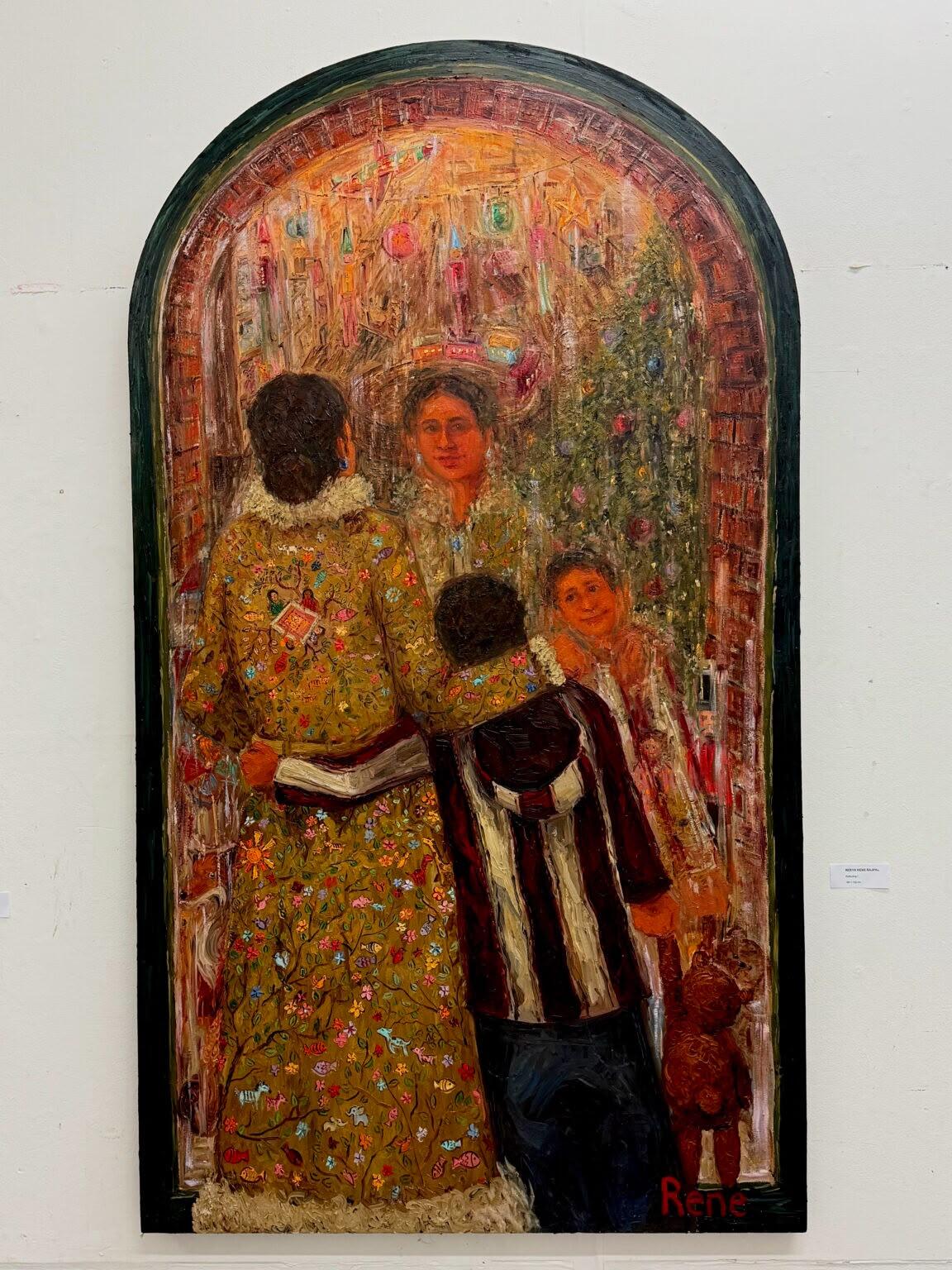
Rene’s paintings are filled with the beauty of fervour and the intensity of textural tactility in the creation of moods. Her strokes are a variety of different tenors and tones and you see at once that she is able to translate emotions and situations into a medley of many articulations that speak of human enactments and scenes.
She explains that her studio practice as a visual artist is an ongoing exploration of the “human experience” which involves looking at and depicting the micro and macro facets of being a human holistically- including but not limited to the physical, emotional and socio-cultural.


Self portraits, friends and family
Primarily working with the subjects of family, friends and self portraits; her practice is informed by looking at people as stories in flesh and blood, allowing her to observe and interpret them as layered beings.Her portrait of herself created in striations of white strokes is a masterpiece.
Yet another self portrait is close up that accentuates not just her sustained virtuosity, but her diverse forms of expression, techniques, recurring known characters woven into seminal art historical allusions.


She creates an amalgam of landscape and people in yet another burgundy toned work that has distinct locations that hold both resonance and allure for viewers. Her love affair with landscapes is endlessly self-renewing. It is the silent commentary that presents curiosity as well as charisma.
Art, literature and creative narratives form the core of the identities of her paintings .When she paints groups she looks at grouping of human figures in an elegant group of gaiety and fervour.Over the past 15 years she has forged a relentlessly inventive path, deploying an array of technical skills as well as canonical art historical knowledge to channel her own painterly modes of world art history into works of individual originality. In her treatment of tone and texture we see that she synthesises past pictorial languages and motifs of European Masters, to create, her own composites of human expressionist states painted in myriad ways.


Cerebral and instinctive
At the centre of the exhibition of 9 paintings lies the continuum between reality and the human gaze, where observation functions as revelation and identity assumes a natural dimension. In this context, Rene’s personal diary of reflections is brought into dialogue with the operative power of human figures and the enduring symbolic charge of everyday reality, emphasising the image as an active presence. In both Rene’s practice and the ritual use of human figures and faces across time, the act of appearance is inherently performative: a form in which identity is assumed, and enacted.
Oftentimes, for onlookers, the influence of multiple moments can be felt in a single work. Most of Rene’s paintings feature human figures, these are portraits of living individuals who are invented as enigmatic characters, captured in ways that reveal their beauty and humanity.


Furthermore, this exhibition also delves into a student’s personal diary as a vital force. Rene’s asserting studies of human figures resonate with the fertility and familiar forces embedded in human and facial forms, where feminine identities are integrated with graceful intimations as well as continuity. This convergence highlights the human figure and relationships as an important site of understanding and a web of growth in associations.Rene’s works reveal how cross-border encounters have, across time, reshaped the descriptive, documentary, and imaginative functions of draftsmanship as a young Indian artist in London.
Images: Reya Rene Kapoor, London
Disclaimer
Views expressed above are the author’s own.