
Parenting advice often travels across borders, but some approaches attract attention because they are woven so deeply into everyday life that they barely resemble a set of rules. Japan is one example. The country’s child-rearing culture is shaped by ideas about shared responsibility, consideration for others, and the small rituals that quietly organise daily routines. These habits are not usually presented as parenting techniques. They appear in greetings exchanged on the street, the way meals begin, the way classrooms are kept tidy, and how children are encouraged to think about the people around them.
How Japanese parents teach children respect, empathy and responsibility
11 Jun 2026 | 18:00
Joint family vs Nuclear family: Which do you think is harder on parents?
Starting the day with an acknowledgement
In the Japanese culture, for instance, a simple greeting means much more than it could mean anywhere else. Children learn how to identify their teachers, neighbors, and classmates from the daily greetings they have with each other. This is such a commonplace act that one doesn’t give it any thought at all.However, when done on a regular basis, it teaches us something about being aware that we are interacting with one another. In the case of children, this is something that they could learn right from the beginning.
Responsibility begins with everyday mess
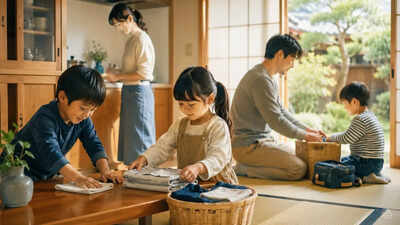
Many parents eventually find themselves picking up toys, folding clothes or clearing plates because it saves time. Japanese parenting tends to push in the opposite direction by involving children in these tasks from an early age.The aim is not perfection. A child may take longer to tidy a room than an adult would, but the process teaches ownership. When children contribute to maintaining their surroundings, they learn that shared spaces require effort and care. That lesson often extends beyond the home.
Treating objects with care
Animism, which involves the idea that things in nature possess spirits or a presence, has been part of Japanese traditional culture for some time. Even if contemporary families understand this concept differently, traces of its presence can still be seen in their behavior.In many cases, children are taught not to treat items they own carelessly, but rather appreciate what they have. Books get put away, school supplies receive proper attention. It is not necessarily about the objects themselves, but rather cultivating mindfulness.
Looking beyond your own feelings
Empathy is often taught through conversation rather than instruction. After disagreements or moments of conflict, children may be encouraged to think about how another person experienced the situation.That shift in perspective can be surprisingly powerful. Instead of focusing only on whether a rule was broken, the discussion centres on consequences and emotions. Over time, children begin to recognise that their actions affect those around them, helping them develop a more nuanced understanding of relationships.
The value of giving something away
Certain Japanese expressions carry cultural meanings that are difficult to translate directly. One common phrase used when handing something to another person reflects a broader idea of generosity and consideration.For children, these small exchanges become opportunities to practise sharing. The act of offering a toy, helping a friend or giving someone else a turn is framed as a positive experience rather than a sacrifice. Repeated often enough, generosity becomes part of normal behaviour.
A clear line between outdoors and home
Visitors to Japanese homes quickly notice the expectation that shoes are removed before entering. Schools, traditional inns and some workplaces follow similar customs.The practical benefit is obvious. Floors stay cleaner. Yet there is also a symbolic aspect. Removing shoes creates a transition between the outside world and a more peaceful domestic environment. For children, the routine helps establish boundaries and reinforces a sense of order without requiring lengthy explanations.
Slowing down instead of rushing through everything
Family life can be fragmented nowadays as dinner is disturbed by the phone, the dialogue is interfered with TV, and there is no time left for stopping.It is common practice in Japanese parenting that one should concentrate totally on the current activity. For example, children learn how to focus on the meal, the process of painting, reading books, or doing household chores. It is not done in a rush, but in time the child learns to concentrate.
Turning meals into a moment of gratitude
It is common practice in many Japanese families before they eat their meal, to recite a traditional saying that conveys their feelings of gratitude to the food presented to them and also to those individuals responsible for growing, harvesting, transporting, and cooking the food.In doing so, children are made aware that their meals are not magically presented to them at the dining table. Individuals like farmers, transporters, sellers, and even family members have contributed to the meal.
Learning restraint in shared situations
Taking the last bit of food from the common plate might be considered perfectly all right in certain cultures. The Japanese tend to wait a bit to see if anyone else wishes to have it before they take it.This kind of practice falls under the wider umbrella concept referred to as self-restraint for the sake of others. Those who grow up under such conditions learn to think about collective considerations rather than their personal desires.
Peace as a family habit
The children often absorb emotional cues from the adults around them. A calm household does not mean the absence of disagreements or difficult moments. Rather, it involves responding thoughtfully instead of reacting immediately.Parents who model patience, composure, and self-control create an atmosphere that children gradually mirror. These behaviours are not taught through lectures. They are learned through observation, repeated day after day.