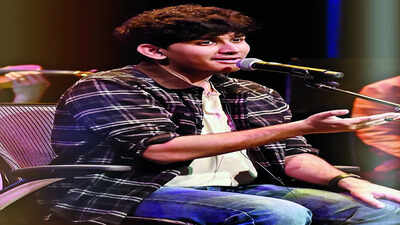

Gen Z Indian-American who’s wowing Kerala with his take on old film songs | page 17At first blush, Navaneeth Unnikrishnan could easily pass for a typical Gen Z-er who grew up far from his cultural roots. Born and raised in Arizona, US, the 21-year-old Indian-origin lad speaks with an American accent. He walks on stage in an open plaid jacket over a white T-shirt. But once the lights dim and the spotlight settles on him, Navaneeth takes his audience on a journey through vintage Indian melodies by some of the greatest composers the country has produced.Gen Z Looks, Vintage HooksOn stage, Navaneeth becomes a bridge between audiences, continents, and musical traditions. In one performance, he sings the classic Malayalam song, ‘Innenikku Pottukuthaan Sandhyakal Chalicha Sindooram (Today, I adorn my forehead with vermilion woven from twilight)’. After completing the opening stanza, he pauses to explain that the composition is rooted in Miya ki Malhar, a Hindustani raga.“Miya ki Malhar is a Hindustani raga. It’s very commonly sung in concerts. But you would never have thought of hearing that in a Malayalam film song,” he tells the audience.In another segment, he traces the musical journey of Indian composer Salil Chowdhury across languages. He demonstrates how Chowdhury’s Bengali song ‘Jhanana Jhanana Baje’ later became the basis for the Malayalam song, ‘Kaadaru Maasam Naadaru Maasam’, from the 1968 film Ezhu Rathrikal. In doing so, he shows how melodies travelled across regions, taking on new languages and contexts while retaining their emotional and musical essence.What sets Navaneeth apart is not just his command over Indian film songs, ragas, musical instruments and their use in cinema, but the way he breaks them down for an audience. He can sing, analyse and explain the science behind a composition without making it sound intimidating.Drawing Old-School CrowdsIn a relatively short span, Navaneeth has built a following both online and offline. What makes his rise especially striking is the audience he has managed to draw. At one of his concerts in Kochi earlier this year, rows of middle-aged men and women sat listening in rapt attention as a young man raised in the US brought to life the songs of their youth.Through his renditions and explanations, Navaneeth explores the nuances of compositions by legends such as music composer Devarajan Master, Salil Chowdhury, Ilaiyaraaja and others, dissecting their structures and illuminating the musical anatomy hidden beneath familiar melodies.His popularity has also made him a recurring attraction for the Bank Employees Arts Movement Ernakulam (BEAM), which has invited him to Kochi for three consecutive years.“After Navaneeth’s first performance, people demanded that we invite him again. People even started buying our annual membership just to attend his concert. It is due to the craze for his concerts that we conducted his events three years in a row,” said BEAM president K S Raveendran.Recognition has followed the applause. Navaneeth has received several prominent honours and accolades, including the 49th Kerala Film Critics Award for Best Male Playback Singer for his rendition of ‘Vidaparayam’ from the film Hridayapoorvam, and the Swaralaya-Devarajan Master Award in 2025.Music historian Ravi Menon says Navaneeth’s popularity has fascinated him. “Navaneeth is a self-made musician, highly influenced by Devarajan Master, who died around the time he was born. Yet Navaneeth studied compositions that are over 50 years old, analysing and understanding them, which is no small feat,” Menon said.Kerala On ReplayNavneeth’s relationship with Indian music began long before he could understand its grammar. Born and raised in America to parents from Kannur in Kerala, he grew up in a home where music was a living presence. His father, Unnikrishnan Vadakkan, and mother, Priya Vannarath, migrated to the US in 1998. Vadakkan works as an engineer at a semiconductor firm, while Priya is a paediatrician.Some of Navaneeth’s earliest memories are of sitting beside his parents and listening to Indian classical music, Malayalam songs, devotional recordings and folk traditions. Their collection of cassettes and CDs became his first music library, introducing him to musicians whose work would later shape his identity.Navaneeth jokes that as a child, he could read English before he could comfortably speak it because life at home revolved around Kerala. As for Malayalam, he worked on his pronunciation, listening to recordings repeatedly until every syllable felt right and often turning to family members and friends for help. He brings the same discipline to Hindi and Bengali songs, convinced that respecting a language begins with respecting its sound.His musical ability was evident from a very young age. Vadakkan said Navaneeth started singing when he was one-and-a-half years old and could identify songs by their opening notes. By the age of three, he had memorised more than 2,000 Malayalam, Tamil and Hindi songs.“By hearing the initial sounds of a song, he could identify the music. That was when we realised he was different from most other children,” Vadakkan said.He added that several musicians later recognised Navaneeth’s rare talent. “As a child, he was fascinated by the violin and flute. The first name he learnt to write was that of violinist Balabhaskar, not his own,” he said.Vadakkan said neither he nor his wife had a musical background. “We just played music at home. Nothing more than that,” he said.Cinema And Classical MusicNavaneeth’s parents enrolled him for Hindustani classical music lessons when he was four, and years of training under respected gurus was later complemented by lessons in Carnatic music. But, for him, classical music and cinema were never separate worlds. Every raga he learnt prompted him to revisit familiar film songs with fresh ears.Gradually, he realised that many composers had woven complex classical structures into melodies that millions could hum without recognising the underlying musical sophistication.Vadakkan said Navaneeth’s performances are not heavily planned. “In a three-hour concert with around 120 songs, he may prepare only about 10 songs. The rest are stored in his mind. He can talk about music for days without preparation,” he added.Navaneeth remembers listening to M Balamuralikrishna’s renditions of Tyagaraja’s kritis, or structured devotional compositions, and being mesmerised by the expressive power of Indian classical music. Around the same time, Malayalam cinema introduced him to the genius of K J Yesudas, Devarajan Master, Johnson Master, M S Baburaj and Salil Chowdhury. For a child growing up far from India, music became his strongest bridge to home, keeping Malayalam and its culture alive despite the thousands of kilometres that separated him from Kerala.The Past, In A New PitchDespite his liking for classic film songs, Navaneeth rejects the simplistic belief that only older music deserves admiration. Every generation, he says, produces its own innovators. While Devarajan Master, Baburaj and Ravindran transformed Malayalam music in their era, contemporary composers such as Sushin Shyam and Rex Vijayan are expanding its vocabulary in new ways. He is equally enthusiastic about Kerala’s thriving independent music scene.Perhaps the most refreshing aspect of Navaneeth’s musical philosophy is his refusal to lean only on nostalgia. Many in his audience grew up with the songs he performs, but he does not choose them simply because they remind people of the past. He chooses them because they reward close listening. Every composition, he believes, carries lessons in melody, poetry, orchestration and imagination.After his graduation in data science from New York University, Navaneeth is preparing to begin a full-time career in data science next month. But he says music will remain an integral part of his life. He plans to continue performing, deepen his learning and focus on creating more independent music.Looking ahead, Navaneeth hopes to explore the vast diversity of Indian music beyond classical and film traditions. He is keen to study semi-classical, folk and regional musical forms, including music from North Kerala traditions such as Theyyam music and Pulluvan Pattu, while drawing connections between different styles of music from across India and beyond.“In every form of music there’s something to learn from. So, I want to explore that, and go deeper into that and understand the links between different forms of music. That is something I’m very passionate about. That is my dream, to do that more and more at a grander scale,” says Navaneeth.