The term “archive” is derived from the Greek word “archaeion”. The word “archeion” derives its etymology from the word “arch,” which originally denoted the magisterial residence and later the public office where official papers are kept. Archives contain a wide range of objects, such as stone inscriptions, copper plates, historical manuscripts, and isolated letters from previous rulers. Archives are any section, whether current or not, of an organization’s, institution’s, or individual’s records that are preserved for their enduring value. In order to write about history and evaluate the past using modern writing such as diaries, letters, court cases, newspapers, pamphlets, leaflets, songs, and ghazals, archives were essential. When we write about the social history of Bihar from 1912 to 1947, I get quite concerned about the role of the newspaper as an archive source. There are several publications in Bihar, such as Searchlight, Mithila Mihir, Desh, Al-Hilal, Bihar Bandhu, and others, but they hardly ever talk about the lower classes’ involvement in India’s independence movement.
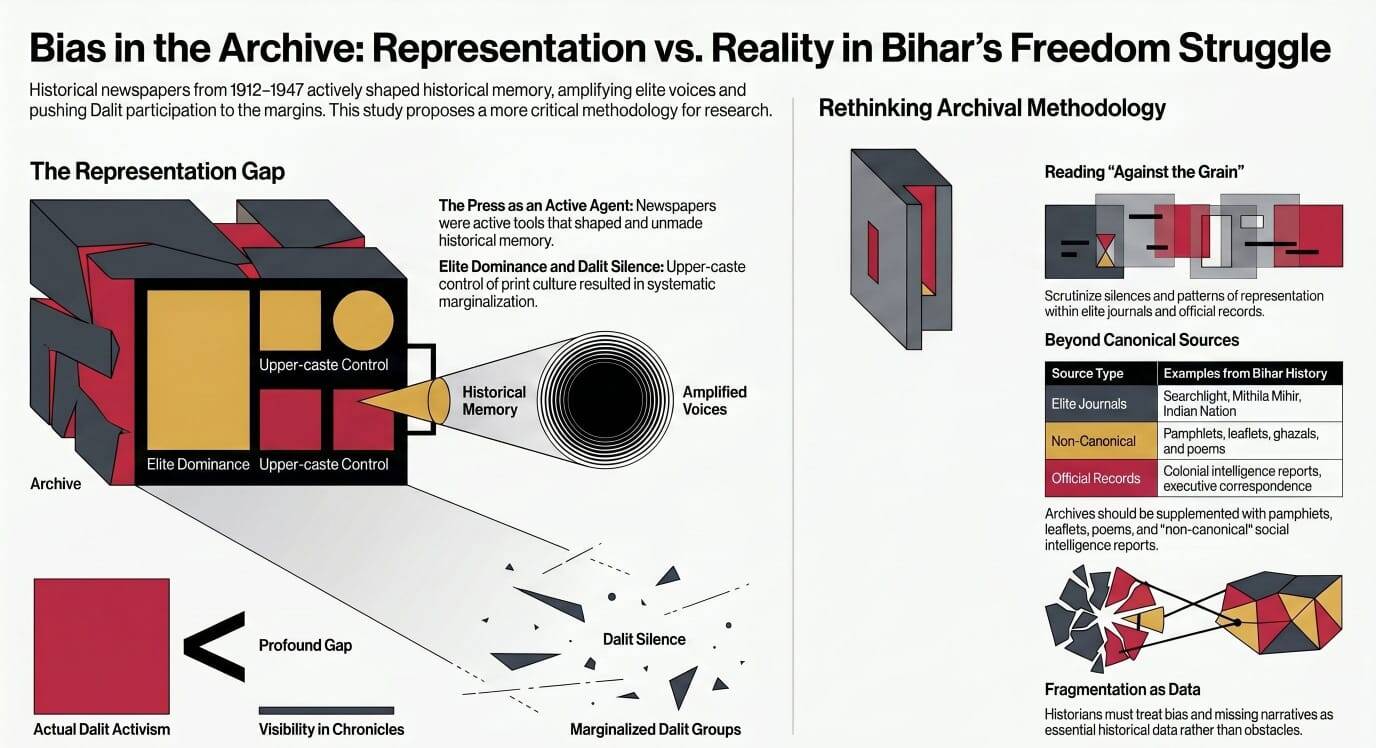
Rather than treating newspapers as neutral carriers of information, the historian approaches the press as an active agent in the making—and unmaking—of historical memory. It asks whose struggles were recorded, whose voices were amplified, and whose participation in the freedom movement was quietly pushed to the margins. At the heart of the project is the relationship between uppercaste dominated print culture and the lives of Dalit and other oppressed communities, including Dom, Bhangi, Halalkhor, Chamar, Dusadh, Mehtar and others. The fundamental fact that the archives are not gathered in the traditional meaning of the word by the establishing institution or organization—rather, they develop organically out of their operations and activities—is what makes press archives legitimate. Similar issues arise with colonial records, which Sabyasachi Bhattacharya (2019) refers to as colonial archives.
The official narratives of the national movement tend to foreground elite leaders and respectable middleclass politics; scattered traces suggest that marginalised communities were not passive observers. They organised, agitated, and responded to events in ways that rarely found sustained acknowledgment in mainstream newspapers or later historiography. True history writing therefore asks a set of linked questions: How were Dalit and “lower” caste actors represented in local and regional newspapers in Bihar during freedom struggle? When they appeared at all, were they portrayed as agents, as victims, or as problems to be managed? And how did the ownership and editorial control of these presses shape what could be said about them?
To address these questions, the one should examine a wide range of literary archival sources. These include local and regional papers such as Yuvak, Grihastha, Aryavarta, Rashtravani, The Behar Herald and The Beharee, as well as Motherland, Indian Nation, AlHilal, Mithila Mihir, Searchlight, Bihar Bandhu and others. Alongside these published sources, one also look colonial government archival records, intelligence department reports, pamphlets, leaflets, poems and ghazals. The period is also important and reflects how colonial archives themselves contributed to fixing certain images of Bihar and erasing others. The Indian Nation adopted a liberal nationalist approach but largely supported the interests of Bihar’s zamindars, often differing from the Congress on key issues without openly opposing it.
The period places particular emphasis on the period of Gandhian politics and the language of “Harijan uplift,” asking how this vocabulary affected the portrayal of marginalised communities in the Bihari press. By bringing together press history, caste studies and regional political history, the future research should aim to expose the gap between Dalit participation in the freedom struggle and its representation in both contemporary print and later historical writing in Bihar.


Rethinking the Archive
Unborn exploration must move beyond a narrow reading of elite journals and sanctioned records and borrow a purposely critical, multi-source archival methodology. First, indigenous and original journals both English and conversational should be read against the grain, paying close attention to silences, conceits, and patterns of representation. The question should n’t only be whether Dalit actors appear, but in what places agents, victims, objects of reform, or pitfalls to order.
Second, press libraries must be supplemented with social intelligence reports, executive correspondence, pamphlets, circulars, poems, ghazals, and othernon-canonical material that capture political exertion outside respectable public spheres. These sources help recover forms of mobilisation, resistance, and everyday politics that mainstream print culture frequently ignored or delegitimised.
Third, the language of reform, especially Gandhian expressions similar as “Harijan uplift” needs close scrutiny to understand how moral vocabularies shaped the visibility and architecture of marginalised communities in the public sphere. This requires sticking press converse within the broader political frugality of Bihar, including zamindari interests, Congress politics, and social propaganda strategies in the 1920s and 1930s.
Eventually, chroniclers must treat the archives itself as a literal subject. Rather than seeking a single, complete narrative, unborn work should admit fragmentation and bias as literal data. By combining press history, caste studies, and indigenous political history, similar exploration can bridge the gap between Dalit and women participation in the freedom struggle and its inadequate representation in both contemporary print and later historiography. In doing so, archives can be reimagined not only as instruments of authority, but also as spaces for critical recovery, ethical engagement, and literal justice.
Disclaimer
Views expressed above are the author’s own.
END OF ARTICLE