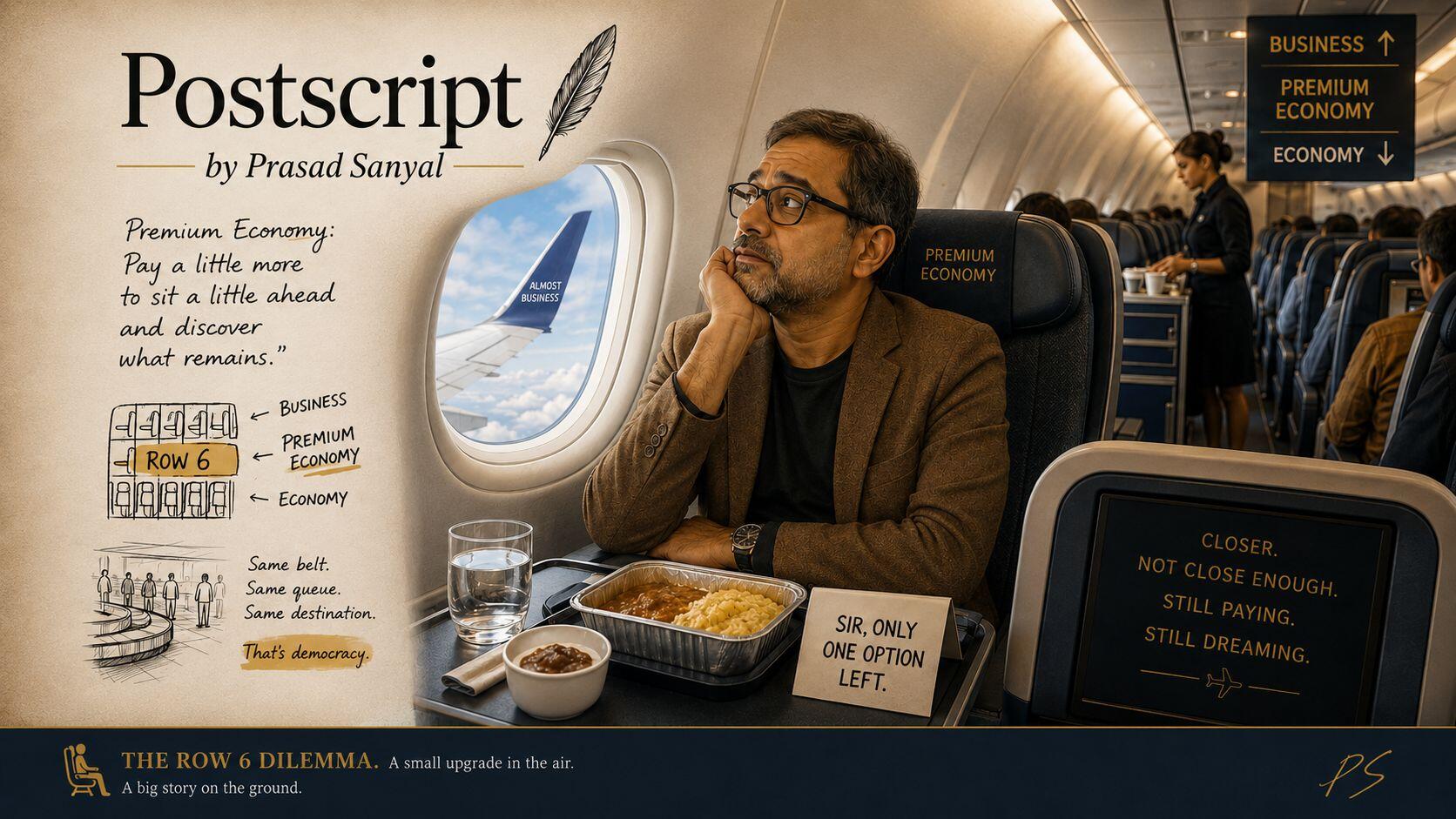
I found myself there recently on a domestic flight, staring thoughtfully at the seat in front and wondering whether Premium Economy might be the most Indian product ever invented. Not because it is especially good or especially bad, but because it captures, with remarkable precision, the story of an entire generation that has spent three decades upgrading itself one EMI, one credit card and one aspirational purchase at a time.
The name itself deserves admiration. Premium Economy. One imagines a room full of marketing executives bravely bringing together two words that have no natural business being in the same sentence. Premium suggests abundance, indulgence and a degree of excess. Economy is what happens when abundance has been rejected by finance. Putting the two together is rather like offering a diet gulab jamun, an exclusive airport lounge with a waiting line of two hundred people, or luxury studio apartments where the drawing room, dining room and bedroom maintain a cordial but intimate relationship with one another.
Yet the product survives because it understands something fundamental about modern India. We do not necessarily aspire to luxury. Luxury is expensive, often vulgar and occasionally difficult to explain to one’s spouse or accountant. What we aspire to is proximity to luxury. We like the feeling of being near it, seeing it, occasionally brushing against it. We may not have the sea-facing apartment, but we enjoy the glimpse of water visible if one leans sufficiently out of the balcony. We may not own the luxury car, but we are perfectly happy with the top-end variant of the sensible car. Premium Economy belongs firmly to this tradition. It is Business Class for people who still compare prices.
The trouble, of course, is that Indian aviation is now a highly efficient business conducted almost entirely inside narrow aluminium tubes. Whether one is flying on an Airbus A320neo or a Boeing 737 MAX, one is still essentially travelling through the skies in a remarkably sophisticated bus. The great domestic aviation story is now dominated by the enormous scale of IndiGo and the steadily expanding reach of Air India, both of which understand that there is only so much differentiation possible inside a flying cylinder. One can alter the seat pitch, change the upholstery and create a few new boarding groups, but there are limits to what can be achieved without physically enlarging the aircraft.
This is where Premium Economy becomes fascinating. The seat is indeed larger. The legroom is undeniably better. For a tall traveller, these things matter. Yet one cannot escape the sensation that the product has been designed less as a class of travel and more as a state of mind. You board slightly earlier, but not so early that anyone notices. You are close enough to Business Class to observe its rituals, which may be the cruellest feature of the entire arrangement. The people in front of you are having a genuinely different experience. You, meanwhile, are enjoying a superior view of that experience.
The true theatre begins when the food trolley emerges.
Now, food occupies a sacred place in Indian civilisation. We are among the few people capable of discussing lunch while eating breakfast and making dinner plans before lunch has concluded. Entire family disputes have begun over less consequential matters than the quality of a fish curry. It is therefore inevitable that the deepest flaw in Premium Economy reveals itself through catering.
The trolley starts somewhere ahead. The first few rows inspect the options with the seriousness of a parliamentary committee reviewing a national policy. One passenger requests chicken, another paneer, a third wishes to know whether there might be something else available, while a fourth appears determined to conduct an independent audit of the inventory. As these negotiations continue, the traveller in Row 6 watches events unfold with the growing anxiety of a shareholder observing a market correction.
By the time the trolley finally arrives, the menu card has usually completed its transformation from a document of choice into a work of historical fiction.
“Sir, only one option left.”


At that moment, the entire philosophy of Premium Economy reveals itself. A menu implies agency. This is not agency. This is notification. The cabin crew are no longer asking what you would prefer to eat. They are informing you what fate has already decided.
The irony, particularly on certain carriers, is exquisite. Having paid extra for the privilege of travelling in Premium Economy, one often discovers that the principal premium feature is being among the last passengers in the forward cabin to discover what food remains. The distinction between Premium Economy and Economy begins to resemble the distinction between being mildly disappointed and being moderately disappointed.
And yet people continue to buy it, because Premium Economy is not really selling comfort. It is selling aspiration. Airlines understand something that property developers, automobile manufacturers and credit card companies discovered long ago: people will happily pay a little extra to feel that they are moving forward, even if the actual distance travelled is only three rows.
The greatest joke arrives after landing. Business Class passengers stand up. Premium Economy passengers stand up. Economy passengers stand up. The carefully constructed hierarchy collapses with astonishing speed. Everyone crowds the aisle. Everyone waits impatiently for the doors to open. Everyone gathers around the same baggage carousel, staring accusingly at a conveyor belt that appears to operate according to principles unknown to science. The gentleman in Row 31, who paid significantly less and spent the entire flight watching downloaded episodes of a crime thriller, reaches the taxi queue at exactly the same time as the passenger from Row 6.
For a brief and beautiful moment, Indian democracy is restored at thirty-five thousand feet and remains intact until the airport exit.
I have stopped thinking of Premium Economy as an airline product. It is a metaphor. It is a small, upholstered reminder of how much of modern life consists of paying slightly more for the reassuring sensation of being slightly closer to something better. Not close enough to transform the experience, certainly not close enough to qualify as luxury, but sufficiently close to keep the dream alive. And perhaps that is the most Indian thing about it. We are a civilisation that has always understood the value of hope. Airlines, it turns out, have merely found a way to charge for it by the row.