The eastern part of Odisha is developed and holds regional significance. In the present decade, other regions appear to have gained some significance. This article aims to highlight the changes observed in the other parts, particularly Western, over the present decade, contrasting with previous years.
Introduction
In any state, it may not be realistic to expect all regions to develop uniformly. However, it becomes a matter of grave concern when regional disparities are stark and severe. Some regions remain far more advanced; some remain at the distant last, and some in between. Odisha, as a state, suitable exemplifies this situation where regional disparity is disgracefully evident and unusually frightening. The coastal region, comprising around one-fourth of the state, broadly identified as the eastern part, is the most developed region. The remaining three-fourths of the state is largely backward and underdeveloped. Notably, the rest of Odisha could also be divided into two categories in terms of development. This article, in this context, seeks to highlight some of the changes that appear to have occurred in the rest of Odisha, in general, and Western Odisha, in particular, in the present decade, as distinct from those of the earlier one.
The disparity
The regions outside the eastern part of Odisha are often overlooked. In crucial development metrics—such as poverty levels, debt-induced migration (Dadaan), literacy, life expectancy, malnutrition, and overall standard of living—the rest of Odisha falls significantly behind. The situation is such that some government employees posted to certain parts are sometimes called ‘punishment postings’. This neglect is evident across various domains, including political representation, ministerial berths, and the number of people occupying government offices or important positions. Similarly, there is a severe disparity in terms of the development of physical infrastructure. All major and crucial educational institutions and health facilities are established in Bhubaneswar or Cuttack. It won’t be an exaggeration to say that the dream of higher education will not be realised for a student from the rest of Odisha without studying in Bhubaneswar. Similarly, the survival of a patient is not possible without getting treatment in Bhubaneswar. The same applies to the judicial service. A court case may not be resolved without visiting Cuttack. This dynamic creates a perception that Odisha is synonymous with Bhubaneswar or vice versa. The marginalisation is not confined only to economic, political, or infrastructural development, but also to culture and language.
The enduring pattern of regional disparity for decades raises critical questions about policy formulation, and its implementation aimed at developing underprivileged areas. It continues, possibly, because the political leadership fails to raise the issues, or, even if raised, fails to have them sincerely and sympathetically heard and resolved. Issues often go unaddressed because political leadership is primarily based in the eastern region. Consequently, residents of the rest of Odisha feel sidelined by a persistent lack of attention to their needs and concerns.
Appearance of change
Despite the ongoing regional disparity, a sign of change has been noticed, particularly in the present decade or a little earlier. Although less pronounced, the rest of Odisha appears to get some significance.
The following developments help unravel the changes:
- An Indian Institute of Management (IIM) has been established in Sambalpur, breaking the trend of reputed educational institutions being centred in Bhubaneswar.
- The first Skill India Centre (SIC) was inaugurated in Sambalpur in 2024 by Union Minister Shri Dharmendra Pradhan, underscoring a commitment to skill development in the region.
- Odisha previously had only one airport in Bhubaneswar; however, Jharsuguda Airport became operational in 2018, along with others in Utkela (Kalahandi) and Rourkela, showcasing improved air service infrastructure. Similarly, there is no neglect of the development of other infrastructure, such as roads and railways, at present, as compared to earlier.
- The first ethanol biorefinery plant of the country, sanctioned to be established in Bargarh in 2018, has been operationalised in 2026. It benefits the farmers of adjoining districts such as Bargarh, Sambalpur, Sonepur, and Balangir.
- Since 2018, the Odisha Rajdhani train runs weekly, passing through the central and a larger part of Odisha (Dhenkanal, Anugul, Sambalpur, Jharsuguda and Rourkela), providing residents with the opportunity to experience the premium Rajdhani train travel.
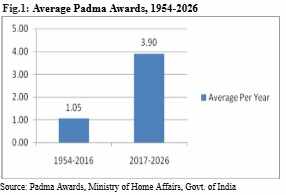
- The recent trend in Padma awardees from Odisha illustrates a significant increase in recognition (see Figs. 1 and 2). What is also true is a larger decentralisation of the awardees across the regions of Odisha earlier concentrated certain parts.


- Similarly, historical research on other regions and its personalities are being promoted, including extensive research and publications of books (on Kudopli) on the life and contributions of Veer Surendra Sai.
- Books in the Kuui and Desia tribal languages were launched in Bhubaneswar in 2023 by the Union Education Minister Shree Dharmendra Pradhan and Finance Minister Smt. Nirmala Sitharaman.
- Mahima Dharma, and the philosophical legacy of its renowned saint-poet, Bhima Bhoi, is being promoted by opening dedicated Bhima Bhoi Chairs and research centres at University of Delhi, Central University of Odisha and Guru Ghasidas Vishwavidyalaya. The Honourable Education Minister has also urged the UGC to include Mahima Dharma philosophy in undergraduate and postgraduate courses.
- Eminent Koshali literary figure Sri Haldhar Nag was honoured with the Padma award in 2016, marking cultural acknowledgement.
- Three eminent personalities, Shri Jitendra Haripal, Smt Krishna Patel (singers) and Sri Mitrabhanu Gountia (composer) of the popular Sambalpuri song ‘Rangabati’ were awarded with Padmashree in the years 2017, 2023, and 2020, respectively.
- ‘Rangavati Centre of Excellence in Cultural and Sustainable Management’ at IIM Sambalpur was inaugurated by the Union Minister for Education, Shri Dharmendra Pradhan, in the year 2024, aiming at the preservation of the art, literature, culture, and history of Western Odisha, with a special emphasis on textiles.Conclusion
It may have been the beginning of the change, but it remains promising as it acknowledges long-overdue recognition for the rest of Odisha and Western Odisha. It’s important to acknowledge that this enhanced recognition is not coincidental; it stems from central government initiatives and the sensitivity of leaders who represent and advocate for these regions. Continued attention and action are vital to sustain and build upon these developments.


Disclaimer
Views expressed above are the author’s own.