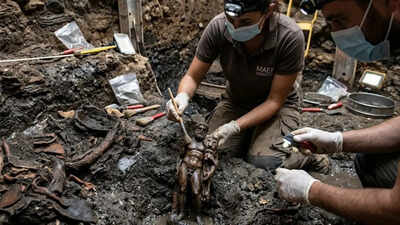

Archaeological investigations carried out along the sun-kissed shore of Ibiza before building work have uncovered something of great importance: an ancient 2-millennia old wooden statue of the legendary hero Hercules. The 30-centimetre-tall statue was found about 7 metres underground inside an ancient waterlogged pit. Because organic objects such as wood decompose rapidly in a Mediterranean climate, there shouldn’t have been any wood left after 2,000 years. However, this grain silo had no oxygen because it was left open to the rain and had a muddy environment after it was abandoned. This incredible discovery provides an extraordinary insight into the Roman time period when Ibiza was known as Ebusus and illustrates how strongly the spiritual or cultural aspects of Greco-Roman mythology affected the lives of ancient people on the island.
Archaeologists uncover Hercules statue in water-filled pit in Ibiza
According to the research published in Ancient Origins, in the centre of Ibiza Town, archaeologists found the figurine in a sealed water-filled pit. The statue shows a strong person with the recognisable lion skin on their left shoulder, which is typical of the hero Hercules. The size of the statue is about 30 centimetres high. Some leather pieces and plant remains were found together with the figurine in the pit, providing the information that the pit served as a place for domestic waste or storage before being sealed.
How mud saved the statue
Underwater conditions are extremely rare for the preservation of wood in archaeological contexts and require unique ‘anaerobic’ (oxygen-free) conditions. According to conservation standards for organic materials, some fungi and/or bacteria that will usually destroy wood cannot grow in waterlogged conditions. The pit was sealed with layers of mud and water, and the wood was kept in a liquid, saturated state for 2,000 years, thus preserving its physical shape.
Evidence of Roman influence in Ebusus
Ibiza, known to the Romans as Ebusus, was an important link on the Mediterranean shipping routes. Following the Second Punic War, Ebusus made the transition from Carthaginian to Roman influence. The existence of the Hercules figurine shows the integration of Roman religion and the idolization of heroes into the everyday lives of the people of Ebusus during the 1st or 2nd century BC.
High-tech treatment protecting Ibiza’s 2,000-year-old discovery
At the present time, the Archaeological Museum of Ibiza and Formentera (MAEF) is where the statue is located. To conserve the statue, there must be a complex procedure in replacing the water in the wood cells with stabilising agents such as Polyethene glycol (PEG), so that the wood will not shrink or disintegrate as it dries out. This is necessary to protect the integrity of the statue before it can be exhibited to the public.