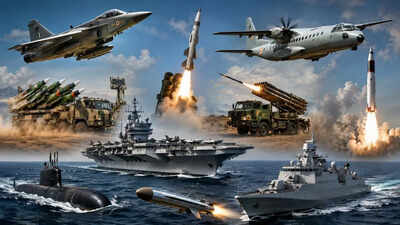

NEW DELHI: India’s defence production has more than doubled in five years to touch a record Rs 1.78 lakh crore in FY 2025-26, marking a major milestone in the country’s drive towards military self-reliance. As New Delhi celebrates the achievement, Prime Minister Narendra Modi on Tuesday highlighted the evolution of India’s indigenous defence ecosystem by resharing a MyGovIndia post showcasing key weapons platforms and strategic systems developed or inducted over the past decade.The ministry of defence earlier announced that defence production had risen 15.6% from Rs 1.54 lakh crore in FY 2024-25 and more than doubled from Rs 84,643 crore in FY 2020-21. Indigenous defence manufacturing has nearly quadrupled from Rs 43,746 crore in FY 2013-14, reflecting the government’s push for Aatmanirbhar Bharat in the strategic sector.Sharing the thread, MyGovIndia said: “The future belongs to nations that invest early in capability, technology, and resilience.India’s defence journey over the last 12 years offers a compelling example of this principle in action. Across air, land, and naval domains, India has expanded indigenous capabilities, advanced strategic technologies, and accelerated its journey towards self-reliance.Read the full thread to discover how India strengthened its defence ecosystem, enhanced strategic capabilities, and built a stronger foundation for a self-reliant and future-ready nation.”The thread highlighted a series of major platforms that now form the backbone of India’s defence stack.
Tejas: India’s indigenous fighter programme comes of age
The Light Combat Aircraft Tejas has emerged as one of the most visible symbols of India’s indigenous aerospace ambitions.Developed by Hindustan Aeronautics Limited (HAL), the fighter demonstrated India’s ability to design, develop and manufacture a modern combat aircraft. With the Indian Air Force already operating Tejas Mk-1 fighters and preparing for large-scale induction of Tejas Mk-1A aircraft, the programme has become the foundation of India’s indigenous combat aviation ecosystem.The development of the larger and more capable Tejas Mk-2 and the fifth-generation Advanced Medium Combat Aircraft (AMCA) is expected to further strengthen domestic aerospace capabilities.
Akash : Building an indigenous air defence shield
The Akash surface-to-air missile system has become a key pillar of India’s layered air defence network.According to MyGovIndia, “The Akash missile system has emerged as a key pillar of India’s air defence architecture.Operational with the armed forces and gaining international interest, it showcases India’s growing defence capabilities. The next-generation Akash-NG further enhances performance with faster reaction times, improved target tracking, and stronger interception capability.”The Akash family now forms an important component of India’s efforts to build a multi-layered air defence shield against aircraft, drones and cruise missile threats.
Pinaka : The artillery force multiplier
India’s indigenous Pinaka multi-barrel rocket launcher system has transformed the Army’s battlefield firepower.Developed to provide rapid, high-volume fire support, Pinaka has evolved through multiple variants with increased range and improved accuracy.MyGovIndia noted: “Pinaka has transformed India’s artillery capabilities with its mobility, precision, and indigenous design. Developed to deliver rapid and effective battlefield support, the system has continuously evolved with enhanced range and strike accuracy. Today, Pinaka stands as a key pillar of India’s modern artillery strength.”The system has increasingly replaced imported artillery rockets and is also attracting export interest.
Agni-V: Strengthening strategic deterrence
India’s long-range Agni-V ballistic missile marked a major step forward in strategic deterrence.The recent successful testing of Multiple Independently Targetable Re-entry Vehicle (MIRV) technology significantly enhanced its capability by enabling a single missile to carry multiple warheads aimed at separate targets.MyGovIndia said: “Agni-V marked a major milestone in India’s strategic defence capabilities. With the successful testing of Agni-V equipped with MIRV technology, a single missile can carry multiple warheads aimed at different targets. This achievement places India among a select group of nations with this advanced capability, strengthening India’s strategic deterrence.”
Suryastra and India’s hypersonic ambitions
India’s successful hypersonic missile technology demonstration represented one of the country’s most significant technological breakthroughs in recent years.Hypersonic systems travel at speeds exceeding Mach 5 and are considered among the most advanced weapons under development globally.According to MyGovIndia: “India’s successful hypersonic missile technology test marked a major milestone in strategic defence capability.This breakthrough places India among a select group of nations shaping the future of advanced warfare technologies.”The technology is expected to underpin future long-range precision-strike weapons.
INS Arihant: Completing the nuclear triad
The induction of INS Arihant fundamentally transformed India’s strategic deterrence posture.As the country’s first indigenously built nuclear-powered ballistic missile submarine, Arihant completed India’s nuclear triad by providing a credible sea-based deterrent capability alongside land- and air-based nuclear forces.MyGovIndia said: “The induction of INS Arihant marked a historic milestone in India’s strategic defence journey. By completing the nuclear triad, India gained credible sea-based nuclear deterrence alongside land and air capabilities. This significantly strengthened the nation’s second-strike capability, enhanced strategic stability, and reinforced India’s long-term security architecture.”
INS Vikrant: India’s aircraft carrier club entry
The commissioning of INS Vikrant showcased India’s growing naval shipbuilding capability. As India’s first indigenously designed and built aircraft carrier, the vessel serves as both a strategic asset and a symbol of technological achievement.MyGovIndia said: “INS Vikrant represents the rise of India’s indigenous shipbuilding capabilities. As the country’s first indigenous aircraft carrier, it serves as a floating airbase and a symbol of technological achievement. Its induction places India among a select group of nations capable of designing and building aircraft carriers.”
Nilgiri-class frigates and naval modernisation
India’s maritime modernisation efforts have accelerated through indigenous warship programmes such as the Project 17A Nilgiri-class stealth frigates and Project 15B Visakhapatnam-class destroyers.The Nilgiri-class are advanced stealth frigates designed for anti-air, anti-surface and anti-submarine warfare missions.According to MyGovIndia, “India’s naval modernisation has accelerated through indigenous platforms such as Project 17A stealth frigates, Project 15B destroyers, and Kalvari-class submarines. These advanced systems have strengthened maritime security, air defence, anti-submarine warfare, and underwater combat capabilities across strategic waters.”
BrahMos and the missile ecosystem
India’s missile development programme has expanded beyond a single platform into a broader ecosystem of advanced weapons.MyGovIndia highlighted the progress made across missile programmes, stating: “From the globally acclaimed BrahMos missile to Astra and Rudram, India has built a robust indigenous missile ecosystem.These systems have enhanced strike capability, beyond-visual-range engagement, and anti-radar operations, reinforcing India’s position as a growing force in advanced defence technologies.”The BrahMos supersonic cruise missile, jointly developed with Russia, remains one of India’s most successful defence exports and operational strike systems.
C-295: Building an aerospace manufacturing ecosystem
The C-295 transport aircraft programme represents a major shift in India’s defence manufacturing strategy.Produced in partnership between Airbus and Tata Advanced Systems, the programme is establishing India’s first private-sector military aircraft production line.According to MyGovIndia, “The C-295 programme marks a new chapter in India’s aerospace journey. Beyond enhancing tactical airlift capabilities, it is helping build a robust domestic manufacturing ecosystem, expanding private-sector participation, and strengthening indigenous aviation expertise, reinforcing the vision of an Aatmanirbhar defence industry.”
Record production and exports
The showcase of India’s growing defence stack comes as the country records its highest-ever defence production figures.Government data shows defence public sector undertakings and public sector units accounted for around 76% of total production in FY 2025-26, while private sector participation reached a record 24%, contributing nearly Rs 42,000 crore.India also recorded defence exports worth Rs 38,424 crore during the fiscal year, another record high.Taken together, platforms ranging from Tejas and Akash to Arihant and Vikrant illustrate the scale of India’s transformation from a predominantly import-dependent military power into a country increasingly capable of designing, building and exporting advanced defence systems across air, land and sea domains.