In 1959 William Archer published his classic work, India and Modern Art, which traced the growth of the modern movement in Indian art. In this work Archer discussed four artists whom he felt embodied the face of Indian Modernism in the 20th century. Alongside Rabindranath Tagore, Jamini Roy and Amrita Sher-Gil, he also featured George Keyt. Archer included Keyt because he believed that he was essentially Indian in spirit, attitude and culture. As such, he was “entitled to be termed a modern Indian artist.”
The work of George Keyt is remarkable. As we look at the untitled sketch on page 17 of the introduction of the book by Dr. SinhaRaja Tammita-Delgoda, we are met with an originality and dynamism, which brings together a host of cultural influences reminiscent of ancient Sri Lankan art and India, all fused together in a brilliant artistic mind and put forward with remarkable ease and simplicity. Here we have a vision which has imbibed the beauty of eyes seen at Ajanta and at the Sigiriya Caves of Sri Lanka; a style which is familiar with medieval Indian miniature paintings, one that has seen the work of the Bengal School of the early 20th century and, above all, a boldness of direct expression which reflects the very best of modern art. Truly a work of genius which can inspire us today. As Mark Twain said, successful oratory may have in its foundation the words of a thousand people gone before. Similarly, here we see an artistic expression which carries a heritage of the past, transformed and living in its present. A truly fine example to understand that the genuine continuation of tradition is originality and not copying.
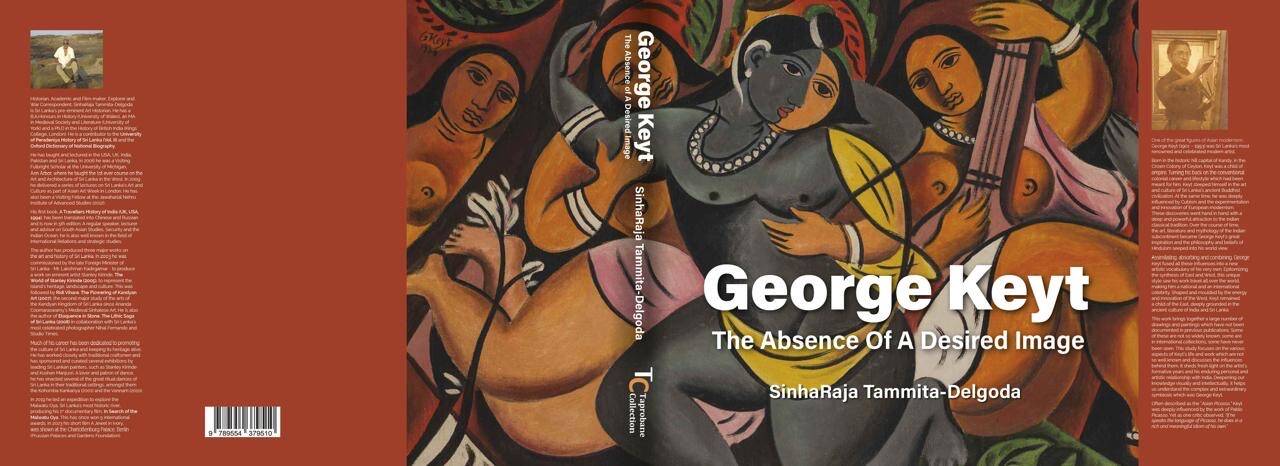
I am looking through a splendidly-brought out book, lavishly illustrated on art paper in large format by the Sri Lankan publisher The Taprobane Collection. The book entitled ‘GEORGE KEYT The Absence of a Desired Image’ by SinhaRaja Tammita-Delgoda, covers the complexity of the subject assiduously and with passion and runs into 464 pages. The writing is excellent and the author has a deep affinity with the subject, as he belongs to the country and milieu in which this art was created. Historian, Academic, Film maker and Explorer, Dr. SinhaRaja Tammita-Delgoda is a pre-eminent art historian of Sri Lanka. Much of his distinguished career has been dedicated to promoting the culture of Sri Lanka and keeping its heritage alive. He has also been a deep scholar of Indian art and heritage and the reviewer has been aware of Tammita-Delgoda’s penetrating exploration of the sharing of cultural heritage between India and Sri Lanka. Therefore, Tammita-Delgoda is well-qualified to bring us an insider’s view of the life and art of one of the greatest painters of Sri Lanka in the 20th century.


The well-modulated and richly-descriptive prose of the author takes us on a journey, not only of the life and evolution of the painter, but also through the tapestry of cultural influences of colonial and post-colonial Sri Lanka. This is fascinating for the Indian reader and is very reminiscent of the cultural awakening of Indians in the 20th century.
The earliest influences on Keyt were English literature and poetry. He was a voracious reader and expressed himself often and eloquently through his own poetry. Then came the transforming chapter of his life, when he befriended the Buddhist monk Ven Pinnawela Dheerananda, who became his mentor and guide. This was the opening of a huge door, through which Keyt was able to imbibe and immerse himself in the historic culture of Sri Lanka and the great philosophic heritage of Buddhism. His earliest art was sketches published in the Buddhist Annual of Ceylon. The dynamic confluence of artistic traditions in Keyt’s work is already seen here in these sketches. We see the gentleness and fluid lines coming from the Buddhist tradition, shaped by a sensibility which is contemporary and modern. For the most part, the art is minimalistic and the focus is on a very clear expression of the themes. The graceful and often undulating lines are unforgettable. The tress and foliage appear to have a life of their own, as seen in the art of Ajanta, Pahari miniatures and in the sculptural relief of Sanchi. Already, in the 1920’s, Keyt was an artist spanning the heritage of a vast geography, with energetic originality. These illustrations in the Buddhist Annual of Ceylon gave new life to these ancient themes.
Keyt was an ardent admirer of the Indian intellectual giant Rabindranath Tagore, as well as of the Bengal School artists Abanindranath Tagore and Nandlal Bose. He had even successfully taken admission to Shantiniketan, the university founded by Rabindranath Tagore. Unfortunately, his father did not allow him to join there. However, we see the unmistakable influences of the Bengali painters and thinkers of that period. In fact it is wonderful to see the shared journies and directions of art of the painters across these vast geographical distances.
Tammita-Delgoda writes with understanding and empathy. His mellifluous words lead us on an enchanting journey into the world of Keyt. We are shown how Ananda Coomaraswamy created a movement in Sri Lanka of the revival of interest in Sri Lanka’s ancient art and culture. Keyt was among the many who were deeply inspired by Coomaraswamy’s writings. It was felt that the colonial experience had led to an ignorance and forgetting of the indigenous art of living and knowledge of Sri Lanka’s artistic heritage. A direct relationship with ancient art was encouraged in an attempt to revitalize fading artistic and philosophic traditions.
There was magic in Keyt’s encounter with the paintings of Sigiriya. From the 1930s onwards, we see the development of his deeply personalized style in art, which would last across the decades to come and would provide works which were modern and individualistic, yet rooted deeply in his responses to the marvellous 5th century paintings of Sigiriya. The confident, clear and curving lines which Keyt saw in the Buddhist murals continue in his work and display a continuation of a great inheritance coming from Ajanta and Sigiriya, right across the 20th century. Keyt had seen Sigiriya first, but the eyes he depicts take us right back to the most sensitive depictions of eyes in the world, which is seen at Sigiriya and at Ajanta. There is oft-times a tenderness in the looks and glances which he paints and an inward look which takes us far from the noise and clamour of the material world. There is a strong line which curves through these works, which provides a strength and optimism and a lyrical grace. Keyt is a rare artist who presented the living tradition of Ajanta in the 20th century. To Tammita-Delgoda goes the credit of highlighting so well and clearly bringing before us this artist, through his wonderful book.
It was Keyt’s closest friend, renowned photographer Lionel Wendt, who, more than anyone else, urged Keyt to paint. It was also Wendt who introduced Keyt to the latest developments in art and literature around the world and modernism. All this was combined with Keyt’s experience of living in rural Sri Lanka, which was far removed from the westernized milieu of urban Sri Lanka. The result is a magical confluence of artistic impulses coming from a wide range of roots. In his many studies of rural life there are two elements which stand out the most. One, there is a combination of languid grace and curving line (which connects the gentleness of ancient art with modernity) and the angular abstractions which convey a vitality and energy. Here we are reminded of the medieval idiom of painting in India and the dynamic abstractions of Jaina manuscript paintings. (Interestingly, the well-known protruding farther eye of these manuscript paintings is also sometimes seen in Keyt’s work.) Second, with all the vibrancy of lines, the focus is on the stillness of the look, which is often turned inwards and takes us into the depth within. It is an active and energetic world of the intellect, yet deeply connected to the finding and transmitting of the peace within. Keyt uses his experience of village life to convey the vibrant landscape of his being.
Modernism was sweeping European painting and with the help of the Lionel Wendt, Keyt was exposed to new movements in art. He saw and greatly appreciated the work of Picasso, Braque, Matisse and Derain.
As Keyt said in 1937: “Art arranges again with shapes and spaces, uses colour in measurements in order to emphasize design and infuse more life, and creates generally an organization which gives an importance and an independent existence to the particular things of life which are depicted”. Tammita-Delgoda writes: “The theories of modernism provided George Keyt with a series of stepping stones, giving him the opportunity to explore and to experiment, to innovate and to reinvent. Keyt did not avoid these stepping stones. For him, they were merely markers, which enabled him to learn and to grow. They gave him the opportunity to formulate his own visual language and go his own way”.
Keyt was strongly individualistic. Unlike Picasso and Braque, he remained passionate about his lines and forms. Sinuous lines continued to move through his art and his love for human form remained a preoccupation. These are the elements of Keyt’s work which make him stand apart.
Tammita-Delgoda takes us not only through the life and work of Keyt, but also into the realm of a nation breaking out of a deep forgetfulness of its own culture, owing to the shroud of colonialism. We see the development of a National art movement which is also modern in outlook. Keyt’s contribution in shaping this trend in art is most significant, as he is, more than his contemporaries, the one artist who deeply imbibed the historic culture of his land. As Tammita-Delgoda writes: “What made George Keyt exceptional was that he went out of his way to break with his colonial inheritance. Overcoming his own inherited compulsions, he was able to penetrate the core of Sri Lanka’s social and cultural fabric. This gave him the understanding and the grounding to rediscover the roots of his society.
Crossing the boundaries of alienation, Keyt was able to find a new truth and forge a relationship with his environment. This endowed his work with the enduring relevance which exists to this day.”
In the latter part of his career, Keyt spent much time in India and steeped himself in the deep philosophy and exquisite mythology of Hinduism. He was profoundly moved by the dance, music, literature and art of India. Keyt travelled extensively in the sub-continent and visited the temples of Madurai, Thanjavur, Mamallapuram, Khajuraho, Bhubaneshwar, Konark, the museum at Mathura and the historic site of the battle of Mahabharata at Kurukshetra.


In the words of Tammita-Delgoda: “Although it is clear that he had adopted Modernism to reinterpret the human form, Keyt was also very aware that the art of distortion and exaggeration was deeply embedded in Indian art.” The sculptures on the walls of Indian temples celebrated the human form and provided Keyt with vibrant subjects for his favourite theme of feminine representations. In ancient and medieval Indian artists, Keyt had found kindred souls, who had given up mere optical realism, to present the movement and beauty of the human body with utter freedom and graceful liberties. In masterly works such as ‘Serenade’ (1992) Keyt fuses the themes of Indian mythology with his innate quality of gentleness, transporting us to a world of the spirit, full of depth and lyrical expression.
It is widely believed that after his return from India, Keyt was so completely taken over by Indian art and culture that he discarded everything else. This is evidently not the case. Sinhala culture clearly was a strand which remained embedded within him. It was a manifestation of the man he had become. Whatever path he chose to pursue, he could not and did not set it aside. Keyt did not change the man he had become, he merely acquired more layers.
Keyt gave a shape and a voice to a need which resonated with the aspirations of India in the 1940s. In this way, he provided direction and inspiration to both Sri Lankan and Indian Modernism and art. Although Mulk Raj Anand rubbed shoulders with the greatest Indian artists of his time, it was Keyt who he asked to represent the genius of Indian heritage through the centuries. To portray his friend’s vision in his book ‘The Story of India’ (1949), George Keyt travelled through the history, the art and the culture of India from the earliest beginnings to modern times. The range, the detail and the sheer diversity of the illustrations made by Keyt underline just how deeply a part of the Indian tradition he had become. This was the work of a man who was “essentially Indian” in his attitudes and his outlook”. (W. G. Archer, quoted in ‘GEORGE KEYT The Absence of a Desired Image’)


In the years after his stay in Mumbai, Keyt’s work had become embedded in the Indian vision. In New Delhi newspapers, Keyt was hailed as a product of the Indian tradition. The Statesman wrote that “Underneath the formal elements of his work, there lurks the eternal Indian”. To many, Keyt’s inspiration and his subjects were the very embodiment of India’s culture. They felt that his rich colour was “rooted in the Indian soil;” his style was based in her sculpture and folk art. The world and vision of George Keyt is brought alive in the excellent writing of SinhaRaja Tammita-Delgoda, whose book will be an enduring bridge of cultural understanding between the people of India and Sri Lanka.
Coming away from a work of George Keyt, one is left with a vision of eyes: eyes that are deep, thoughtful and invite you to a journey within. This is the hallmark of the spirit and the finest art of South Asia.
Disclaimer
Views expressed above are the author’s own.
END OF ARTICLE