There’s a pattern here — and it’s not about what Donald Trump said. It’s about how we react every single time someone outside says something unflattering about India.
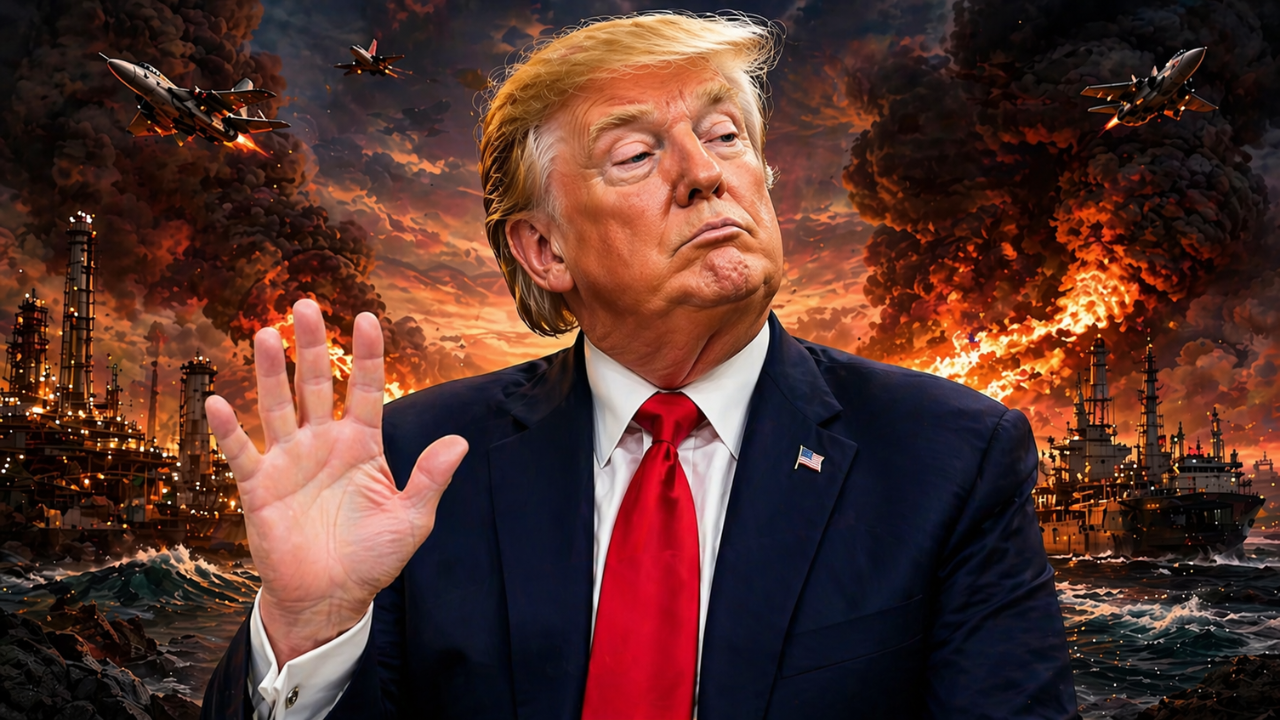
Let’s get the facts right first. Trump didn’t actually call India a hellhole. He reposted a transcript of remarks made by Michael Savage — conservative commentator, Newsmax fixture — who said that a baby born in America becomes an instant citizen and then brings “the entire family in from China or India or some other hellhole on the planet.” Trump amplified it. He did not author it. The distinction matters, though it is admittedly a thin one given that a president’s repost is not a casual act.


But let’s also be honest about what kind of actor we are dealing with. Trump may not fully register the import of what he copy-pastes from a MAGA commentator. The impact may simply not dawn on him — because a sense of entitlement of that magnitude tends to crowd out everything else, including consequence. What he does understand, instinctively and completely, is the choreography of flattery. Mollycoddle him enough. Convince him he’s the boss and you’re the grateful minion. And he will shower you with warmth and public affection. Exhibit A: General Asim Munir and Prime Minister Shehbaz Sharif, who played that script with considerable finesse and walked away with a diplomatic win. One need not begrudge them the result — but one should be clear-eyed about the method.
Which makes our outrage even more puzzling. We are offended by a man who wasn’t really paying attention — while simultaneously watching others who were paying attention, and playing accordingly.
But look at what followed.
Outrage. Wall-to-wall. Political statements. Media debates. Social media indignation. And then, almost predictably, the United States Embassy stepping in, clarifying, softening, reminding everyone that Trump has called India a “great country” and shares a “strong relationship” with Narendra Modi.
That sequence itself tells you something deeper than the remark. It tells you that what we are seeing is not a civilisational trait, but a reaction loop driven by our political class, media cycles, and social media amplification. We mistake that noise for national sentiment.
A truly self-confident nation doesn’t swing between outrage and reassurance. It doesn’t need diplomatic firefighting to feel respected. It doesn’t amplify every stray remark into a national insult. The issue is not that we react — it’s that we react reflexively, loudly, and without calibration.
Every overreaction reinforces a different perception — that we are sensitive, reactive, and constantly seeking approval.
And this instinct — to be seen, to be acknowledged — shows up in how we view geopolitics as well.
Look at the current churn in West Asia. Pakistan positions itself as a peacemaker in the US-Iran equation, engages diplomatically at the highest levels, and secures visibility. The immediate reaction here: why isn’t India doing the same?
Why should we?
Geopolitics is not a performance sport. Nations act based on interests, leverage, and timing — not optics. India made a choice. She has her own compulsions. Pakistan, by contrast, had its own compulsions — Hormuz disruptions hitting its fuel costs, remittance concerns from Gulf-based workers, a restive western border. These are Pakistan’s drivers. Ours are different.
It is also structurally entangled in the conflict in ways India simply is not. Islamabad has a formal mutual defence arrangement with Saudi Arabia, under which aggression against the Kingdom can draw Pakistan in. At the same time, it maintains working ties with Iran and has to manage that long land border and relationship carefully. That is not strategic flexibility — that is strategic pressure.
Which means Pakistan’s push for peace is not just diplomacy — it is self-preservation.
If Pakistan’s efforts help stabilise the region, India benefits anyway — our oil imports ease, our energy costs stabilise, our Gulf trade breathes again. That Pakistan gets the diplomatic credit is irrelevant to our material interests. That’s how mature statecraft works — you don’t need to be at the centre of every frame to gain from the outcome.
But our instinctive reaction? FOMO.
Watch how major powers behave. China says nothing about being left out of negotiations. European powers don’t erupt into outrage cycles every time a leader says something provocative. They calibrate. They choose when to engage, when to ignore, and when to respond firmly.
Which is why, in this instance, the government’s response — or rather, the deliberate absence of it — is the most telling thing of all.
Stay quiet.
Observe.
Engage only when it serves a purpose.
That’s not weakness. That’s control. Not every comment deserves a counter. Not every provocation needs amplification. Not every stage is ours to occupy. We don’t need to be the khalifa of every issue — we need to be clear about which issues matter to us, and act accordingly.
Right now, the real question isn’t what Trump said — or what Pakistan did.
It’s why we still let it matter this much.
Until we learn to distinguish between noise and national interest, this cycle will repeat — provocation, outrage, clarification, brief relief.
A country of our scale should not be this easily provoked — or this easily pacified.
We are not a “hellhole.”
But at times, we behave like a country still waiting to be told that we aren’t.
Disclaimer
Views expressed above are the author’s own.
END OF ARTICLE