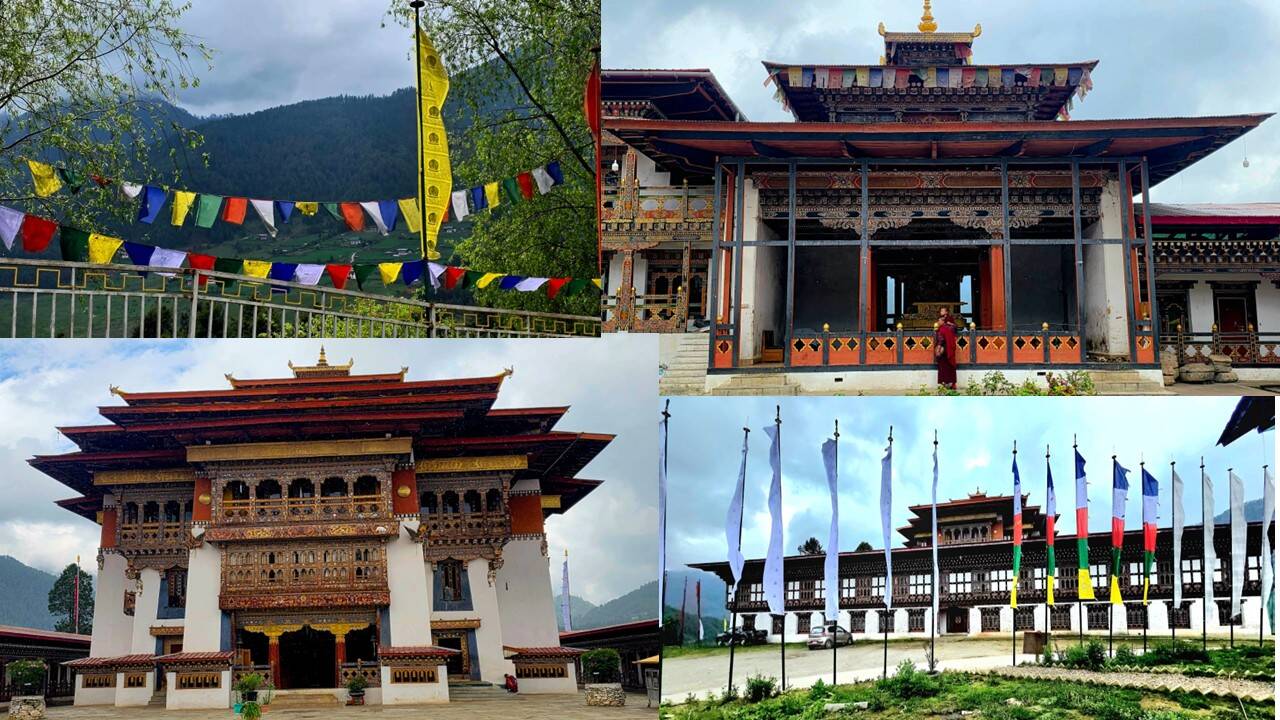
From Bumthang, I embarked on a scenic 157-km drive to Gangtey (Gangtey Gompa), passing through Bhutan’s lush emerald forests, picturesque towns, majestic dzongs, ancient monasteries, and countless stupas. The winding mountain roads unfolded breathtaking vistas at every turn, with snow-capped peaks rising majestically in the distance, while crystal-clear rivers cascaded joyfully alongside, as though celebrating the journey with me.
Nestled in the Wangdue Phodrang District at an altitude of approximately 9,840 feet, Gangtey overlooks the magnificent Phobjikha valley, a broad U-shaped glacial valley embraced by the towering Black Mountains. Revered as one of Bhutan’s most beautiful and spiritually significant destinations, Gangtey is a paradise for meditators, nature lovers, photographers, birdwatchers, and all those seeking silence, peace, and spiritual awakening.


At its heart stands the magnificent Gangtey Monastery, one of Bhutan’s largest and most revered monasteries of the Nyingma School of Vajrayana Buddhism. Founded in 1613 by Gyalse Pema Thinley, the grandson of the great Buddhist master Pema Lingpa, the monastery fulfilled a remarkable prophecy. Although Pema Lingpa himself never visited Gangtey, he had foretold that a great monastery would one day arise there. His grandson brought that prophecy to life by establishing Gangtey Gompa, which later became the principal seat of the Peling tradition, one of the most important branches of the Nyingma lineage in Bhutan.
The monastery is an architectural masterpiece, housing a magnificent golden Buddha statue, exquisite murals illustrating profound Buddhist teachings, sacred relics, ancient statues, rare scriptures, priceless thangkas, tantric ritual objects, and meditation traditions preserved for more than four centuries. It also serves as an important monastic institution where young monks receive rigorous training in Buddhist philosophy, Vajrayana meditation, ritual practices, sacred Cham dances, and liturgical traditions.

Every year, Gangtey comes alive during the colourful Gangtey Tshechu, when monks perform sacred masked dances that attract devotees and pilgrims from across Bhutan.
I stayed in a traditional homestay located beside the monastery gate. Colourful prayer flags fluttered gracefully in the mountain breeze, filling the surroundings with an atmosphere of serenity and devotion.
One of the most memorable moments of my visit was meeting the gifted artist who had painted the monastery’s magnificent murals. He kindly escorted me to the monastery museum, where I was amazed by the priceless collection of ancient treasures, sacred artefacts, manuscripts, and relics that have been lovingly preserved through the centuries.
The monastery itself has three beautifully constructed levels, with quadrangular balconies overlooking the inner sanctum. During my visit, I witnessed monks performing an elaborate prayer ceremony. The senior adept sat at the centre while the monks formed a circle around him, chanting sacred prayers and performing ancient Vajrayana rituals with remarkable discipline and devotion.

Since I practise Vajrayana Buddhism, I quietly joined the chanting. A monk warmly invited me to sit beside them, making me feel deeply welcomed. After the prayers concluded, he gently asked whether I would like to receive blessings from the revered adept. With profound gratitude, I bowed and followed him. The adept was about 85 years old. Looking at me with great affection, he lovingly blessed me and said, “If you follow what you are doing now, you will go very far, and you will meet me again in your life.” His words touched my soul.
Filled with bliss, reverence, and overwhelming gratitude, I offered butter lamps and a khadar. That divine encounter remains one of the most treasured spiritual experiences of my life.
From the monastery grounds, panoramic views unfolded across the breathtaking Phobjikha Valley, undoubtedly one of Bhutan’s most pristine, peaceful, and spiritually significant landscapes. One of Bhutan’s few glacial valleys, Phobjikha is internationally recognised as a protected wetland under the Ramsar Convention. Its vast alpine meadows, marshlands, crystal-clear streams, Nakay Chhu (Black Water) and Gay Chhu (White Water), traditional Bhutanese villages, and extraordinary biodiversity create an ecosystem of remarkable beauty. The valley shelters numerous rare birds and mammals and is celebrated as one of Bhutan’s finest alpine wetlands.

Phobjikha is especially renowned as the winter home of the endangered Black-necked Crane, which migrates every year from the Tibetan Plateau. According to local tradition, these sacred cranes circle Gangtey Monastery three times before landing in the valley and repeat the same ritual before departing in spring, paying homage to Guru Padmasambhava (Guru Rinpoche) and receiving his blessings before continuing their remarkable journey. The valley’s spiritual significance extends far beyond its natural beauty.
When Guru Padmasambhava visited Bhutan during the 8th century, blessing many hidden valleys throughout the Himalayas, he foretold that Phobjikha would one day become a sacred sanctuary where the Dharma would flourish for future generations. He is believed to have concealed spiritual treasures within the region, destined to be revealed by realised masters at the appropriate time.
Many Bhutanese therefore regard Phobjikha as a Beyul—a hidden sacred valley divinely protected by Guru Padmasambhava. According to Vajrayana tradition, Beyuls are sanctuaries preserved for sincere spiritual practitioners during times of moral and spiritual decline. Such places are believed to possess exceptionally pure spiritual energy, making them ideal environments for meditation and inner transformation.

The following morning, at 5 am, I drove down into the heart of Phobjikha Valley, often called the “Switzerland of Bhutan.” What unfolded before me was nothing short of celestial. An endless carpet of emerald grass stretched across the valley floor, surrounded by majestic mountains. Crystal-clear streams meandered gently through the meadows while cattle grazed peacefully nearby. Small traditional villages dotted the landscape, and a monastery stood gracefully at the valley’s centre, as though blessing the entire region.
Soft morning mist floated like ethereal clouds around the mountain slopes. The eastern sky gradually transformed into delicate shades of orange, gold, crimson, and soft pink, as though nature itself was preparing to welcome the rising sun and shower Mother Earth with its first golden rays.
For a moment, I felt I had entered another world, a dream beyond imagination.
The valley’s heavenly beauty naturally drew me into a state of awakened meditation. Sitting quietly upon a rock, I immersed myself completely in the profound silence and healing energy that flowed through every part of this sacred landscape. Time seemed to stand still.
Night brought another magical transformation. Gentle moonlight bathed the valley in soothing shades of silver-blue. Moonbeams danced upon the sparkling streams while countless stars illuminated the crystal-clear Himalayan sky. Everything radiated an indescribable stillness and peace.
I did not want to awaken from this beautiful dream.

The following morning, after breakfast, I began my journey back to Paro before returning to India. Among all the countries I have travelled through across Europe, Asia, and Africa, Bhutan remains the most extraordinary.
Its breathtaking natural beauty, profound tranquillity, joyful simplicity, compassionate people, majestic mountains, sacred caves, serene valleys, pristine forests, sparkling waterfalls, melodious birdsong, and deeply spiritual monasteries touched my heart in ways no other place has. This journey was not merely a holiday. It was one of life’s greatest blessings.
I shall remain forever grateful to my beloved spiritual master, Guru Padmasambhava, for guiding me to his sacred land and showering me with his boundless grace and divine blessings, and to the Bhutanese government for inviting me as a national guest.
Disclaimer
Views expressed above are the author’s own.