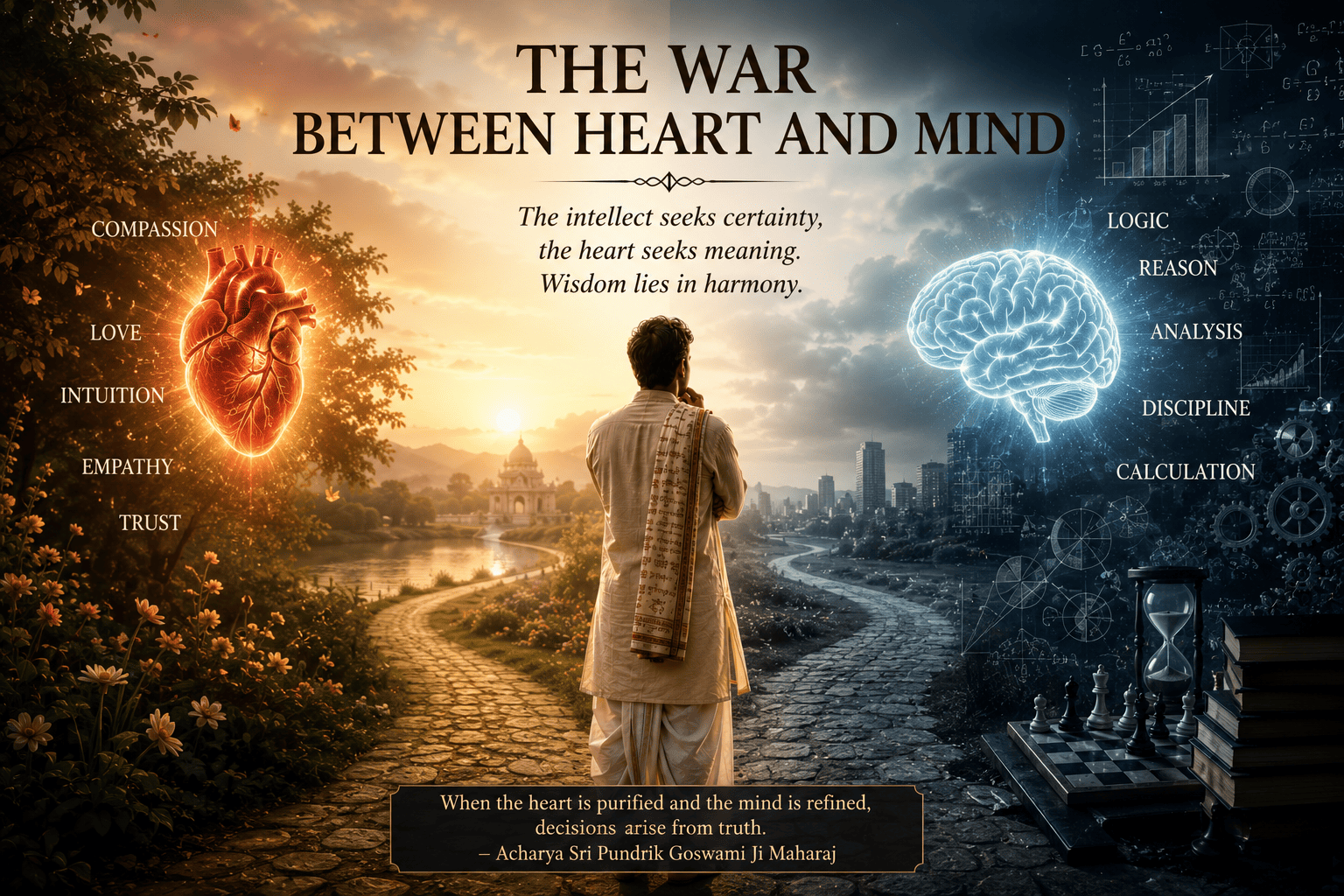
Human beings often explain their decisions by saying, “My heart wanted this,” or, “My mind told me otherwise.” It is one of the oldest struggles known to mankind. We speak as though two separate rulers exist within us, each pulling us in a different direction.
One seeks comfort, affection, and belonging.
The other seeks logic, calculation, and certainty.
And between the two, human life unfolds.
Yet the deeper we contemplate this conflict, the more we begin to question whether such a division truly exists.
Does the heart really make decisions?
Or is it simply another expression of the mind itself?
When we describe a choice as emotional, compassionate, or loving, we often attribute it to the heart. When we describe a choice as rational or practical, we attribute it to the intellect. But in reality, every experience passes through the mind. Every fear, every attachment, every affection, every calculation, every dream, and every decision emerges from the same inner faculty.


The heart, in many ways, is simply the softer face of the mind.
It is the mind when it becomes tender.
It is the mind when it becomes vulnerable.
It is the mind when it wishes to love without demanding explanations.
The intellect, on the other hand, seeks evidence. It seeks certainty before commitment. It wishes to understand every outcome before taking a step forward.
This creates a fascinating dilemma.
Life often presents situations where explanations are incomplete.
Why does a mother sacrifice so much for her child?
Why does a devotee continue to pray despite difficulties?
Why does a person stand beside truth even when it brings suffering?
Pure logic alone cannot always answer these questions.
Some realities can only be understood through experience.
The intellect demands proof.
The heart seeks meaning.
The intellect asks, “What will I gain?”
The heart asks, “What is right?”
The intellect calculates consequences.
The heart embraces responsibility.
This is why human beings often feel divided within themselves.
A person may know what is profitable yet feel drawn toward what is virtuous. He may know what is comfortable yet feel compelled toward what is meaningful. He may know what is easy yet feel attracted toward what is right.
This inner struggle is not weakness.
It is the beginning of self-awareness.
The real danger arises when either side becomes excessive.
A life governed only by emotion becomes unstable.
A life governed only by calculation becomes dry.
Compassion without wisdom can become attachment.
Wisdom without compassion can become arrogance.
Neither extreme leads to harmony.
The purpose of spiritual growth is therefore not to destroy the intellect, nor to abandon emotion. The purpose is to bring both into balance.
A mature consciousness possesses clarity without becoming harsh.
It possesses sensitivity without becoming weak.
It remains compassionate without losing discernment.
This balance is beautifully reflected in the lives of saints.
A saint’s decisions are not sentimental, yet they are full of compassion. They are not coldly intellectual, yet they are rooted in wisdom. Their actions emerge from a consciousness that has become purified through devotion.
That is why their decisions carry peace.
Most of our struggles arise because the mind itself remains divided. One part seeks higher ideals, while another remains attached to comfort. One part seeks surrender, while another seeks control.
Until this inner conflict is resolved, decision making remains painful.
The solution is not to silence the heart.
Nor is it to worship the intellect.
The solution is purification.
When the mind becomes purified through humility, self-reflection, and devotion, the conflict gradually begins to dissolve. What once appeared as a battle between heart and mind transforms into a unified movement toward truth.
Then decisions no longer arise from fear.
They arise from clarity.
They no longer arise from ego.
They arise from sincerity.
And when sincerity guides intelligence, and compassion softens wisdom, a person begins to make decisions that not only benefit the world around him, but also elevate his own consciousness.
For the greatest victory is not choosing between the heart and the mind. It is transforming the mind itself into a servant of truth.
Disclaimer
Views expressed above are the author’s own.