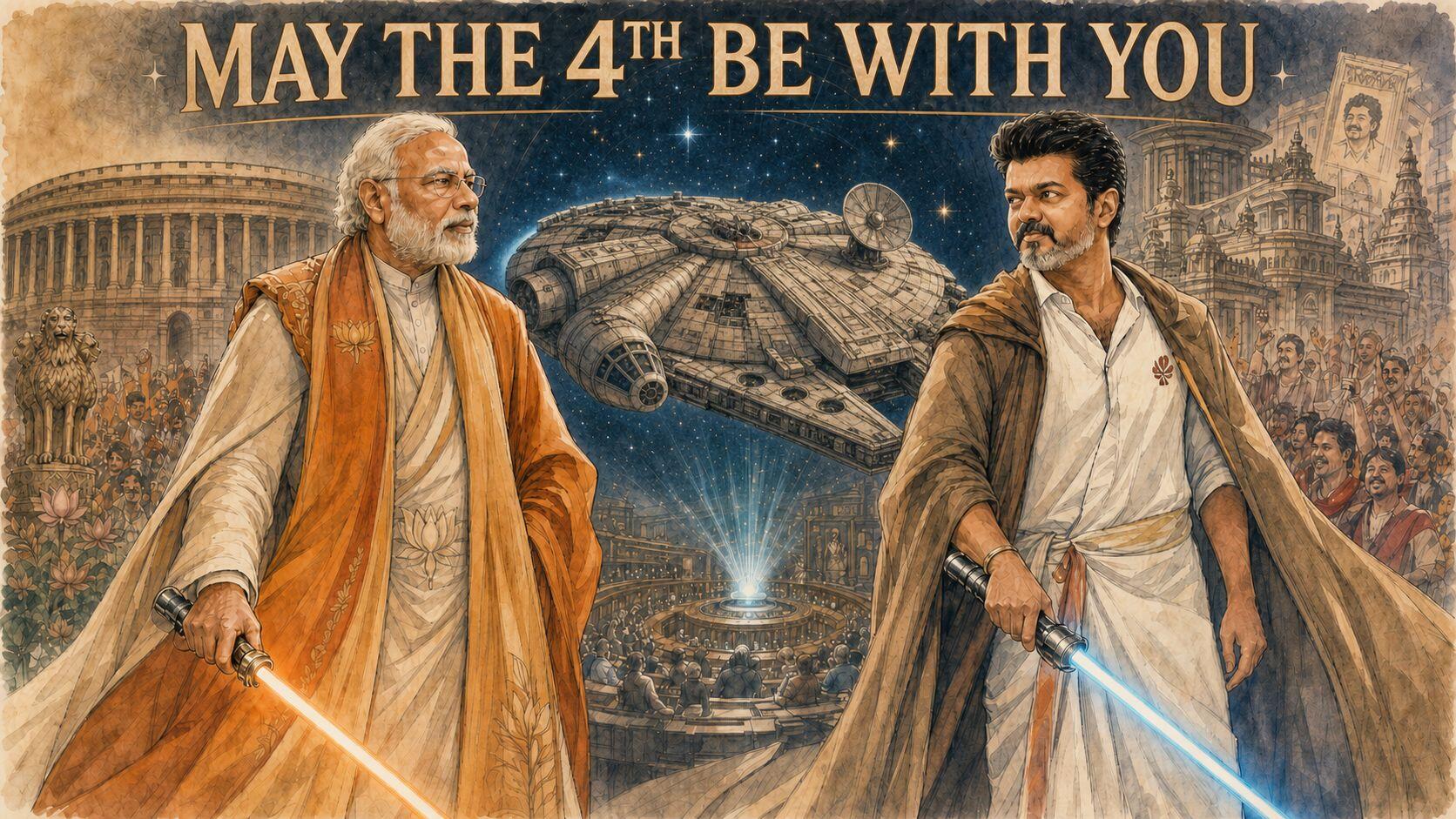


On this May 4, the force in Indian politics is not with the regional satraps.
In Tamil Nadu, Joseph Vijay Chandrasekhar – simply Vijay to his supporters – has just delivered the biggest disruption of this election cycle. It is arguably the most consequential shock in Dravidian politics since 1967, when the DMK defeated the Congress.
Vijay’s Tamilaga Vettri Kazhagam (TVK) is past the 100-seat mark. In a 234-member assembly, that puts him within striking distance of a majority. For decades, this House has been dominated by the DMK and AIADMK. That era has ended now.
In West Bengal, the fortress that resisted the Bharatiya Janata Party’s surge for a decade has finally cracked. Mamata Banerjee’s Trinamool Congress (TMC) is staring at a rout.
In Kerala, the Congress-led United Democratic Front (UDF) is making a comeback. The Left’s rare back-to-back term has ended.
Taken together, today’s results are reordering Indian politics. The BJP is edging from dominant to hegemonic. Regional parties are scrambling. The Congress is unexpectedly re-emerging as a national alternative.
Counting is still under way. But the broad picture is unlikely to reverse.
Tamil Nadu: Vijay ‘the redeemer’
For months, Tamil Nadu’s story was supposed to be about chief minister MK Stalin. His goal was simple and ambitious: Secure a second term and cement the DMK as the natural party of governance.
But the voters had other ideas. They have delivered a generational verdict against the Dravidian duopoly. All day, both DMK and AIADMK have been fighting for second place only.
Vijay’s ascent is not just a celebrity wave. The message is less ideological and more emotional. Voters are signalling exhaustion with legacy parties.
Tamil Nadu now faces its first truly three-cornered structure since the MGR era. There is a new Vijay pole. There is a wounded DMK. And there is an AIADMK that must decide what it wants to be: a serious regional force or a BJP appendage.
For New Delhi, the takeaway is blunt. For the first time in half a century, a Tamil chief minister may owe nothing to either of the traditional Dravidian machines – or to the Congress or the BJP.
Follow live updates for Tamil Nadu assembly election results
West Bengal: Breaching the fortress
If Tamil Nadu is the shock, Bengal is the strategic prize.
Five years ago, West Bengal was where the BJP’s pan-India ambitions stalled. Mamata Banerjee’s TMC did not just win in 2021. It humiliated the BJP. The party then spent years painting the BJP as outsiders to Bengal’s culture and politics.
This time, the BJP has reversed that script.
The party recalibrated its campaign. The personalised, often vitriolic attacks on “Didi” that backfired in 2021 were dialled down. Instead, it leaned into development rhetoric, law-and-order anxieties, and identity politics around migration and religious polarisation.
The BJP ran its campaign like a software rollout. It repeated a tight message with discipline. It saturated the state with central leaders. Rallies by PM Modi and Amit Shah were stitched to granular caste and community arithmetic. Booth-level mobilisation was anchored by the RSS and a growing cadre in north Bengal and Jangalmahal.
Banerjee, by contrast, looked trapped. Incumbency weighed on her. So did scandals and anger over SIR projects.
Bengal has now gone from the BJP’s most coveted redoubt to its biggest trophy. This is also the single largest psychological blow yet to the myth of invincible regional satraps.
Follow live updates for West Bengal assembly election results
Kerala: A Left-free India
Kerala has long prided itself on flipping governments every five years. The Left broke that pattern in 2021. It was a rare high point for global communism.
Today’s verdict has closed that chapter.
The UDF is making a comeback with a thumping majority. For the first time in almost 50 years, India will not have any Left government in office.
The BJP may not be forming the government in Thiruvananthapuram. For the national story, that almost does not matter.
Follow live updates for Kerala assembly election results
BJP juggernaut rolls on
The party is set for a third straight term in Assam. It has finally cracked Bengal. Its alliance is winning in Puducherry. Its vote share in Kerala continues to inch up from a low base.
The pattern is clear. The BJP is no longer just the dominant national party. It is moving towards hegemonic status. It is present in every region. It can turn almost any state into a two-horse race with itself as one of the contenders. It can “plug and play” a campaign template: PM Modi’s brand, central welfare, disciplined cadre work, and ruthless alliance-building.
In 2024, the Lok Sabha verdict checked that ascent. Voters cut the BJP down to a minority in Parliament. Today’s map suggests that was an aberration, not a trendline. The party’s state election machine remains intact, even enhanced.
Follow live updates for assembly election results 2026
Congress: Four states, one burden
Yet the political vacuum is not being filled by regional parties. It is being refilled, almost by default, by the Congress.
With Kerala added to Himachal Pradesh, Karnataka and Telangana, the Congress will govern four states outright. It will also have footprints in a few coalition governments.
This is far from a “Congress-mukt Bharat”. It gives the party real geographic spread: the western Himalayas, the South, the coastal belt. It also gives it organisational oxygen.
But it also brings a new burden.
The INDIA bloc’s regional pillars are crumbling or distracted. The DMK is out in Tamil Nadu. The TMC is routed in West Bengal. AAP is mired in leadership crises and legal battles. The Shiv Sena has split into fragments. The Left has been electorally obliterated in its last bastions outside Kerala.
That leaves the Congress as the only national party outside the BJP. It is also the only opposition force with multiple state governments, a pan-India cadre – however frayed – and a recognisable leadership brand.
If there is to be any coherent front against BJP hegemony in 2029, it will have to be built around the Congress. In many states, it will have to be built in spite of regional partners.
The future of regional parties
It is tempting, on a day of regional defeats, to write obituaries for regionalism. That would be a mistake.
Regional parties emerged from specific histories. They draw on linguistic assertion, caste movements, and sub-national pride. Those fault lines have not disappeared.
What today shows is not that regionalism is dead. It is that lazy regionalism is.
Parties that confuse welfare schemes with governance are being punished. Parties that mistake dynastic charisma for renewal are being punished. Parties that rely on anti-Delhi rhetoric instead of a development model are being punished.
After May 4: A new binary
By the time the last EVM is tallied, India’s map will look very different from a decade ago.
The BJP, despite a parliamentary setback in 2024, will have extended its reach to some of the last resistant states. The Left will be functionally absent from power. Several once-mighty regional parties will have been reduced to shadows of their former selves.
What remains is a starker binary. On one side, a dominant BJP. On the other, a patchwork opposition increasingly forced to rally around the Congress.
Disclaimer
Views expressed above are the author’s own.
END OF ARTICLE