The World Cup just got 63% bigger. Whether that made it more valuable, and why FIFA really did it, is the interesting part.

Every luxury house knows one rule by heart: make too much of something precious and you cheapen it. Scarcity is not an accident of value. Often it is the source of it. So what happens when the most valuable event in sport decides to flood its own market?
The 2026 World Cup is that experiment. FIFA has staged the largest edition ever: 48 teams instead of 32, and 104 matches instead of 64. That is 40 extra games, 63% more football. The easy assumption is that more football means more money. But if part of what makes each match an event is that there are only so many of them, does adding 40 more deepen the tournament or dilute it? And before we trust anyone’s answer, a prior question: why did FIFA do this at all?
The real reason, which is not audience
It is tempting to assume the expansion was a grab for viewers. It mostly was not. The real reasons are simpler, and more revealing.
The first is how FIFA earns. The overwhelming majority of its income arrives in a single World Cup year; in the last cycle, one tournament year alone brought in roughly three-quarters of FIFA’s revenue. When your whole business rests on one product every four years, you have essentially one lever for growth: make that product bigger. FIFA now expects around $13 billion for the 2023 to 2026 cycle, up about 72% on the last one, with roughly $8.9 billion of it from the tournament alone. More matches mean more broadcast inventory, more sponsorship, more hospitality, and more tickets.
The second reason is politics, and it may matter more than the football. The FIFA president is elected by 211 member associations, each with a single equal vote. The expansion handed more qualifying places to Africa, up from five to nine, and to Asia, up from four and a half to eight. Those two confederations alone control roughly 100 of the 211 votes. Offering dozens of nations a genuine chance to qualify, alongside development grants worth up to $8 million each, is a highly efficient way to build and keep political support.
The third reason, the one FIFA emphasises publicly, is inclusion and development. That part is real, and for nations long shut out a place at the table is transformative. But the money and the politics alone would have justified the expansion without it. Development is the wrapping; money and votes are the engine. The new teams, in short, were added for revenue and for votes, not for ratings.
So did it dilute the tournament?
Here the scarcity worry meets a messy reality, and the honest answer is that the evidence points both ways.
On one side, there are real signs of strain. Two days before kickoff, roughly 180,000 tickets were still unsold. FIFA’s aggressive variable pricing pushed the cheapest final seat past $5,000 and the priciest beyond $11,000, drawing price-gouging inquiries from the attorneys general of four states. Days before the tournament, FIFA quietly cut prices across all 104 matches and handed back around 70% of the hotel rooms it had block-booked, a clear admission that demand had been overestimated. Several lower-profile group games were played to visibly empty seats. Spread a fixed appetite across 63% more supply, and this is roughly what dilution looks like.
On the other side, the top-line numbers held up better than critics feared. Official group-stage attendance ran close to full. In the United States, the largest market, matches on Fox averaged well over double their 2022 audience, and Telemundo did better still. Even fixtures between unfamiliar nations drew sizeable crowds. On the surface, the flood did not drown the tournament.
Why the numbers are not what they seem
It is tempting to read those viewership figures as proof that the expansion worked. That is the trap. The surge is almost entirely a US phenomenon, and the US is the host. The tournament is being played, for the first time in a generation, inside the world’s largest media market, in friendly time zones, with a host nation caught up in the novelty of staging it, and a vast Spanish-speaking audience drawn in by Mexico co-hosting. Two technical shifts flatter the comparison further: television now counts the large out-of-home audience in bars and fan zones it missed in 2022, and streaming platforms that did not exist then are adding millions more.
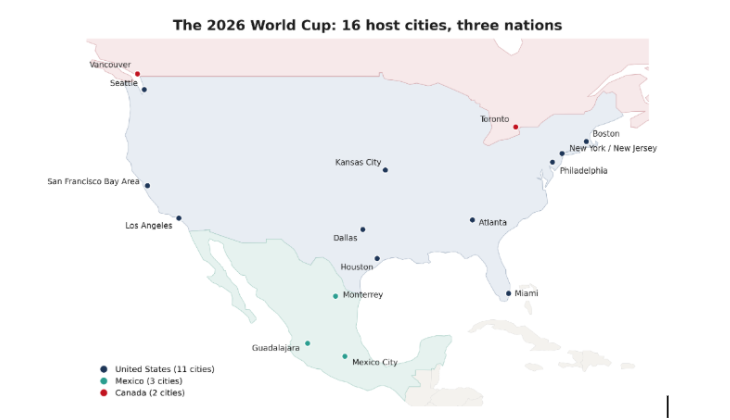
So two things changed at once. FIFA made the tournament bigger, and it moved the tournament to the biggest, most reachable market on earth. When both happen together, it is a mistake to credit the first for a result the second may have produced. The rising numbers do not show that 48 teams is better than 32. They show that a World Cup in North America reaches more people than one in Qatar. The expansion and the audience are two separate stories sharing a stage.
One seductive explanation is worth killing directly, because it hides the real lesson. The tempting story is that each new nation brought its own new audience. It did not. Cape Verde has around half a million people, Curacao fewer still, and even the larger debutants, Jordan and Uzbekistan, are not markets that move a global audience. The Americans who tuned in for these unfamiliar teams were not their compatriots. They showed up for the spectacle, in a country that happened to be hosting it.
The lesson beyond football
This is where the tournament becomes a business story. Almost every growing company faces a version of FIFA’s decision. Do we add more products, more content, more outlets? At a glance, the World Cup looks like proof that piling on volume creates value. It is not. Volume did not create the audience; placing the event in front of a far larger and more reachable market did. Those are two different levers, and the costly mistake is confusing them. Add more units for the audience you already have and you tend to dilute, splitting the same attention across more things. Growth only compounds when it reaches genuinely new demand. FIFA got away with 63% more supply because it happened, at the same moment, to reach a far bigger market. Hold the same expanded tournament somewhere smaller, and those 40 extra matches would have thinned the crowd, not thickened it.
There is a subtler warning here too. When two things change together and the result is good, the temptation is to credit whichever move you are proudest of. FIFA will be tempted to conclude that expansion was vindicated, when the honest reading is that favourable placement rescued a decision made for money and votes. Businesses do this constantly: they launch a new product and enter a new market at once, succeed, and draw the wrong lesson about which move mattered. Knowing the difference between the lever you pulled and the one that actually moved the result is most of the discipline of growth.
The verdict is not the trophy
Whether the expansion truly worked will not be settled by who lifts the trophy on 19 July, nor by one host nation’s television ratings. It will be settled over years, by whether the average match comes to be worth more or less than before, in broadcast value, in sponsorship, and in the plain attention of a global audience. That number does not exist yet, and anyone claiming certainty this early is selling something.
What can be said now is narrower, and more useful. Scarcity protects value only when demand is fixed. The moment you can put your product in front of genuinely new demand, you can grow without diluting. But volume alone never does it, and a well-chosen market can flatter a decision that volume alone would have exposed. FIFA expanded for money and for power, then moved the show to the richest room in the world. The trick, for anyone hoping to learn from it, is not to confuse the two.
Disclaimer
Views expressed above are the author’s own.