

This week, we are tracking:
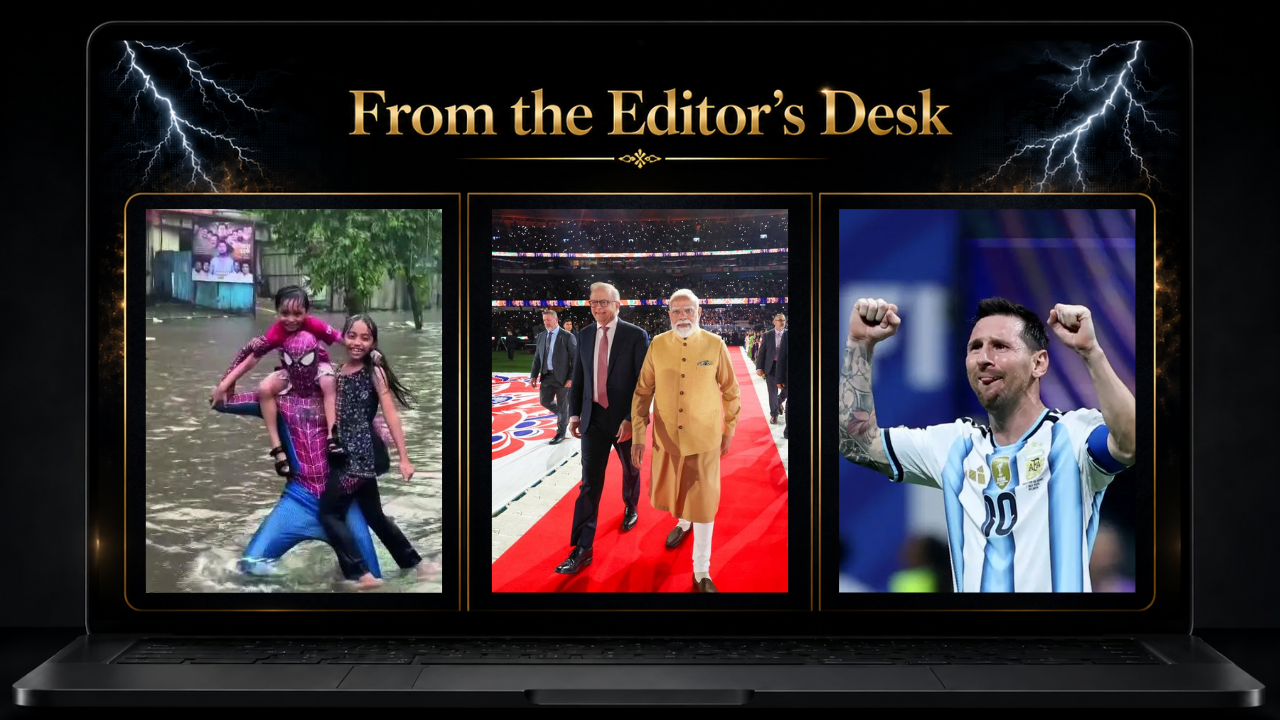
• Every monsoon, Mumbai sinks. Its ‘spirit’ rises
• PM Modi’s Indo-Pacific detour: India looks beyond US and China
• The great E20 experiment: Who really benefits?
• Nijjar killing: Canada’s police puncture Trudeau’s India charge
• Messi cries, Brazil dies: The week that blew up the World Cup
Barsaat, BMC and Mumbai ‘Spirit’: When a city gets ‘high’ on water – every monsoon
Mumbai has a ‘spirit’ issue. Not with alcohol, though. Every July, the city gets “high” on rain. Roads turn into creeks. Rail tracks become aquariums. Mumbaikars post the same-type of flooded-street photos they posted last year, and the year before that.
Governments have changed. BMC commissioners have changed. The plot has not. Since 2005, Mumbai has been running on loop every monsoon season.


The 2026 script began with a twist. A municipal official fell into a manhole while the mayor was on an inspection for monsoon preparedness. If you were looking for a metaphor for Mumbai’s governance, you couldn’t script it better.
To be fair, this year genuinely is different. The rain is record-breaking, not routine. The rain really has been off the charts. IMD’s Colaba observatory logged over 880 mm between June 30 and July 6. Santacruz was close to 990 mm in that span – more than the annual average rainfall of Delhi and Pune, and nearly matching Bengaluru’s yearly total. In just days, the city “finished” what other metros take 12 months to clock.
Mumbai ‘spirit’
Mumbai has built an entire civic identity around the idea of “spirit”: That magical resilience that keeps the city going no matter what. We romanticized it after 26/7 in 2005. We invoked it during terror attacks and pandemics. And we’re doing it again now.
But “spirit” is doing the quiet work of letting everyone off the hook.
Bombay high court has started saying the quiet part out loud. Hearing a dispute over a loop road and encroachments in eastern Mumbai, Acting Chief Justice Ravindra Ghuge didn’t just lament the flooding. He turned the mirror on citizens.
“BMC gave us drains. What do we do? We fill it with dirt…cover the gutter to grab land. BMC gave us footpaths. We put pav bhaji stalls on it … Look outside the HC, there is no space to walk … We are destined to see rainwater on roads … we cannot help it. Everything is clogged.”
Then the gut punch: “Our habit is to rob our own motherland …We put pavement blocks. They are inaugurated by people’s representatives and then they become parking areas. One spell of rain blocks roads in Mumbai … it is our creation.’’
That line matters. Because the easy narrative is to blame a faceless “BMC” and move on. The harder narrative is this: Mumbai is drowning in a system built jointly by politicians, builders, and us.
‘Spirit’ is more than a myth. It’s a shield. Every time we praise the city’s capacity to bounce back, we lower the bar for its infrastructure and governance.
Beyond US and China: How India is charting a new map of self-reliance
PM Narendra Modi’s visit to Indonesia, Australia and New Zealand is more than a routine foreign tour. It is India’s quiet signal to the US and China: New Delhi wants more friends, more markets, more access to minerals, technology and security partnerships. It does not want to be dependent on any one power.
Stop 1: Jakarta
India signed a deal to sell BrahMos to Jakarta, following similar packages already sold to the Philippines and Vietnam. That’s India quietly building out a role as a security exporter across Southeast Asia, not just a customer.
Why it matters: Indonesia is India’s biggest ASEAN trading partner. It also sits on some of the world’s largest nickel reserves, a mineral India desperately needs for EV batteries.
This is India’s China hedge in action. Not formally anti-China, but unmistakable. If China uses ports, minerals and manufacturing networks to build influence, India is trying a different mix: Defence exports, trusted supply chains, civilisational outreach and maritime partnerships.
Stop 2: Melbourne
During PM Modi’s visit, India and Australia reached a deal for Australian uranium exports to India for peaceful nuclear use. The logic is clear: India wants to build 100 GW of nuclear energy capacity by 2047, and Australia wants to diversify its trade exposure.
The real story here is critical minerals. India is almost entirely import-dependent on lithium, cobalt and nickel: The building blocks of its EV ambitions. China supplies over 80% of India’s lithium imports and dominates global processing of cobalt and nickel. That’s not a supply chain. That’s a chokehold.
Australia, alongside the US and Japan, is part of the Quad‘s critical minerals push — a framework explicitly designed to build alternatives to Chinese-controlled mining and refining. India’s 2026-27 budget already earmarked “rare earth corridors” in four states. Melbourne was about turning that ambition into actual partnership.
Stop 3: Auckland
This is the first visit by an Indian PM to New Zealand in 40 years, since Rajiv Gandhi in 1986.
Why it matters: New Zealand is a small partner on paper. But it’s part of India’s broader Pacific Islands push: A region where India and China are quietly competing for influence, mineral access and, eventually, votes at multilateral forums.
The great E20 question: Are we really saving fuel?
When India fast-forwarded its ethanol push and made E20 the default petrol, it sounded like a win-win. Less crude oil, more money saved, happier farmers, cleaner air. On paper, it ticked every policy box.
Except, maybe, the one that matters most: What people feel at the pump.
Across cities, many motorists are asking the same thing: Why am I suddenly getting fewer kilometres from every litre?


The government’s answer is clear and confident. The mileage loss, it says, is “marginal”: Around 3-4%. Automakers broadly back that up. Ethanol has less energy than petrol, so a small dip in fuel economy is expected. Years of testing, they insist, show E20 is safe for vehicles already on the road.
But cars don’t run in laboratories. They live in traffic.
And Indian traffic is its own special ecosystem. AC permanently on. Cars crawling and braking. Two-wheelers darting through gaps. Engines idling for minutes before you finally get to move 20 metres. In those conditions, plenty of drivers say their mileage hasn’t just dipped a little; it has dropped sharply.
You can call them “crazy anti-nationals” online, or you can ask a more uncomfortable question: What if they’re right?
Then, there is the issue of older vehicles. Older cars and two-wheelers seem to feel it more. And that matters for the bigger economic story. If older vehicles burn a lot more fuel to cover the same distance, the savings math gets shaky. Petrol’s share per litre may be smaller. But if total consumption climbs, the crude-import benefit shrinks too.
There’s also a quieter irony here.
While everyone argues over a few percentage points of mileage, another fuel-guzzler hides in plain sight. India’s roads. Potholes, rough patches, constant braking and accelerating. Research shows all of this burns fuel too. Fix the roads, and you might save more fuel than any ethanol tweak ever could.
So where does this leave things?
First, government needs to stop denying. If the mileage drop in older vehicles is truly marginal, large-scale, transparent city-driving tests should prove it. If it isn’t, the forex math needs a rewrite.
Second, higher blends must be a choice, not an ambush. Brazil built its flex-fuel ecosystem over decades and gave drivers options at the pump. India jumped from E10 to a nationwide E20 in just a few years. Any move to E25 or beyond should come with parallel fuel grades, clear labelling and guidance on what’s safe for which vehicle.
In the end, the E20, E25… debate isn’t just about chemistry. It’s about whether people believe the numbers and whether they get a say in what goes into their tanks.
Nijjar killing: Trudeau cried wolf. Canada’s own police just confirmed it
When the US unsealed its sweeping “Operation Hard Ball” indictments this week, the headline grabber was obvious: Jailed gangster Lawrence Bishnoi and his aide Goldy Brar allegedly ordered the hit on Khalistan separatist Hardeep Singh Nijjar in British Columbia.
But buried in the legalese was a political bomb closer to Ottawa than to New Delhi. Canada’s own Royal Canadian Mounted Police has now said there is “no evidence” linking Indian officials to the crimes covered by the US charges, including the Nijjar killing. For New Delhi, that’s vindication. For Justin Trudeau’s legacy on foreign policy, it’s an indictment of a different kind.
The allegation that blew up a relationship
In September 2023, Trudeau stood up in Parliament and said Canadian agencies were pursuing “credible allegations” that Indian government agents were involved in Nijjar’s killing.
India called the charges “absurd” and politically motivated. Officials in New Delhi saw a familiar pattern: a Canadian leader under pressure at home leaning on India-bashing to shore up a domestic political coalition where pro-Khalistan activists are loud, organised and electorally useful in key ridings.
The fallout was immediate and severe. Diplomatic ties sank to a new low.
So what actually happened to Nijjar?
According to the DOJ, Bishnoi ran the whole operation from inside a Gujarat prison, using smuggled phones. Brar handled North America. They allegedly picked the target, supplied his photo and addresses, and got it done. This was gang warfare with a global footprint. Not a state operation.
Messi’s tears, Haaland’s heroics, Mbappe magic: The week the FIFA World Cup turned wild
Brazil is out: Five-time champions Brazil are eliminated. A rampaging Erling Haaland led Norway to a stunning 2-1 win over Brazil, one of the biggest shocks in recent World Cup history.
Messi cries: If you’re going to watch one clip this week, make it Argentina vs Egypt. Argentina were inspired by Messi to pull off a stunning 3-2 comeback win deep in injury time after going 2-0 down with just 11 minutes left. Messi was in tears afterwards and it is not hard to see why. Argentina were one bad bounce away from going home.
Cristiano Ronaldo’s World Cup career is over. The end of an era. Portugal lost to Spain 1-0 in the Round of 16, shutting the door on any chance of a Messi-Ronaldo showdown on the world’s biggest football stage: A rivalry fans have waited twenty years for and will never get.
Then France. Morocco reached another quarter-final dreaming of revenge after their 2022 semi-final loss but France were too good again. Kylian Mbappé missed a penalty but then scored a spectacular goal and assisted another as France won 2-0 to become the first team through to the semifinals.
And where does the tournament stand? Brazil, Portugal, US and Morocco are out. France look ominously placed. Spain and Belgium are on the brink of collapse. England must stop giant-killers Norway. And Messi is still here.
Editor’s picks: Some of our most and must-read articles
Iran’s Khamenei buried in Mashhad four months after US-Israeli strikes killed him
Australia to sell uranium to India: What the landmark deal means
Target vs target: What US hit in Iran, and what Tehran struck in response
Stories behind capital’s Ozempic shaadis: ‘How did this guy get a girl like you?’
E-rickshaw shutdown prank: Centre tells Google, Apple to remove 7 apps from their stores
‘Teetering on the brink of failure’: Ex-Singapore diplomat’s blunt warning for Pakistan
Disclaimer
Views expressed above are the author’s own.