As Indian firms integrate into global conflict supply chains, US sanction on a Raipur explosives company reveals the accountability gap at the heart of India’s defense boom
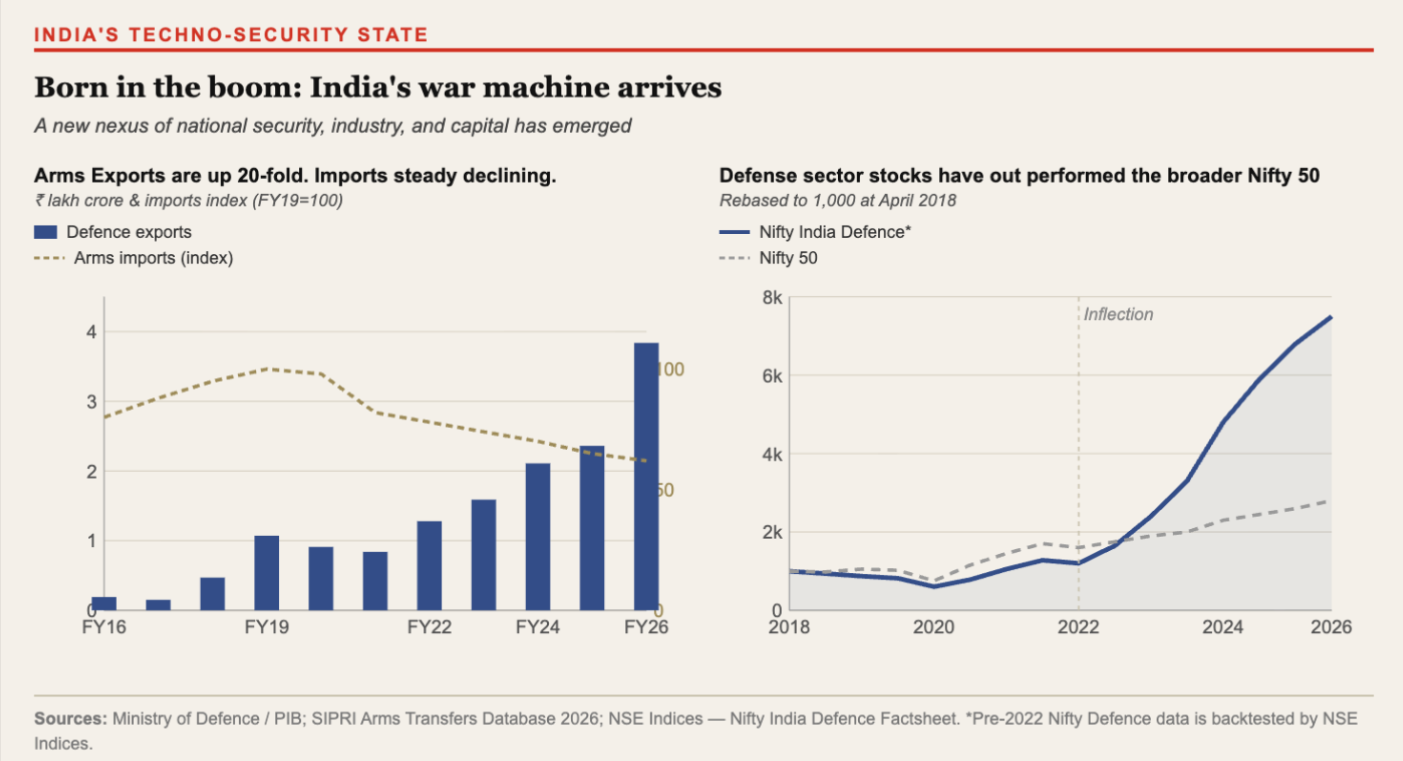
India’s arms are showing up across the world. Brahmos missiles to Vietnam. Pinaka rocket systems to Armenia. Avionics and subsystems to the US. Even artillery shell components in Ukraine. Meanwhile, the Indian state has been supportive, even celebratory.


The ministry of defence has ringfenced 75% of its modernization budget for domestic procurement, guaranteeing a multi-billion-dollar captive market. Through the iDEX initiative, over 16,000 MSMEs and startups have received direct grant funding and military testbed access. The new Anusandhan National Research Foundation (ANRF) has been established to bridge fundamental science with national security applications.
This is the birth of India’s modern techno-security state – an emerging nexus of economic development, national security, technology, and innovation. India’s new war machine is real, even necessary. Yet, it remains largely unexamined on democratic terms.
The concern is not whether India should build this capability. The concern is the structural logic of a techno-security state. Top-down priorities, concentrated power, and ambitions of becoming a leading arms exporter stand with an inherent tension with democratic pluralism. Four fault lines are already visible.
The first fault line is institutional lag. Domestic demand for arms is rising amid border tensions. Global demand too is surging with European rearmament and widening conflicts. At the same time, global arms supply is constrained by declining confidence in the United States’s political reliability and Russia’s weakening export credibility. This geopolitical window might not stay open indefinitely. India’s opportunity to develop a modern techno-security base is real but fleeting.
The United States built its techno-security ecosystem over decades through durable institutions such as DARPA and the NSF, alongside a culture that empowers private enterprise. India’s counterparts like the DRDO, iDEX, ANRF, etc. have a mixed record at best. These institutions take decades to earn credibility and the window to get this architecture right is now.
The second fault line is centralization. The techno-security state requires coordination across finance, research, procurement and national security. This implies concentrated power mobilizing resources at speed and scale. The Manhattan Project, Soviet Space Program, or China’s drone ecosystem, are a testament to the top-down thrust across regimes. In China, Xi Jinping personally chairs leading state institutions and has shaped the techno-security state largely in his own image. For an India increasingly characterized by centralized executive decision making, this model holds seductive appeal, given the enviable Chinese success. Yet, its pitfalls like low institutionalization, personalistic fragility, and succession risk are less often discussed.
The third fault line is statism. India’s PLI schemes, the ANRF, and the iDEX framework are all forms of what characterizes as the entrepreneurial state – a proactive, risk-taking government that leads rather than merely corrects for market failures. This is not inherently dangerous. But statism tends to exceed the bounds of its original mandate, as India’s experience with the License Raj aptly demonstrates. Thus, inviting caution.
The fourth is the private sector trap. The US recently sanctioned a Raipur based explosives firm, SBL Energy Limited, and its CEO, for allegedly supplying over 200 shipments of explosives to Sudan’s military. Washington alleges these shipments fueled a civil war. Yet, no Indian domestic regulator had flagged it. A foreign government’s sanctions regime filled the accountability gap. Indian firms are now sufficiently integrated into global defense and conflict supply chains that their activities attract geopolitical scrutiny. The question of who watches them at home has no answer yet.
India is opening its defense ecosystem to private firms like Bharat Forge and Adani Defence. The democratic work is to define who these firms answer to and under what rules.
The choice is not between democracy and defense. It is about whether India builds its techno-security state consciously, with democratic accountability baked in, or drifts into one by default and circumstance. India has begun building the factories, it’s the institutions that remain unfinished.
Disclaimer
Views expressed above are the author’s own.