

“Dr, yesterday I had to travel by road to return to my hometown. It was a 5 to 6 hours’ drive. However, we, my daughter and I, were to start by approximately 1-2pm so as to be home latest by 8pm. It so happened that the interview for which we had travelled got repeatedly delayed. Instead of the scheduled time of 12 noon, it began after 4pm. While I waited in the hotel room, all kinds of distressing thoughts kept plaguing me. The thought of two women travelling alone with a taxi driver, though the driver was known to me, the hazards on the road, fear of being attacked, meeting with an accident, car breakdown, running out of petrol and newspaper lines of women being dragged out of cars and raped kept persistently flashing in my mind, making me exceedingly tensed. Despite my best efforts I could neither control my thoughts nor feel relaxed during the drive. By the time I reached home unharmed and safe, I was feeling mentally exhausted, had a severe headache and stomach-ache. I realised I was prone to these apprehensions and tensions as this was hardly the first time it was happening to me. I also did not like the way my body reacted to these worries. This cannot be normal as the rest of my family does not react in the same way. But when I get into this loop, I just cannot stop the thoughts”.
One could understand her mental agony as thoughts that create anxieties, once started take a long time to subside.
It has long been debated which pain is worse, physical or mental. Although both types of pains are subjective experiences, but the intensity of pain depends upon the threshold of endurance of the person who bears it. Threshold of pain perception does not solely depend upon the physical factors like gender, age, genetics and pain sensitivity but also on the personality type, abilities to cope with stress, unresolved conflicts and amount of emotion regulation. However, physical pain is mostly temporary and gets resolved with time. Emotional pain, on the other hand, is for longer duration, sometimes lifelong altering the personality, creating mental health problems like depression, anxiety, stress, painful memories and lowered self-esteem. Socially, too, physical pain is empathized with whereas, mental pain is often disbelieved, disdained and scorned as stigma.
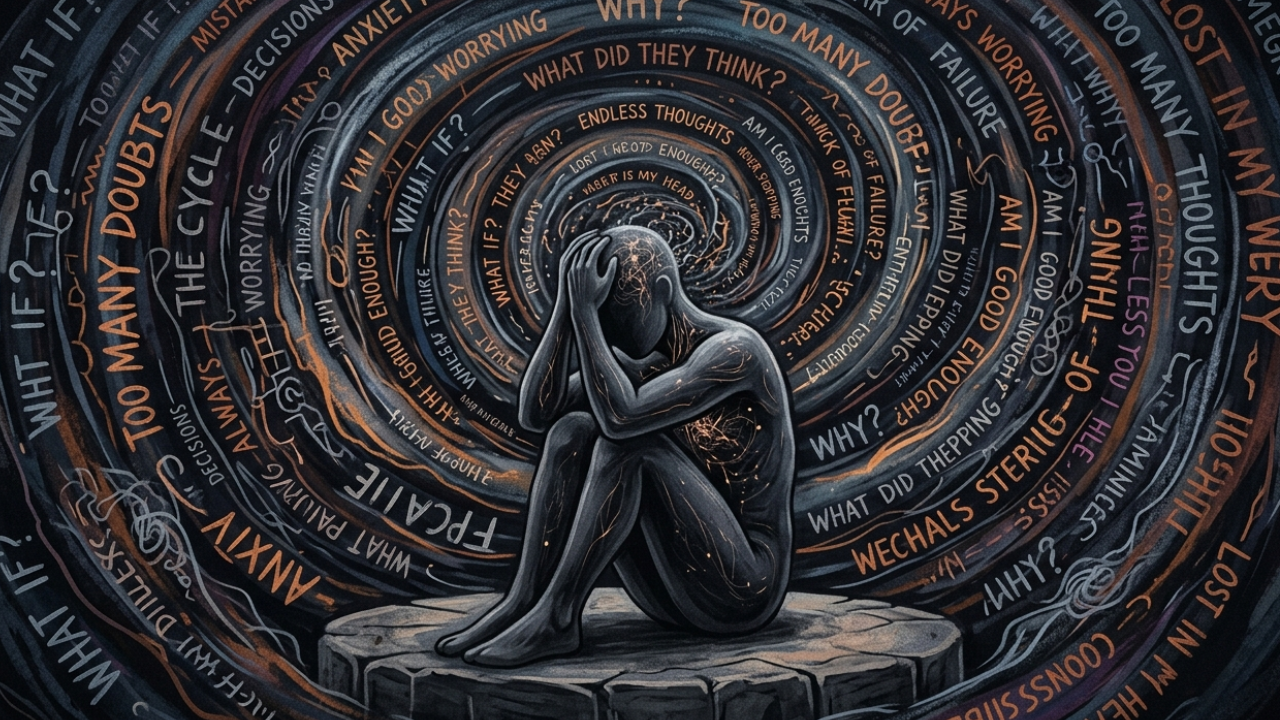
Mental pain ironically is largely related to the twin boons with which humans are blessed with, namely, to think and to emote. The same blessings when utilized judiciously can create wonders but overdone can play havoc in one’s life. Overthinking is one such phenomenon, as we saw also in the above cited case. Overthinking, as the word connotes, involves the habit to over analyse, revisit past events and worry about future prospects, which results in constant state of anxiety, indecisiveness and mental exhaustion. The thoughts over a period become repetitive, unproductive and unhelpful in solving problems or reaching a conclusion. The best analogy of this phenomenon is like riding a stationary cycle; you ride on the same ground for a long time but reach nowhere.
What is overthinking?
Overthinking involves repeatedly analysing an event, situation or topic, from all possible viewpoints without coming to a decision. It is believed by overthinkers that thinking through thoroughly would help them to come to a better decision, but as no decision is ever reached, it actually indicates a detrimental process, as one is caught is a never-ending loop. It is different from analytical thinking which involves gaining a perspective, reaching a solution even at the cost of exhaustion, and in the end helps guide your actions.
Overthinking is thus characterized by being repetitive, being unable to address the issue and come to a solution; apprehension of what might happen, uncertainties and imagining could be worst scenarios; inability to relinquish hold over small things; being in a constant state of self-doubt, self-criticism and self-denigration over past events; unable to relax as there is constant worry; unable to rest and sleep well; have racing thoughts that one cannot control nor distract oneself from it. This constant mental agitation leads to endless worry, anxiety, mental exhaustion, uncertainty, sleep deprivation, catastrophic thinking, second guessing and irritability in a person.
Overthinking is interchangeably used with other names like ruminations, obsessing, analysis paralysis and over-analysing. However, there is a difference. Ruminations refers to dwelling on past negative experiences (seen in Depression); fixating or obsessing is repetitive thinking of a specific thought (Seen in Obsessive-Compulsive Disorder); worrying is constant chain of thought of future threats or potential negative outcomes (seen in Generalized Anxiety Disorder); analysis paralysis occurs when excessive thoughts and research and fear of making wrong decisions actually paralyzes the decision-making ability and over-analysing happens when thoughts are broken down into minutest detail, making the process unproductive. Overthinking itself is not a disease or disorder but tends to disrupt life by building needless stress.
How overthinking affects health?
Constant overdrive of thinking leaves its footprints on our body and mind. Overthinking increases stress hormones like cortisol while reducing mood-regulating chemicals like serotonin and dopamine (happy hormones). Chronic mental over-stimulation or ruminations leads to the rewiring of the brain, altering not only the brain chemistry but structure too. A constant activation of the limbic system (area of the brain that activates emotions) with reduced mood regulating hormones (cortisol), results in negative emotions (anxiety, depression) thereby weakening the prefrontal cortex, which is responsible for controlling thoughts (cognitions). It is a vicious cycle often difficult to break.
Physically, overthinking disrupts sleep patterns, appetite, creates body fatigue, headaches, stomach-aches, muscle soreness, nausea, digestive imbalances, general feeling of unwellness and in some cases, blood pressure dysregulation. Mentally and emotionally, it affects attention and concentration, increases feeling of restlessness, inability to relax, inability to cope with even small problems, losing confidence and self-esteem. Over a period of time serious mental health issues like anxiety disorders-Generalized Anxiety Disorder and Obsessive-Compulsive disorder and even Depression maybe experienced by the sufferer. These effects have a bearing on one’s social relationships especially close ones, decreases work efficiency and reduces quality of life.
Helping oneself:
Since overthinking interferes with one’s daily life, it is important to address it. Every person has thousands of thoughts in their minds every day. However, most of them stay for some time and then disappear. The overthinker finds that the thoughts do not disappear, but some persist and create patterns mostly related to past mistakes that maybe real or imagined. The thoughts or apprehensions could also be about the future; that involves imagining unpleasant happenings by catastrophizing the probable though not yet occurred incidents. Let us view how you can help yourself.
Identify the thoughts creating loops:
Recognize these trigger thoughts as the first step towards healing. Label these thoughts as the ones causing the thought loop. Try distancing from the emotional content of the thought. For instance, instead of ‘I’m always a failure’ say ‘my thoughts are telling me that I’m no good at my work’. The longer you create the sentence like ‘today my thoughts are repeatedly telling me about my work not being good’; the more you will be able to emotionally detach yourself from the emotional component of the thought. Even if the thoughts counteract your positive thoughts, learn not to argue with them. Just accept the thought. If the acceptance is not easily forthcoming, then go back to emotionally distancing yourself from the thought.
Challenge the thoughts:
When rumination or catastrophic responses occur, challenge the thoughts by checking them against facts. For instance, if I’m a failure how many times did, I actually fail in the tasks given to me? Does two or three times constitute an overall failure? If the realization that this thought is not worth keeping as it is not representing the truth, learn to discard it. Another simple method is to imagine the worst-case scenarios, and the realization that this is excessive, also helps to break the loop.
Mindfulness:
Mindfulness means maintaining a moment-by-moment awareness of our thoughts, feelings, bodily sensations, and the environment. This awareness needs to be non-judgmental and self-compassionate instead of self-critical. It means that one lives in the present moment, observing one’s thoughts without judgment and letting the thoughts pass through without considering them in absolute rightness and wrongness terms. It helps in being non-judgmental about one’s past mistakes and also curbs the apprehensions of the future.
Mindfulness involves five processes-recognition, relaxation, review, respond and return. Recognize involves getting attuned to one’s inner thoughts and dialogues especially when thoughts are negative and fear based. Relaxation helps in exploring ways to calm and slow down one’s mind and body. Review includes seeking answers to questions about what really is under your control, your choices and changes you can make. Respond comprises of choosing judicially wise responses to situations without letting stress and worry to overwhelm you. Return implicates refocusing on the present without getting embroiled in the past experiences or future apprehensions. The mindfulness principles of being non-judgmental, patient, having a beginner’s mind, trust and non-strife, are needed to be followed, which in turn helps in creating self-awareness, acceptance and peace.
Mindful meditation and yoga meditation also help in slowing down the racing thoughts. Yogic practices like balasana (child’s pose), uttanasana (forward bending), vrksasana (tree pose), gyan mudra, aalom vilom and nari shodhana are some other effective ways to calm one’s mind.
Interrupt the thought loop:
When thoughts are getting difficult to control then learn to voluntarily break the cycle. This method is known as the STOP method. When the thought loop starts, break the thought by banging your hand on the table and loudly say “STOP”. After awhile, the bang on the table can be coupled with a silent STOP in your mind. As you get accustomed to the process, the bang can be stopped and the internal voice saying STOP can be retained. As the practice continues you will voluntarily learn to break the chain of thoughts. Once you are able to break the loop, then fade both the bang and the voice. You can schedule this exercise 2 times in a day for 30 minutes. You can additionally allot a specific time that you would spend to think over the problem instead of brooding the whole day.
Another method called 5-4-3-2-1 technique, or 3-3-3 technique is useful where you voluntarily distract your mind. 5-4-3-2-1 technique requires 5 things for you to see, 4 things you can touch, 3 things you can hear, 2 things you can smell and 1 thing you can taste. 3-3-3 technique is the shorter version of see, touch and hear. When your mind is busy in the above activities the thought chain or loop is broken.
Walking or physically moving to break thought processes is also effective. Involving oneself in absorbing work or new ventures is equally effective in breaking the thought chain. Socializing and forming a good social network too gives a sense of security and the doubts with which overthinkers suffer. Social interactions require constant attention to hear and respond to conversations.
If all the above strategies do not help, then seek a mental health professional.
Steps to manage overthinking
If overthinking interferes with daily life, professionals suggest taking action:
- Identify the cycle: Recognize when you are ruminating (dwelling on the past) or catastrophizing (worrying about the future).
- Practice mindfulness: Focus on the present moment to break the habit of dwelling.
- Seek therapy: Cognitive Behavioral Therapy (CBT) is highly effective for breaking negative thinking patterns.
- Action-oriented approach: Focus on finding solutions to problems rather than dwelling on the problems themselves.
For those experiencing severe distress, consulting a mental health professional is recommended.
Key effects of overthinking
- Mental fatigue: Constant mental activity leads to exhaustion, according to Verywell Mind.
- Insomnia: Difficulty falling asleep due to an overactive mind, says HopeQure.
- Anxiety/Depression: Increased risk of mental health challenges, notes Amaha.
Tips to reduce overthinking
- Practice mindfulness: Focus on the present moment to break the cycle of rumination.
- Set time limits: Allow a specific, short amount of time to worry, then move on.
- Take action: Focus on small steps you can take to address the issue rather than just thinking about it.
- Challenge thoughts: Ask if the thought is realistic or helpful.
- Fact-check your thoughts: Overthinking creates scenarios based on fear and insecurity.
- Ask yourself: “Is this thought based on facts or just my anxieties?”.
- Set a “worry window”: Dedicate 15–30 minutes daily to address concerns. If a worry pops up outside this time, write it down and save it for later.
Focus on action, not perfection
Stop waiting for the perfect answer. Action is the antidote to thought. Make decisions with the information you currently have and accept “good enough” rather than aiming for perfection.
- Practice grounding techniques: Use the 5-4-3-2-1 technique (identify 5 things you see, 4 you can touch, 3 you hear, 2 you smell, 1 you taste) to bring your mind back to the present.
- Move your body: Shift from your head to your body. Take a brisk walk, do yoga, or perform deep, slow abdominal breathing to break the stress cycle.
- Set time limits for decisions: Avoid agonizing over choices by setting strict time limits, even for small decisions.
- Accept imperfection: Replace negative self-talk with a growth mindset, recognizing that mistakes are learning opportunities rather than evidence of failure.
Disclaimer
Views expressed above are the author’s own.