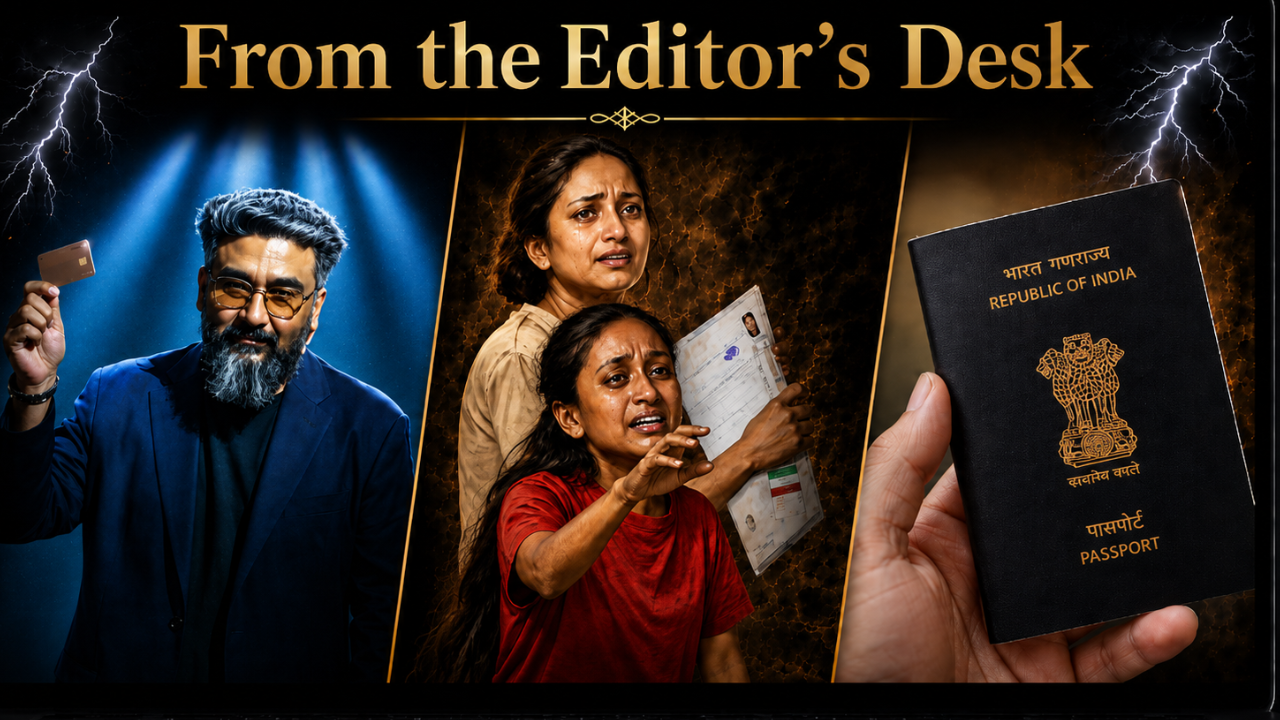


This week, we are tracking 5 very different but revealing stories:
- The emotional cost of broken exam and civic systems on India’s youth
- The confusion over what actually proves Indian citizenship
- Meta’s unconventional bet on Kunal Shah to lead WhatsApp
- Giorgia Meloni’s attempt to turn Trump’s insult into an advantage
- Billy Heartnose, the psychic cat for its World Cup predictions
No entry, no exit: How exams and cities are failing India’s youth
It is difficult to decide which tragedy should haunt us more.
A NEET aspirant crying outside an exam centre, her future locked behind an iron gate because she arrived a few minutes late. Or a mother in Lucknow screaming, “Mujhe jaane do apne bete ke paas,” as smoke swallowed the building where her son was trapped.
One scene comes from an exam system that has forgotten students are meant to be its future. The other comes from an urban system that has forgotten buildings that hold human lives. Read together, they say something uncomfortable about how India treats the young people it claims to be banking on.
What connects them isn’t bad luck. It’s a systemic failure.
A final phone call
In Lucknow’s Aliganj, the fire did not begin as a national tragedy. It began as an ordinary afternoon. Students and trainees had gone to an animation and gaming centre, some learning skills meant to open a different kind of career: Gaming, graphics, films, digital work. Their parents had probably pictured them sitting safely in a classroom, not fighting for breath in smoke.
Then came the calls.
“Bacha lo.” “Papa, please save me. I don’t think I will survive. We are suffocating.”
These aren’t just quotes from a tragedy. They’re evidence — proof that the people inside understood they were trapped well before anyone could get them out. That gap, between knowing and escaping, is the most damning part of the story.
A fire can start from a short circuit. Smoke can spread fast. But when people die because there is no safe exit, no working evacuation route, and apparently no real compliance check — that’s a building, and a system, failing at the one job either was supposed to do.
The cruel gatekeepers
A day earlier, another kind of gate had already become a national symbol.
At NEET re-exam centres, students were turned away for arriving past the cut-off — in some cases by only a few minutes. Rohit Saran’s TOI op-ed put a name to the moment with its headline, “The Cruel Gatekeepers“, describing a system where five minutes late can undo five years of work.


Rules matter. Exams need discipline. But discipline and cruelty aren’t the same thing, and India’s exam machinery keeps confusing one for the other.
An exam that decides the future of lakhs of young people needs to be secure. It also needs some basic humanity built in. A delay caused by a rally, an accident, bad traffic management or poor signage at the gate shouldn’t be enough to wipe out years of preparation. Yet India’s high-stakes exams keep behaving like a trapdoor — one wrong minute, and an entire year of effort disappears with it.
Listen before the next scream
There’s a thread connecting the NEET gate and the Lucknow fire exit: Both are gates run by systems, just deciding different things. One decides who gets in. The other decides who gets out. Neither, this past fortnight, worked the way it should have.
India can’t keep calling its young people a demographic dividend while putting them through systems that exhaust, humiliate and occasionally endanger them. An academic year shouldn’t hinge on how fast someone can climb a locked gate. Nobody should have to jump from a window to stay alive. And no parent should have to hear something like “Bacha lo” on the phone, and then spend the night searching hospitals and later mortuaries.
It’s time India fixed its exam systems, its coaching economy, and the way its cities actually enforce civic rules.
Who is an Indian citizen, really?
“Nationality: Indian.”
We, especially the urban middle class, tend to think of the passport as the last word on citizenship. So when an MEA official said this week that a passport is a travel document, not a citizenship document, the instinctive response was: If not this, then what actually proves I am Indian? To be told it’s “to facilitate foreign travel” and “must not be compared with documents establishing citizenship” feels, frankly, unsettling.
But here’s the thing: This is not a new twist. It’s how the law has always been. The MEA was stating the obvious.
The Passports Act, 1967, doesn’t treat a passport as a citizenship certificate. In fact, it even allows passports or travel documents to be issued to certain non-citizens. The Bombay high court ruling from 2013 made it explicit: A passport is not conclusive proof of citizenship.


Add to that the Supreme Court’s line on Aadhaar – identity, not citizenship – and the Election Commission’s insistence that even a voter ID doesn’t automatically settle your status. Suddenly, all the usual identity documents in your wallet are on a shaky ground.
So if none of these cards are definitive, who is an Indian citizen?
Legally, the answer sits in the Constitution and the Citizenship Act, 1955. The Constitution decided who became a citizen when the Republic started. Then Article 11 handed Parliament the power to make detailed rules through law. That working law is the Citizenship Act.
Broadly, it offers five routes.
First, citizenship by birth in India.
Second, citizenship by descent for people born abroad to Indian parents, with registration at an Indian mission becoming crucial, especially for those born after December 3, 2004.
Third, citizenship by registration for eligible persons of Indian origin, spouses of Indian citizens and certain minors.
Fourth, citizenship by naturalisation for foreigners who meet residence and other conditions.
Fifth, citizenship by incorporation of territory when new areas become part of India.


Notice what’s missing: There is no “magic card” in that list.
Instead, citizenship is a legal status built out of law and life history. Documents – passport, Aadhaar, voter ID, PAN, school certificates, birth records, land and pension files, nationality certificates – are evidence of that story.
The practical takeaway: Your passport still matters, and it opens doors of many nations for you. But legally, it remains exactly what the MEA called it: a travel document.
There is no universal citizenship card for every Indian. It is a complicated and layered issue. It flows from the Citizenship Act and Constitution.
No IIT, No IIM, No Indian-American: Why Kunal Shah makes sense for WhatsApp
At first glance, Kunal Shah is an odd fit for WhatsApp. He isn’t a long-serving Meta executive, doesn’t carry the classic Silicon Valley product-lifer resume, and skips past the IIT-IIM pedigree which India often treats as shorthand for technological destiny. That mismatch is exactly what makes the appointment interesting.
Meta is investing $900 million in CRED at a $4.5 billion valuation, and in the same breath, moving Shah onto the global leadership team to run WhatsApp.


So why this outlier, and why now?
Mark Zuckerberg’s official line is that Shah brings a builder mentality and a global perspective that will serve him well running the world’s biggest messaging app. Underneath the corporate phrasing, though, there are at least three reasons this is an unconventional, almost contrarian pick.
First, he’s an entrepreneur, not a company man. Founders are wired differently from career executives: Comfortable with markets that don’t quite work yet and infrastructure held together with duct tape. Hiring one signals that WhatsApp’s next phase is less about maintaining a mature product and more about reimagining what it could become.
Second, Shah’s edge is behavioural, not technical. He studied philosophy, not computer science, and describes himself, simply, as curious. His public output — podcasts, X threads, long interviews — circles incentives, status, ambition and trust: the stuff that explains why people actually do what they do. That’s useful for WhatsApp right now. The habit of opening the app is already there; the harder question is nudging people from forwarding a message to closing a sale.
Third, Shah advised funds and mentored founders for years before Meta came calling. This means Meta isn’t just hiring an executive, it’s plugging in a network that’s been wired into Indian startups for over a decade.
None of this erases the risk, though. Shah has never run a product at the WhatsApp scale. But unconventional picks are bets by definition. Meta seems to be betting that WhatsApp’s next problem won’t be technical. It’ll be human.
‘Neither I nor Italy ever beg’: Why Meloni may have the last laugh over Trump
US President Donald Trump’s claim to Italian broadcaster La7 that Giorgia Meloni had “begged” him for a photo at the G7 summit was meant to make the Italian prime minister look small. It may have ended up doing the opposite.
Meloni’s response was sharp and immediate. In a video on X, she called Trump’s story totally invented and delivered the line that now defines the rift: “Neither I nor Italy ever beg.” In a separate statement, she went further — her popularity, she said, has nothing to do with her relationship with Trump and everything to do with her record of defending Italy’s national interest.
From MAGA’s woman in Rome to nationalist resister
Not long ago, Meloni was Trump’s favourite European prime minister: She attended his 2025 inauguration, spoke fluently in his language of sovereignty and migration, and positioned herself as the one leader who could read both Washington and Brussels. To other European leaders, that access made her useful. To Italian voters, it let her claim she’d made Italy matter again. The pitch was simple: other leaders complain about Trump, but Meloni can actually deal with him.
But of late, the Trump connection, once worn by Europe’s nationalist right as a badge of strength, is starting to look more like a liability. Meloni spent years cultivating that closeness; she may now be finding that keeping her distance serves her better than the friendship ever did.
Meloni rode the Trump wave for as long as it helped her, and now looks ready to step off before it drags her down. In trying to paint her as desperate for his attention, Trump may have handed her something more durable than a photo: A story Italian voters can believe — of a smaller country’s leader refusing to be pushed around by a much larger one, proving she doesn’t need his spotlight to matter.
Meloni may yet have the last laugh.
Paw the Octopus II: Meet Billy Heartnose, the psychic cat beating World Cup pundits
Remember the 2010 FIFA World Cup? Paul the Octopus sat in his tank in Germany, picked food from boxes marked with national flags, and somehow became more trusted than half the football pundits on television. He correctly predicted several big results, including Spain’s win over the Netherlands in the final. By the end of the tournament, Paul was no longer just an octopus. He was a tentacled oracle, and for some angry fans, possibly the most annoying creature in world football.
And now, the 2026 World Cup has Billy Heartnose.
Billy is a one-year-old British shorthair from Newry, County Down, Ireland, and he has become an Instagram sensation for doing what human experts spend entire careers trying to do: predict football matches without looking foolish.
His method is simple. His owners, Linka Lin and Mark Kelly, place two flags in front of him. Billy examines them with the seriousness of a manager studying penalty data, then taps one with his paw. That paw, according to reports, has so far picked the winner of all 19 non-draw matches he has predicted.
The funniest part is that Billy seems entirely unbothered by his sudden fame. This is classic cat behaviour. Humans are calling him psychic. Fans are checking his predictions. Social media is treating him like the Pep Guardiola of pets. Billy, meanwhile, is probably wondering when the next treat is arriving.
Editor’s picks: Some of our most and must-read articles
Iran invites PM Modi to Ayatollah Khamenei’s funeral
‘Heard party’s answer’: Keir Starmer resigns as UK PM amid Labour Party turmoil
Lionel Messi scripts FIFA World Cup history, becomes first player ever to…
Disclaimer
Views expressed above are the author’s own.