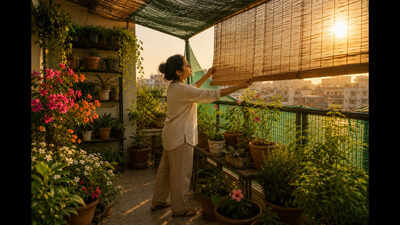

A balcony garden in an Indian summer can quickly turn into a miniature furnace. Concrete walls radiate heat, metal railings become scorching hot, and pots dry out far faster than ground soil. During severe heat waves—now becoming more frequent across cities like Delhi, Jaipur, Lucknow, and Mumbai—plants can go from thriving to collapsing within days.The good news is that balcony gardens are surprisingly resilient if cared for strategically. Garden experts say the key is not simply “watering more,” but understanding how heat stress works in container plants. According to gardening experts cited by Urban Sprout, balcony plants are especially vulnerable because containers heat up much faster than garden beds, causing roots to dry and overheat rapidly.Here are seven science-backed and expert-approved ways to protect your balcony garden during a brutal heat wave.
1. Create shade before plants start burning
The biggest mistake people make is waiting until leaves begin to scorch before providing shade. By then, the plant is already under severe stress. Use green shade nets, bamboo blinds, sheer curtains, or even old cotton bedsheets to diffuse harsh afternoon sunlight. A 50% shade net can significantly lower surrounding temperatures while still allowing enough light for photosynthesis. West-facing balconies are especially vulnerable because they absorb intense afternoon heat. Sensitive herbs, ferns, lettuce, and flowering plants should be moved inward or placed behind taller plants.

The good news is that balcony gardens are surprisingly resilient if cared for strategically. Garden experts say the key is not simply “watering more,” but understanding how heat stress works in container plants. (AI Generated)
The late British gardener and writer Christopher Lloyd, gardening is “an exercise in anticipation.” Heat protection works the same way: prevention matters more than rescue. Use double-layered green nets and lightly spraying them with water to cool the surrounding air.
2. Water deeply, but at the right time
More plants die from improper watering during heat waves than from heat itself. The ideal time to water is early morning, before 8 or 9 am, when soil temperatures are cooler and roots can absorb moisture efficiently. Evening watering can help during extreme heat, but soggy overnight soil may encourage fungal growth in humid climates.Deep watering instead of frequent light sprinkling is a better way to keep plants alive. A shallow splash only wets the surface, while deeper watering encourages roots to grow downward and become more resilient. The “finger test” remains one of the simplest methods.Insert your finger two inches into the soil
- If it feels dry, water deeply
- If it is still moist, wait
Avoid watering leaves under direct sunlight because droplets can intensify scorching. Writer and naturalist Robin Wall Kimmerer, author of Braiding Sweetgrass, often speaks about reciprocity with plants: observing before reacting. In a heat wave, observation matters more than rigid schedules.3. Mulch your pots like farmers protect soilMulching is one of the oldest and most effective heat-protection techniques in agriculture, and it works beautifully for balcony gardens too. A thin layer of dry leaves, cocopeat, straw, bark chips, coconut husk can dramatically reduce evaporation and stabilize soil temperature. Without mulch, container soil can become dangerously hot within hours.Horticulturist and writer Monty Don has repeatedly emphasized that healthy soil behaves like a living ecosystem. Mulch helps preserve that ecosystem even in punishing weather. Think of mulch as sunscreen for your roots.

Tough heat-resistant plants, like bougainvillea, aloe vera, jade plants, hibiscus, and snake plants can tolerate stronger sunlight. Indian summers are increasingly rewarding gardeners who choose climate-resilient native or drought-tolerant species.
4. Move plants according to microclimates
Every balcony has hidden microclimates. Corners near walls may stay cooler. Railings may become unbearably hot. High-rise balconies can create strong hot-air drafts. Experts increasingly advise treating balcony gardens dynamically during heat waves. Move delicate plants closer to walls, under tables or shelves, indoors near bright windows and away from reflective surfaces.Even shifting a pot by one or two feet can change its temperature exposure dramatically. This is especially important for basil, mint, spinach, ferns, peace lilies and young seedlings. Meanwhile, tougher heat-resistant plants like bougainvillea, aloe vera, jade plants, hibiscus, and snake plants can usually tolerate stronger sunlight. Indian summers are increasingly rewarding gardeners who choose climate-resilient native or drought-tolerant species.
5. Protect roots, not just leaves
Focus on leaves but don’t forget the roots. They are cooking inside overheated pots. Dark plastic containers absorb enormous amounts of heat. Terracotta and light-colored ceramic pots stay cooler and allow better airflow. Double-potting, placing one pot inside another, can also create insulation against heat spikes.Some gardeners wrap containers in jute, burlap, cardboard, reflective material to prevent roots from overheating. Container temperature often matters more than air temperature. Adding several inches of mulch can also prevent roots from “frying” during extreme weather. As climate change intensifies urban heat, balcony gardening is becoming less about decoration and more about environmental adaptation.
6. Stop fertilizing during extreme heat
This surprises beginners. During severe heat waves, plants are already stressed and conserving energy. Fertilizers—especially strong chemical ones—can force new growth and burn weakened roots. Experts recommend pausing fertilization until temperatures normalize. Look out for these signs: Heat-stressed plants often show yellowing leaves, curling edges and they wilt despite moist soil. You may also notice premature flower drop.These symptoms do not always mean nutrient deficiency. Instead of fertilizing, focus on: hydration, shade, air circulation and soil cooling. As legendary Japanese farmer and philosopher Masanobu Fukuoka argued in The One-Straw Revolution, sometimes, the best intervention is restraint.
7. Choose plants that actually like heat
There’s one lesson many urban gardeners are learning the hard way: not every Instagram-famous plant belongs in an Indian balcony garden. Heat waves are changing what successful urban gardening looks like. Increasingly, experts recommend shifting toward hardy, drought-resistant, and native plants. Some reliable heat survivors include bougainvillea, portulaca, aloe vera, snake plant, jade plant, rosemary and hibiscus. They are naturally adapted to intense sunlight and lower water availability.

A shallow splash only wets the surface, while deeper watering encourages roots to grow downward and become more resilient.
Meanwhile, cool-season plants like lettuce, parsley, or delicate flowering annuals may need seasonal breaks during peak Indian summers. Celebrated Antiguan-American novelist and essayist Jamaica Kincaid once described gardening as an act of hope and negotiation with nature. In today’s climate reality, that negotiation increasingly involves learning which plants can endure extremes.Urban heat waves are no longer rare events. Scientists warn they are becoming longer, hotter, and more frequent. Balcony gardens now sit at the intersection of climate change, mental health, biodiversity, and urban resilience. Yet gardeners continue adapting. Across cities, people are building tiny ecosystems in impossible spaces—cooling homes, feeding pollinators, and reconnecting with nature one pot at a time. The future of balcony gardening is not about perfect aesthetics, it’s about resilience.