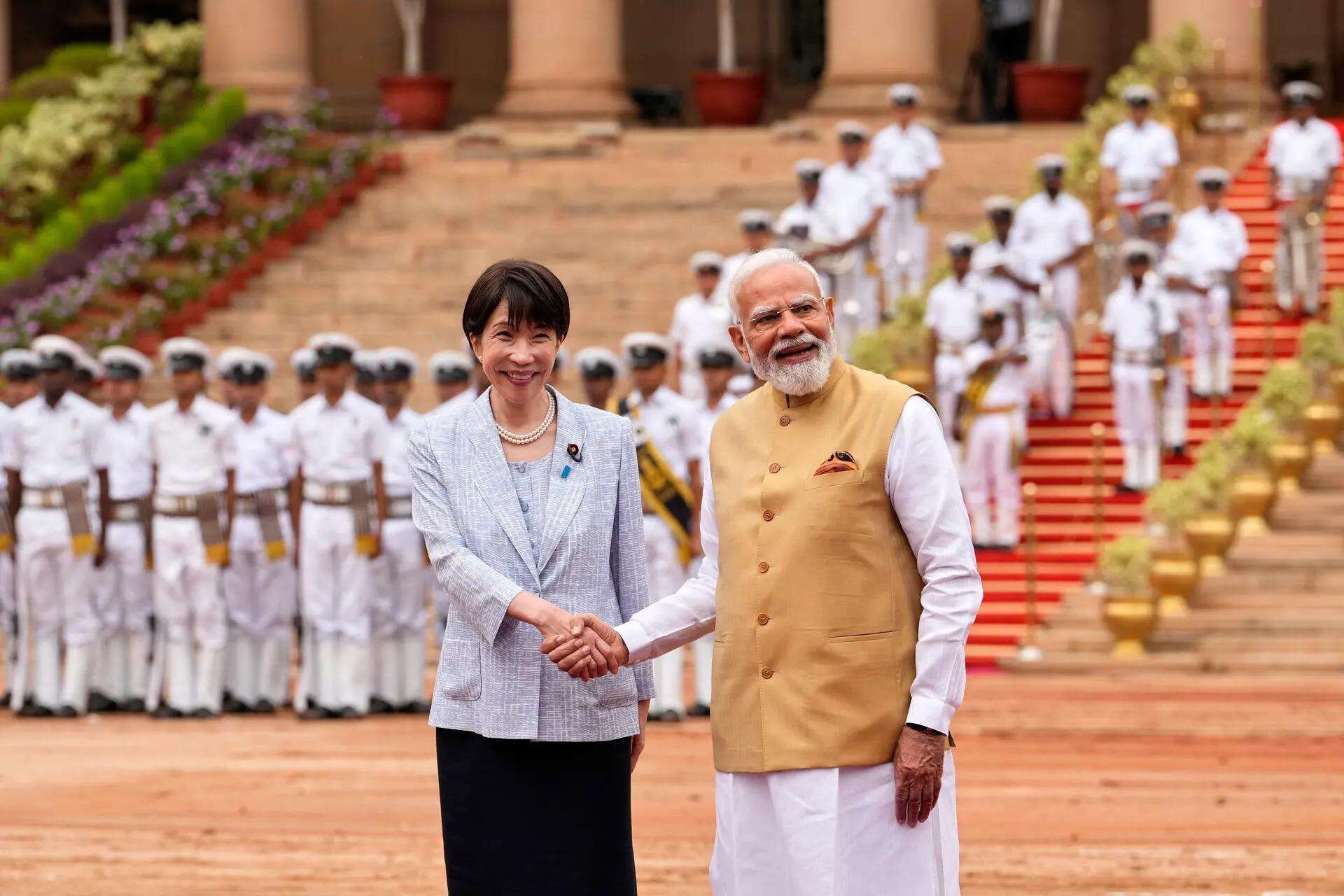
The 16th India-Japan Annual Summit, held in New Delhi, advanced the Special Strategic and Global Partnership by establishing a 16-point roadmap for economic security, artificial intelligence, and energy resilience. The summit solidified mutual defence ties and set an ambitious target of 10 trillion Yen ($ 68 Billion) in Japanese investment to establish India as a core manufacturing hub.
As global supply chains face unprecedented disruptions and geopolitical realignments reshape the Indo-Pacific, the partnership between New Delhi and Tokyo has evolved into a vital pillar of regional stability. The16th India-Japan Summit, featuring Japanese Prime Minister Sanae Takaichi’s official visit to Prime Minister Narendra Modi, transcended traditional trade discussions. The summit elevated the bilateral framework through three core pillars: defence and security, economic security and technological innovation, and sustainable energy.
Defence and Security
In recognition of growing regional security concerns, both nations reaffirmed their commitment to maintaining a Free and Open Indo-Pacific. The leaders agreed to deepen maritime domain awareness through shared satellite capabilities and expanded naval maintenance operations. A significant strategic step forward was Japan’s review of its three principles on the transfer of defense equipment, opening avenues for joint defence technology projects. Landmark initiatives like the Unified Complex Radio Antenna (“UNICORN”) project moved closer to finalization, highlighting a transition from simple buyer-seller dynamics to deep co-development and co-production.
Economic Security
At the forefront of the 16th summit was a landmark Joint Declaration on Economic Security designed to build robust, resilient supply chains for semiconductors, critical minerals, and pharmaceuticals. Technology emerged as a defining vector of the partnership, with the two nations elevating Artificial Intelligence (AI) cooperation into a strategic research partnership.
Agreements between the IndiaAI Mission and Japan’s Ministry of Economy, Trade and Industry (METI) (METI), as well as academic collaborations like those involving IIT Bombay’s BharatGen Technology Foundation, establish a foundation for secure digital infrastructure. Furthermore, the two governments targeted an influx of 10 trillion yen in Japanese investments over the next decade, with over 100 new business agreements fostering Make in India initiatives.
Sustainable Energy
In response to vulnerabilities in global energy shipping routes, the leaders adopted a Joint Statement on Energy Resilience, committing to cooperation on strategic petroleum reserves, clean energy, and a massive biogas initiative. The strategic framework also recognised the importance of the India-Japan Act East Forum, which serves as a vital bridge connecting South Asia with Southeast Asia through infrastructure and regional development.
Challenges Ahead
The strategic alignment between India and Japan has accelerated significantly to counterbalance China’s assertiveness in the Indo-Pacific. However, translating this shared geopolitical vision into robust military integration faces structural impediments, including divergent threat perceptions, stalled defense-industrial transfers, fundamentally different alliance commitments, and asymmetric economic relationships. These are some of the challenges ahead:
1) Fundamental differences in security focus hinder deeper cooperation. India faces land-based threats along its borders with China and Pakistan, requiring a focus on continental defense. Conversely, Japan operates primarily in the maritime domain, prioritizing security around the East China Sea, Taiwan Strait, and North Korea. This divergence in regional priorities limits the ability to maintain consistent, shared focus in operational areas such as the Indian Ocean.
2) Despite frameworks like the Defence Equipment and Technology Cooperation, actual defence trade faces significant bottlenecks. India requires local manufacturing under its “Make in India” initiative, while Japan’s defence sector, constrained by traditional export restrictions, lacks experience in large-scale technology transfers. This discrepancy has stalled projects like the procurement of the ShinMaywa US-2 amphibious aircraft, though recent progress, such as the UNICORN Mast project, indicates slow, incremental movement.
3) The two nations operate in different security frameworks. Japan is a treaty ally of the US, deeply integrated into its alliance system. India, in contrast, prioritises its traditional “strategic autonomy” and maintains a non-aligned stance. This divergence is highlighted in their differing approaches to crises, such as the Russia-Ukraine war, where Japan imposes sanctions while India maintains defence and trade ties with Moscow. These differing stances complicate efforts for fully synchronised actions within frameworks like the Quad.
4) A robust defense partnership is hindered by a skewed economic relationship. Bilateral trade is relatively low and heavily favors Japan, with India facing a persistent trade deficit. Despite the India-Japan Comprehensive Economic Partnership Agreement (CEPA), Indian goods often encounter high non-tariff barriers, specifically in the pharmaceutical and agricultural sectors. Additionally, major projects like the Mumbai-Ahmedabad High-Speed Rail have suffered significant delays.
The Path Ahead
To advance their Special Strategic and Global Partnership, both nations must address these challenges, including the need for defense-export reforms in Japan and improved manufacturing capabilities in India. Further progress will require adapting to these structural differences and finding practical, shared solutions.The 16th India-Japan Summit served as a crucial turning point in redefining the strategic trajectory between two of Asia’s largest democracies. By institutionalising frameworks for economic security, co-developing advanced technologies, and aligning their regional maritime visions, India and Japan have moved beyond routine diplomacy. As the two nations prepare to celebrate the India-Japan Year of Shared Horizons in 2027, the summit outcomes solidify their status as natural and indispensable partners. Their enhanced cooperation will ensure mutual economic stability while acting as a vital anchor for a rules-based order in the Indo-Pacific.
Disclaimer
Views expressed above are the author’s own.