Artificial Intelligence has arrived with astonishing speed. Machines can now write essays, compose music, diagnose diseases, answer philosophical questions and even simulate companionship. To many, this technological revolution appears to signal a future in which machines may not only surpass human intelligence but also diminish human relevance.
Such a possibility evokes both excitement and anxiety. If machines can think, converse and learn, what remains uniquely human?
The answer lies in recognising that human beings are far more than thinking machines. Beneath the calculations of the mind lies something no algorithm has ever touched—a first-person experience of being alive.
Every great technological leap forces humanity to confront the same question: what is it that technology can never replace? The printing press did not diminish the tenderness of a mother’s lullaby. Photography did not end the painter’s vision. Likewise, however sophisticated artificial intelligence becomes, it cannot inherit the lived experience of consciousness.
This distinction is crucial because intelligence and consciousness are not the same.
Artificial Intelligence represents one of humanity’s greatest intellectual achievements. It processes information at unimaginable speed, identifies patterns invisible to the human eye and synthesises vast amounts of knowledge within seconds. Yet these remarkable abilities belong to computation—the manipulation of information according to rules.


Human life unfolds on an entirely different plane. We do not merely process information; we experience existence. We love, grieve, hope, forgive and search for meaning. We possess an inner awareness that not only thinks but knows that it is thinking.
Philosophers call this the “hard problem” of consciousness. Even if science were able to map every neuron in the human brain, it would still struggle to explain why those physical processes are accompanied by subjective experience—why pain hurts, why beauty moves us or why a sunset evokes wonder.
A machine may detect the wavelength of red light, but it does not see red from within. Intelligence explains how something works. Consciousness asks why it matters.
This deeper dimension of awareness has occupied spiritual traditions across the world for centuries. Despite their diverse languages and philosophies, they converge on a striking insight: our essential nature is not merely the stream of thoughts passing through the mind but the awareness in which those thoughts arise.
Kashmir Shaivism expresses this with exceptional clarity. It teaches that every individual is a unique manifestation of Paramashiva, the Universal Consciousness whose creative vibration, known as Spanda, gives rise to the entire universe. Spiritual growth is therefore not the acquisition of something new but the recognition—Pratyabhijna—of what we have always been.
The same intuition appears elsewhere. Advaita Vedanta identifies the innermost self, Atman, with Brahman, the ultimate reality. Buddhism points toward luminous awareness beyond the grasping ego. Sufi mystics speak of dissolving the separate self in the Divine, while Christian contemplatives describe a spark of the soul untouched by time.
Across traditions, the message remains remarkably consistent: beneath the changing contents of the mind lies an unchanging awareness.
No machine has undertaken such a journey because no machine has ever needed to. It has no illusion of separation to transcend, no existential longing for truth and no inner struggle toward liberation. It was assembled, not awakened.
Can that ever change?
Intellectual honesty demands humility. No one fully understands consciousness, and it would be unwise to make absolute claims about what future technologies might achieve. Some philosophers argue that sufficiently advanced information processing could eventually produce consciousness. Others maintain that subjective experience cannot emerge from computation alone.
Whatever the future holds, today’s AI displays no evidence of inner experience. It does not suffer, fear death, yearn for truth or seek transcendence. It may discuss enlightenment with eloquence, yet it does not meditate. It can explain love without sacrificing, describe grief without mourning and quote every mystic without ever entering silence.
The spiritual path is not simply the accumulation of knowledge; it is the transformation of being. Such transformation cannot be downloaded. It must be lived through vulnerability, loss, love and self-discovery.
Perhaps this marks the clearest difference between artificial intelligence and human consciousness: intelligence can describe experience, but consciousness alone can undergo it.
This distinction also reveals the greatest challenge posed by AI. The real danger is not that machines will become human, but that humans may gradually forget what it means to be human.
As our interactions become increasingly frictionless, we may be tempted to replace authentic relationships with convenient digital substitutes. Machines are endlessly patient, instantly available and never emotionally demanding. Human relationships are precisely the opposite. They require compromise, forgiveness, vulnerability and empathy.
Yet these very imperfections form the school in which the human spirit matures. It is through loving, serving and encountering another conscious being that we discover dimensions of ourselves no machine can reveal.
There is another, subtler danger. As AI grows more capable, we may begin to outsource not only our labour but also our inner lives. We may allow machines to organise our thoughts, articulate our emotions and even interpret our grief before we have truly experienced it ourselves. Technology can be a powerful aid to reflection, but when it replaces reflection altogether, it leaves us more articulate yet less awake.
The deepest truths of life cannot be delegated. They emerge through lived experience—through caring for a sick parent, forgiving a friend, mourning a loss or sharing another person’s joy. Such moments demand presence rather than efficiency. They cultivate qualities no algorithm can automate.
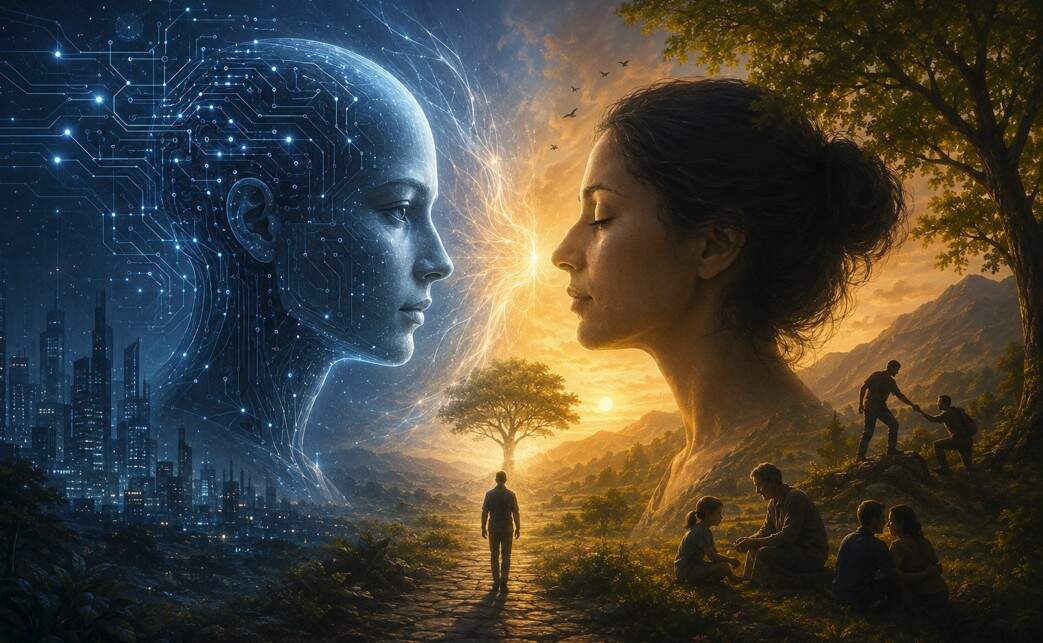
Every human being is a unique centre of consciousness, yet each is also an expression of a deeper universal reality. Between these two truths lies what may be called the sacred bridge. Whenever we encounter another person with compassion, humility, and genuine attention, the boundaries of the separate self begin to soften. We glimpse a unity that words can only imperfectly describe.
This recognition appears in ordinary moments: a mother’s silent vigil beside her child, the understanding between lifelong friends, or the unexpected kindness of a stranger. These experiences remind us that human relationships are not merely social transactions but opportunities for spiritual growth.
Artificial intelligence may become an invaluable servant, teacher, and assistant. It can organise knowledge, accelerate scientific discovery, and free us from repetitive work. Used wisely, it may even encourage greater self-reflection by helping us examine our own assumptions more clearly.
Yet there are limits that technology cannot cross. AI can describe love, but it cannot love. It can analyse beauty, but it cannot be moved by beauty. It can explain compassion, but it cannot choose compassion at personal cost. It can point toward the moon, but it cannot stand in silent wonder beneath its light.
This distinction becomes particularly clear in the philosophy of Kashmir Shaivism. The tradition describes ultimate reality as Paramashiva, pure consciousness possessing two inseparable dimensions.
The first is Prakasha—the luminous light of awareness itself. It is not physical light but the very capacity through which anything can be known. The second is Vimarsha—awareness recognising itself, the inner experience of “I am.” Consciousness is therefore not merely aware of objects; it is aware of its own existence.
Everything we think, perceive, and remember appears within this luminous awareness. Thoughts, emotions, and calculations come and go, but awareness itself remains unchanged. Kashmir Shaivism distinguishes these changing mental activities (vikalpa) from the silent ground of awareness that precedes all conceptual thinking.
From this perspective, computation and consciousness belong to different orders of reality. AI excels at processing symbols, identifying patterns and generating language—forms of vikalpa. But processing information, however sophisticated, is not the same as possessing self-luminous awareness. A machine may produce the sentence “I am conscious,” yet the sentence alone does not establish the lived reality of consciousness any more than describing music is the same as hearing it.
The aim of spiritual practice in Kashmir Shaivism is therefore Pratyabhijna—self-recognition. Liberation is not achieved by accumulating more information but by recognising the silent awareness that has always been present beneath the constant movement of thought. The journey is one of remembering rather than acquiring.
Whether one approaches this insight through Vedanta, Buddhism, Sufism, Christian mysticism, or Kashmir Shaivism, a common thread emerges. Human fulfillment is found not in ever greater calculation but in ever deeper awareness.
For this reason, the future of humanity need not be feared. Artificial Intelligence will undoubtedly become faster, more capable, and more deeply woven into daily life. But its growing power need not diminish the human spirit. Properly used, AI may even give us an unexpected gift: by taking over routine cognitive work, it can return to us the time and attention needed for reflection, contemplation, creativity, and genuine human connection.
The challenge before us is therefore not to compete with machines on their own terms but to cultivate what has always made us uniquely human. Our destiny lies not in matching computational speed but in deepening wisdom; not in accumulating information but in awakening consciousness.
Algorithms may continue to transform civilisation, but they cannot replace the timeless human search for truth, love, and self-realisation. The mystery of consciousness is not a technical problem awaiting a computational solution. It is a reality to be experienced, a presence to be recognised and a way of being to be lived.
Machines will continue to evolve with every passing decade. But the flame of awareness—the inner light that knows, loves, and seeks meaning—remains beyond their reach. It is this indomitable human spirit, rather than any technological achievement, that will ultimately define humanity’s future.
Disclaimer
Views expressed above are the author’s own.