Quad is a “headline-grabbing idea” like “foam on the sea” that would quickly dissipate. – Wang Yi, China’s foreign minister, March 2018
But, if anything, Quad has become stronger and more cohesive since Yi’s 2018 prognosis.
In an era marked by geopolitical uncertainty, technological disruption, and shifting economic alliances, the Quadrilateral Security Dialogue—or Quad—has emerged as one of the most closely watched strategic groupings in the world. India, the United States, Japan, and Australia comprise the Quad, which many initially viewed as an informal consultation mechanism. Today, it is increasingly becoming a significant pillar of stability in the Indo-Pacific region.
As the global balance of power continues to evolve, an important question arises: What does the future hold for the Quad, and how might it shape the geopolitical landscape of the coming decades?


A partnership built for a changing world
The origins of the Quad can be traced back to the humanitarian cooperation that followed the devastating 2004 Indian Ocean tsunami. The four democracies worked together effectively to deliver relief and assistance, demonstrating the potential of coordinated action.
The grouping was formally revived in 2017 amid growing concerns over regional security, maritime freedom, supply chain vulnerabilities, and emerging technological competition. Since then, the Quad has steadily expanded its agenda beyond security matters to encompass critical technologies, climate resilience, healthcare, infrastructure, cybersecurity, and education.
This evolution highlights a crucial truth: military cooperation alone cannot address the challenges of the 21st century. Economic resilience, technological leadership, and sustainable development have become equally important dimensions of national security.
India’s rising role
For India, the Quad represents a strategic opportunity rather than a military alliance. New Delhi has consistently maintained its policy of strategic autonomy while deepening cooperation with like-minded partners.
India’s growing economic influence, demographic advantage, technological capabilities, and central geographic position in the Indian Ocean make it an indispensable member of the grouping. As the world’s most populous nation and one of the fastest-growing major economies, India is increasingly viewed as a key driver of regional stability and growth.
The country’s leadership in digital public infrastructure, pharmaceutical manufacturing, space technology, and renewable energy also aligns closely with the Quad’s expanding priorities. Future initiatives are likely to see India playing a greater role in areas such as semiconductor supply chains, artificial intelligence governance, maritime domain awareness, and critical mineral partnerships.
Beyond security: The new Quad agenda
One of the most significant developments recently has been the Quad’s transformation from a predominantly strategic forum into a platform for practical cooperation.
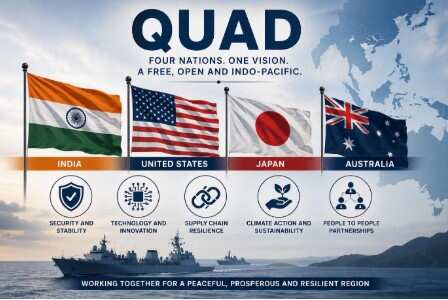
The future Quad is likely to focus on five major areas:
- Technology leadership: Competition in emerging technologies is becoming a defining feature of global politics. Artificial intelligence, quantum computing, advanced telecommunications, and semiconductor manufacturing will shape economic and military power in the decades ahead. The Quad nations collectively possess significant technological capabilities. Collaborative research, talent mobility, innovation partnerships, and secure technology ecosystems could become central pillars of future cooperation.
- Supply chain resilience: The disruptions caused by the COVID-19 pandemic exposed the vulnerabilities of highly concentrated global supply chains. The Quad is expected to deepen efforts to diversify manufacturing networks and reduce dependence on single-source suppliers. This creates opportunities for India to emerge as a major manufacturing and innovation hub, particularly in sectors such as electronics, pharmaceuticals, clean energy technologies, and advanced materials.
- Maritime security: The Indo-Pacific remains the world’s most important economic and strategic region, accounting for a substantial share of global trade and energy flows. Ensuring freedom of navigation, secure sea lanes, and disaster-response capabilities will remain a key focus area. Enhanced maritime cooperation, joint exercises, information sharing, and capacity-building initiatives are likely to intensify in the coming years.
- Climate and sustainable development: Climate change has become a critical security challenge. Rising sea levels, extreme weather events, and resource scarcity pose significant risks to regional stability. Future Quad initiatives may include investments in clean energy, green infrastructure, climate adaptation technologies, and disaster resilience. Such efforts would strengthen regional cooperation and generate economic opportunities.
- Human capital and education: The next phase of Quad cooperation could increasingly focus on people-to-people connections. Academic exchanges, research collaborations, skill-development programs, and startup partnerships can help build a more integrated innovation ecosystem across member countries.
- The strength of any international partnership ultimately depends on the relationships between its people, not merely its governments.
Challenges ahead
Despite its growing relevance, the Quad faces several challenges.
First, the four member nations have distinct national interests and strategic priorities. Maintaining consensus on complex geopolitical issues will require sustained diplomatic engagement.
Second, a delicate balance persists between cooperation and confrontation. The Quad consistently emphasizes that it does not target any specific countries. Preserving this positioning will be important for maintaining regional confidence and avoiding unnecessary escalation.
Third, domestic political changes within member countries can influence the pace and direction of cooperation. Long-term institutional mechanisms will therefore be essential to ensure continuity.
Finally, expectations must be managed carefully. The Quad is not a treaty alliance like NATO, nor is it intended to become one. Its effectiveness lies in its flexibility and ability to deliver practical outcomes without rigid institutional structures.
The road to 2035
Looking ahead, the Quad’s future is likely to be defined less by military posturing and more by its ability to deliver tangible benefits.
By 2035, the grouping could evolve into a comprehensive platform for strategic, technological, and economic cooperation. Joint investments in critical infrastructure, coordinated responses to natural disasters, collaborative technology development, and enhanced regional connectivity may become defining features of the partnership.
For India, the partnership presents a unique opportunity to shape the emerging architecture of the Indo-Pacific while advancing national development goals. For the region, a stronger Quad could contribute to stability, resilience, and prosperity.
Conclusion
The Quad’s journey from an informal dialogue to a significant strategic partnership illustrates how international cooperation is adapting to a rapidly changing world. Its future will not be measured solely by security initiatives but by its capacity to address the interconnected challenges of technology, economics, climate, and human development.
The Quad is poised to play an increasingly influential role as the Indo-Pacific becomes the center of global growth and geopolitical competition. Whether it evolves into one of the defining institutions of the 21st century will depend on its ability to remain flexible, inclusive, and focused on delivering real-world outcomes.
For now, one thing appears certain: the future of the Indo-Pacific and the Quad are becoming increasingly intertwined.
Disclaimer
Views expressed above are the author’s own.