There was a time when a midlife crisis possessed a certain dignity. A gentleman bought a sports car he could not afford, developed strong opinions about single malts, took up golf with more enthusiasm than talent, and spent long afternoons gazing into the middle distance while claiming to be “thinking things through.”
Today he buys a journal.
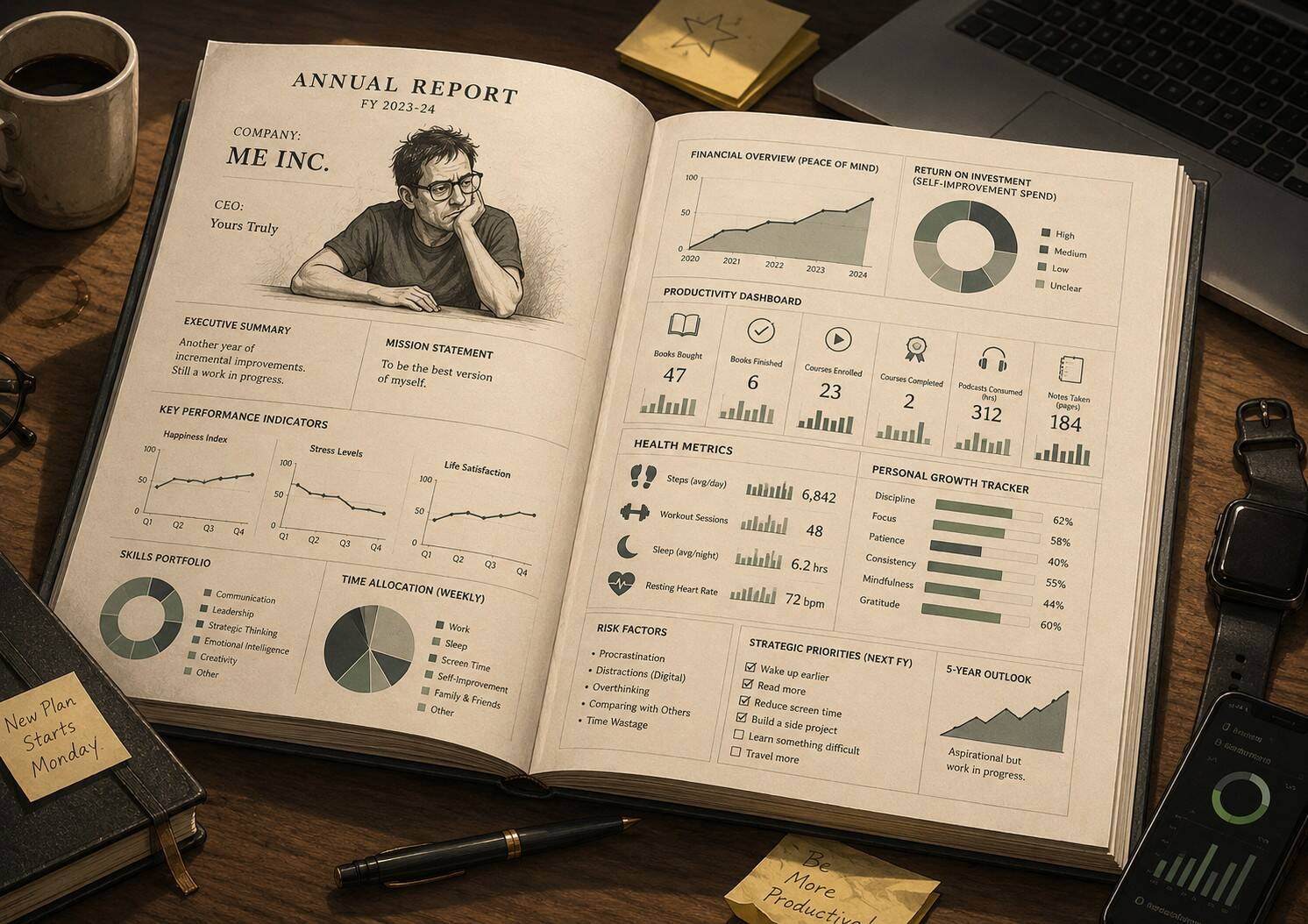
Not a notebook, of course. A notebook is a humble object designed for taking notes. A journal arrives wrapped in aspiration. It is usually bound in linen, accompanied by testimonials, and costs enough to suggest that self-knowledge itself has been moved into the premium category. Somewhere between mindfulness and marketing, we appear to have concluded that wisdom can be acquired through imported paper.


The modern airport bookstore provides a fascinating glimpse into this development. Entire walls are devoted to becoming a better version of oneself. One may become more resilient, more intentional, more productive, more disciplined, more focused, more mindful, more abundant, and, after purchasing enough books on the subject, more exhausted.
The underlying assumption is remarkably consistent. The problem, apparently, is always you. Not your circumstances, not your boss, not the economy, not the fact that your attention span has been systematically strip-mined by a dozen competing platforms. You.
You are insufficiently organised. Insufficiently disciplined, insufficiently self-aware, insufficiently ambitious, insufficiently calm. The solution, naturally, is another framework.
Human beings have always had religions. What has changed is that many of us now worship at the Church of Continuous Improvement. The saints have been replaced by productivity gurus. The sermons arrive through newsletters. The rituals involve habit trackers and morning routines. The indulgences are sold as online courses. Earlier one touched the feet of a guru, now one taps subscribe. (And most modern Gurus seem to approve)
The remarkable thing is not that such an industry exists – human beings have always sought guidance. What is remarkable is the scale of the enterprise. Never before has a civilisation enjoyed such extraordinary levels of comfort, mobility, access to information and material abundance while simultaneously convincing itself that fulfilment remains one more podcast episode away.
The professional spends the day trapped in meetings, metrics and deadlines, only to spend the evening consuming content about escaping meetings, metrics and deadlines. The same smartphone that delivers anxiety during office hours now delivers advice on managing anxiety after office hours. It is a beautifully integrated ecosystem. The snake not only eats its own tail but manages to monetise the experience.
Even leisure has become curiously burdensome. A holiday must now be transformative. A walk must become a wellness practice. A meal must become an exercise in mindfulness. A hobby must aspire to become a side hustle, a side hustle must aspire to become a startup, and a startup, if sufficiently fortunate, must aspire to become a unicorn. No activity is permitted to remain contentedly itself. Everything must justify its existence through growth.
The old Bengali bhadralok, for all his faults, would have regarded this with some suspicion. He was certainly capable of anxiety. He worried about politics, inflation, cricket, the neighbour’s son, the quality of fish available in the market and the gradual decline of civilisation. Yet he possessed one increasingly rare virtue. He could sit in a chair and accomplish absolutely nothing. Not metaphorically – literally.


He would occupy the same cane-backed chair in a club veranda, a north Kolkata drawing room or a Coffee House table for three hours without the slightest concern for efficiency. Several cups of tea or coffee (or something stronger post sundown) would be consumed. Somebody would quote Tagore incorrectly. Somebody else would correct him, perhaps also incorrectly. A discussion about cricket would somehow turn into a debate about Marxism. The waiter would lose patience long before the participants did. At no point would anyone attempt to extract actionable insights from the experience. No one would leave saying, “My key takeaway from today’s conversation is…” The conversation itself was the point. A second cup of tea was not a productivity hack. A leisurely afternoon was not a wellness intervention. Friendship was not networking and life was not a startup.
This is where the Korean-German philosopher Byung-Chul Han becomes useful. Han’s central argument is that modern society no longer exhausts people primarily through external discipline. Instead, we exhaust ourselves. We have become both employer and employee, manager and managed, forever attempting to extract greater performance from our own minds and bodies.The result is a society populated by people who are constantly working on themselves and yet strangely unable to enjoy themselves.
One need not agree with every aspect of Han’s diagnosis to recognise the symptoms. Everywhere one looks are intelligent, capable people treating their own lives as projects under perpetual review. There is always another habit to build, another weakness to correct, another system to implement, another metric to improve. We speak of unlocking potential, levelling up, redesigning our lives and becoming our best selves. We sound less like human beings and more like software awaiting the next release.
And yet one occasionally encounters individuals who seem curiously immune to this frenzy. They read widely, think deeply, laugh easily and appear entirely unconcerned with becoming the best version of themselves. They are interested instead in becoming a more truthful version of themselves.
The distinction is subtle but important. The former assumes that human beings are machines awaiting upgrades. The latter accepts that human beings are complicated, contradictory creatures who occasionally require understanding more than improvement.
Perhaps that is why so much modern advice feels strangely unsatisfying. It begins from the assumption that life is a problem to be solved. Many of the wisest people who have ever lived suspected that life was something rather different: a mystery to be explored, a story to be experienced, a conversation to be enjoyed. The self-improvement industry cannot easily monetise such an idea. There is very little recurring revenue in telling people that they are allowed to sit quietly, read a good book, have an unhurried conversation, change their minds occasionally and stop treating every waking moment as a quarterly performance review.
Which brings us back to the journal, or rather, the notebook masquerading as a journal.
The irony, of course, is that the notebook itself is entirely innocent. It has no ideology, no framework, no growth strategy and no quarterly targets. It does not ask you to optimise your morning routine, unlock hidden potential, embrace abundance, discover your authentic self, or become a better version of yourself before the end of the financial year. Those demands arrive from elsewhere.
The notebook merely waits. Patiently, and with considerably more dignity than most of the self-improvement industry.Unlike the app, it sends no reminders. Unlike the guru, it offers no framework. Unlike LinkedIn, it does not congratulate you for existing. It simply sits on the table saying nothing, which is perhaps why it possesses a certain authority. In an age in which everyone appears determined to advise, guide, mentor, coach, optimise, transform or otherwise improve us, silence has acquired an almost luxurious quality.
The older I get, the more suspicious I become of systems promising transformation and the more fond I grow of people who seem comfortably untransformed. They read, think, argue, laugh, change their minds occasionally and carry on. They are not attempting to become the best version of themselves every quarter. They are simply getting on with the complicated business of being human.
Perhaps that is what feels increasingly radical today. Not self-improvement, but self-forgetfulness. Not optimisation, but absorption. Not the constant examination of life, but the occasional pleasure of living it.
Then again, I may be overthinking the matter. The notebook, which has been sitting untouched on the shelf since February, certainly seems to think so.
Postscript: Rather than reading people who promise to change your life in seven steps, I would recommend spending time with people who spent a lifetime trying to understand it.
- Byung-Chul Han — especially on achievement culture, burnout and the exhaustion of modern life.
- Seneca and Marcus Aurelius — on desire, anxiety, self-command and the art of not making things worse for oneself.
- Viktor Frankl — on meaning, responsibility and human resilience.
- Carl Jung and James Hollis — on the second half of life and the dangers of becoming a stranger to oneself.
- Oliver Burkeman — for the comforting possibility that you do not, in fact, need to optimise every waking minute.
- PG Wodehouse — because no exploration of human folly is complete without laughter, and because Bertie Wooster understood long before the rest of us that life becomes considerably more manageable when one stops trying to improve it quite so aggressively.
Disclaimer
Views expressed above are the author’s own.