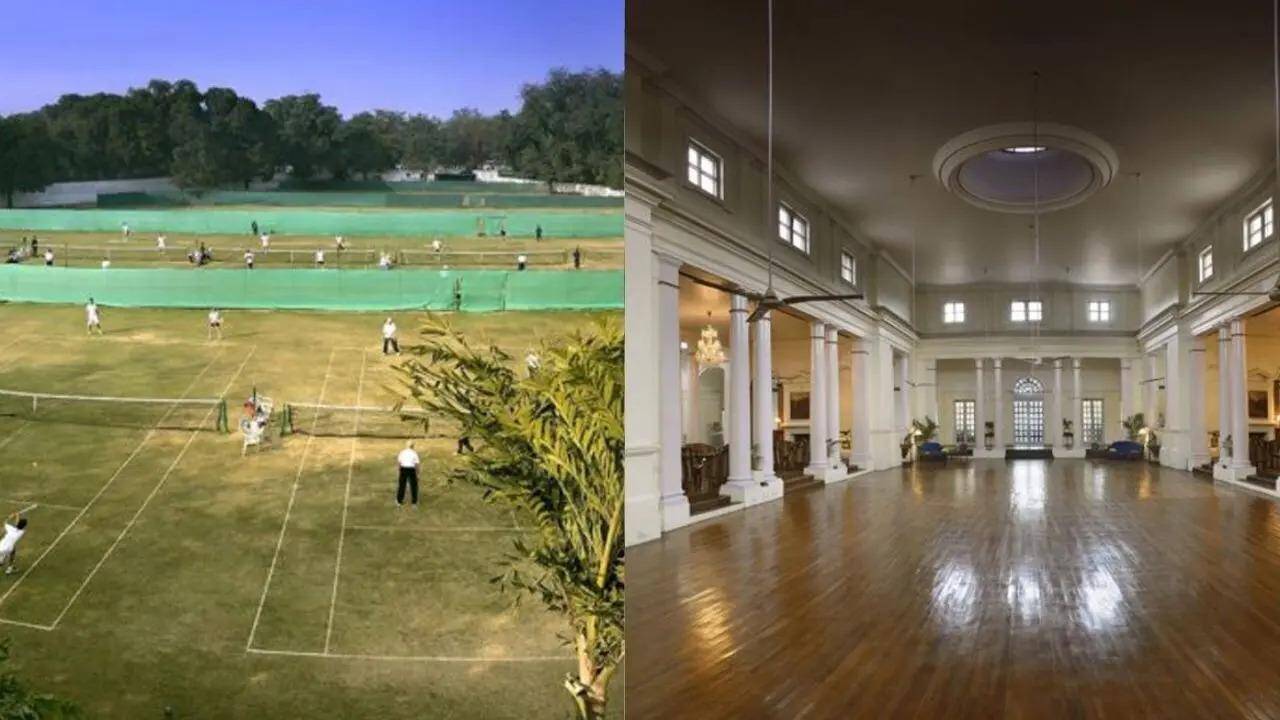
While critics frequently focus on the club’s social spaces, the Delhi Gymkhana’s core constitutional mandate has always been the promotion of athletic sports. In a capital city where world-class, open-space sporting infrastructure is exceptionally scarce, the club remains an irreplaceable asset.
The club’s 26 natural grass tennis courts constitute one of the largest concentrations of grass courts anywhere in Asia. For decades, these courts have served as an vital venue for national tennis development, hosting historic Davis Cup ties and nurturing generations of Indian competitive tennis players who required specialized grass-court training unavailable elsewhere in the country.


Beyond tennis, the club’s sporting history is etched into its very infrastructure. The “Lady Willingdon Swimming Bath” and the “Willingdon Squash Courts,” fast-tracked in 1936 through a historic grant, have provided training grounds for thousands of young athletes. Taking over and repurposing these specialized facilities for administrative office spaces or defense infrastructure risks permanently erasing a vibrant, active sports ecosystem that cannot be easily replicated in a densely built metropolis.
The human factor: Veterans, staff, and families
The contemporary narrative often portrays the club as an enclave for the hyper-wealthy. However, a closer look at its 14,000-strong membership reveals a deeply different reality. The bedrock of the club’s permanent membership consists of retired civil servants, defense veterans, judges, and public intellectuals, many of whom have received the highest civilian and military honours (3 Mahavir Chakra, 13 Vir Chakra, 4 Padma Vibhushan, 10 Padma Bhushan, 13 Padma Shri, 9 Arjuna Awards and many more). For these individuals—many of whom spent their lives living in government accommodations and serving the state on modest public salaries—the club is not a luxury indulgence, but a central anchor of their community, health, and retirement. It is a place where elderly veterans utilize the walking tracks, access the library, and maintain vital social connections. Many have even logistically planned their golden years around the club.
Furthermore, the human cost extends to the club’s institutional workforce. The Gymkhana directly employs over 500 staff members, ranging from cooks and waiters to specialized groundskeepers who possess the rare, dying skill of maintaining pristine grass tennis courts. Many of these families have served the club across multiple generations. An abrupt cessation of operations creates immediate economic vulnerability for hundreds of working-class households who rely on the club for steady livelihoods, healthcare, and stability.


Preserving the institutional memory of the capital as other capitals have
In a rapidly modernizing global capital, physical spaces that preserve a continuous, uninterrupted line of community history are incredibly rare. The Delhi Gymkhana Club is a living repository of the city’s twentieth-century social history.
The delicate balance between a capital city’s urban development and its heritage institutions is not unique to New Delhi. Across Europe and Asia, major capitals face identical debates regarding prime real estate, modern infrastructure, and legacy institutions. However, instead of dismantling these historic enclaves, these cities have long integrated them into the cultural and urban fabric, viewing them as vital repositories of national history and diplomatic life. The architecture and physical setting of these legacy spaces are central to their identity.
In the heart of London, institutions like The Hurlingham Club and The Reform Club offer precise parallels to the Delhi Gymkhana. Sprawling across 42 acres of pristine green lawns along the River Thames in Fulham, The Hurlingham Club has served as a premier bastion of traditional English sports and social life since 1869. Rather than seeing its massive green footprint as an obstacle to London’s dense urban needs, the city treasures it as an environmental oasis and a cradle for polo, tennis, and croquet. Similarly, Pall Mall’s historic clubs, which once provided a sanctuary for the architects of the British Empire, continue to operate under strict self-governance, acting as architectural landmarks that bridge centuries of political and intellectual history.
Further south, Madrid and Milan approach their historic spaces with a similar philosophy of preservation through modernization. Spain’s Club de Campo Villa de Madrid serves as a massive luxury sporting and equestrian complex on the capital’s outskirts, serving as a neutral ground where the country’s financial, legal, and political leadership converge. In Italy, Milan’s centuries-old Società del Giardino (founded in 1783) and Circolo dell’Unione have survived world wars, regime changes, and rapid modernization. European governance consistently recognizes that a global capital’s maturity is measured not just by the efficiency of its new concrete infrastructure, but by its capacity to respect and maintain the continuous, living threads of its historical community spaces.
A similar ethos of institutional preservation guides the management of historic social and sporting clubs across Southeast Asia, where legacy institutions have successfully transitioned from exclusive colonial spaces into foundational pillars of modern, sovereign identity. Rather than dismantling these prominent city-center properties to meet the relentless demands of rapid urbanization, governments in Malaysia, Singapore and Thailand have actively integrated them into their national heritage tapestries, treating them as irreplaceable historical landmarks.
In Malaysia, the Royal Selangor Club (RSC), established in 1884, stands as a prime example of a legacy institution that evolved alongside the nation. Affectionately nicknamed “The Spotted Dog,” its main clubhouse features an iconic Tudor Revival design that sits directly on the edge of Dataran Merdeka (Independence Square) in Kuala Lumpur. On the historic night of August 30, 1957, members of the club gathered on its verandas to witness the Union Jack being lowered and the first Malayan flag being raised on the adjacent field. Recognizing its deep historical resonance, the Malaysian government didn’t reclaim the land for civic expansion. Instead, the club was granted a royal charter by the Sultan of Selangor in 1984, formally cementing its status as a permanent, living national monument that continues to foster competitive sports like cricket, hockey, and rugby.
Across the border in Thailand, a similar philosophy of royal patronage and modern civic partnership has preserved the Royal Bangkok Sports Club (RBSC). Founded in 1901 by a Royal Charter from King Chulalongkorn (Rama V), the RBSC was established specifically to introduce modern athletic sports and improve horse breeding in the kingdom. Occupying a massive, highly valuable footprint in the heart of Bangkok’s Pathum Wan district, the club represents a crucial chapter in Thailand’s twentieth-century history; its grounds even served as the nation’s very first aviation airfield in 1913. Rather than reclaiming this sprawling green enclave for commercial high-rises or bureaucratic expansion, the Thai state and the Crown Property Bureau have consistently protected the RBSC. It remains an invaluable civic oasis, balancing a historic 18-hole golf course, Thailand’s first Olympic-sized swimming pool, and world-class sporting facilities with an enduring respect for national heritage, showing that prime urban land is often best utilized when it honors a city’s continuous living history.
Similarly, Singapore’s Tanglin Club, founded in 1865, has maintained its physical presence in the high-density Claymore district for over a century and a half. Surviving the volatility of the Second World War and Singapore’s subsequent rapid economic transformation into a global financial powerhouse, the club successfully shed its colonial exclusivity to become a cosmopolitan society representing over 70 nationalities. Today, the modern city-state protects the Tanglin Club as an urban oasis, valuing its world-class squash courts, indoor tennis facilities, and state-of-the-art lawn bowls greens. The longevity of these institutions across Southeast Asia demonstrates a clear regional consensus: the true maturity of a modern nation is reflected in its capacity to preserve the physical spaces that hold its shared history, evolving them to serve contemporary society without erasing the architectural and cultural fabric of the past.
Evolution and reform over dissolution
The government’s concerns regarding past management, membership waitlists, and legal regularities called for reflection. In fact, the Ministry of Corporate Affairs’ intervention in 2020 and the subsequent appointment of a government-nominated General Committee in 2022 has now addressed these concerns, paving the way for this regulatory chapter to formally evolve towards a new era of self-governance.
The outcome of this intervention suggests that evolution, rather than dissolution, is the most sustainable path forward. Instead of an outright takeover that completely vacates the historical premises, the institution can be reimagined to serve a broader public purpose while preserving its heritage:
Democratic Accessibility: Under the oversight of the elected management committee, the membership criteria can be thoroughly modernized to eliminate any remnants of colonial-era exclusivity, making the club a merit-based space accessible to wider sections of society, including young sportspersons, scholars, and public achievers.
National Sports Integration: The elite grass and clay court infrastructure could be integrated into national sports development programs, allowing India’s promising young athletes and sub-junior champions to train regularly on world-class surfaces alongside seasoned coaches.
A new arrangement on Land Use: Given the vast 27.3-acre footprint, a strategic architectural arrangement could allow the state to utilize specific perimeters of the property for urgent security and governance infrastructure, while preserving the historic core, main building, and primary sporting facilities intact.
Conclusion
Every great global capital—from London and Milan to Singapore and Bangkok —proudly maintains and protects its historic clubs and institutional spaces, recognising them not as dead weight from the past, but as vital threads in the city’s cultural tapestry. The Delhi Gymkhana Club has successfully outgrown its colonial origins to become an enduringly Indian institution, counting among its roster numerous members who have been decorated with the nation’s highest civilian and military honours.
As the legal proceedings unfold in the Delhi High Court, the ideal resolution lies in a balanced approach. Rather than subsuming the institution entirely, structurally reforming, democratizing, and selectively modernizing the club would fully achieve these objectives while demonstrating a profound, sophisticated commitment to preserving New Delhi’s architectural, sporting and institutional heritage.