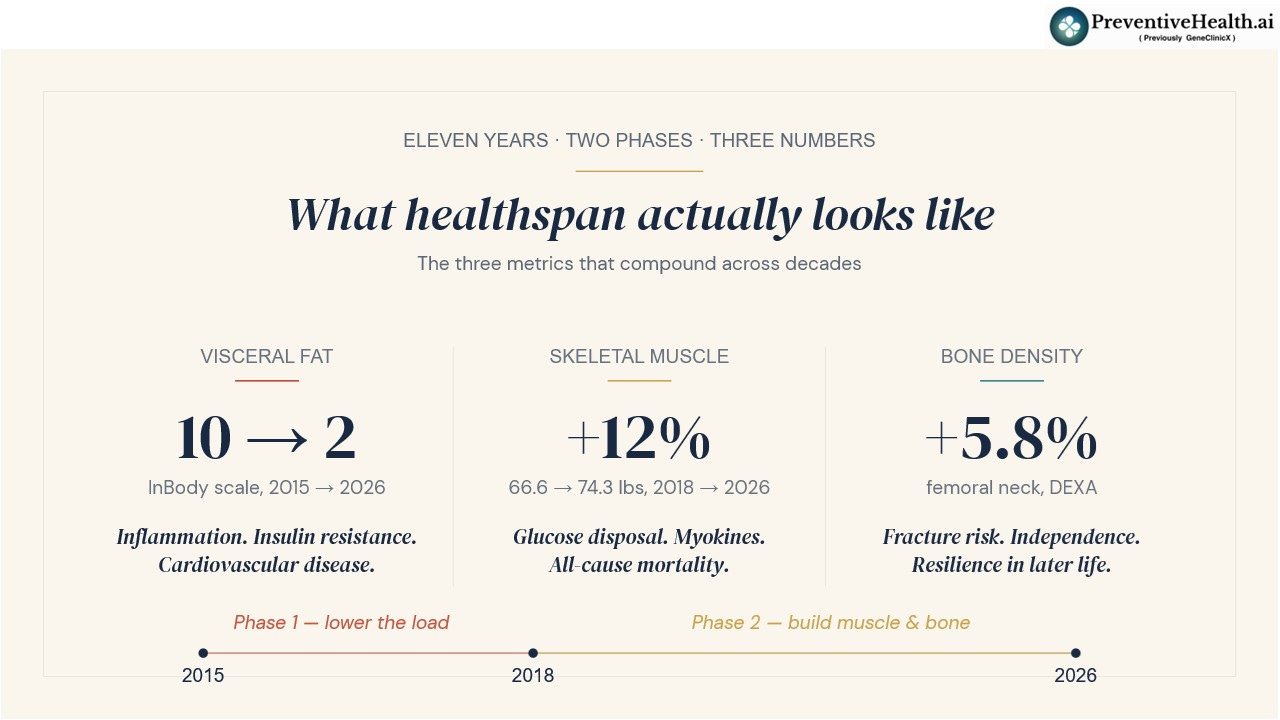
In August 2015, at the age of 43, I was diagnosed with cardiovascular disease. I was lean by every conventional measure, such as weight and BMI, and I engaged in intense endurance sports, which I had always assumed was protecting me. The diagnosis was a reset, and almost eleven years on, the data breaks cleanly into two phases that taught me very different lessons. Phase 1, from 2015 to 2018, was about lowering my cardiovascular risk through diet, less travel-related stress, and continued cardio. Phase 2, from 2018 to today, was about a lever I had ignored my whole life: muscle. In this post (#72), I want to walk through both, because together they point to something I think is underappreciated; that healthspan is not governed by one number but by three equally important ones: visceral fat, skeletal muscle mass, and bone density.
Phase 1: 2015 → 2018: Lowering the cardiovascular load
When I was diagnosed in 2015, my visceral fat was around Level 10 (high) on the InBody scale, in a body that looked entirely fit. Over the next three years, I made three changes:
- A serious overhaul of my diet: far less refined carbohydrate and fewer desserts, much more fiber, more whole-food protein
- A real reduction in the brutal travel-related stress that had been compressing my sleep and elevating my cortisol for years, and
- Continued intense cardiovascular training from soccer, a sport that I had always loved.
By December 2018, my visceral fat had dropped to Level 4, which was very good. My BMI had moved from 23 to 19.6, which had been in the acceptable range even in 2015. What I didn’t measure in 2015 was my muscle mass, which I finally started measuring in December 2018. My skeletal muscle mass was 66.6 lbs and my body fat was 16.8%. Decent on paper, but my dietitian’s polite, disapproving nod about my muscle told me what the scan couldn’t quite say.
Phase 2: 2018 → 2026: Building muscle and resilience
Phase 2 was about a different lever: building muscle.
The honest truth is I disliked strength training for years. My older son set up a small gym at home and walked me through it; I kept going initially out of guilt because I didn’t want to disappoint him. Then I noticed my soccer sprint speed was up, my injuries were down, and at some point I started doing it because I liked how I felt after. Thank you Akhil!
In this phase, I added three things to what I was already doing:
- Strength training 2–3 times a week,
- Consistently higher daily protein, and
- Slightly better sleep (from about 5 hours a night up to around 6.5 using all the hacks I have written about previously).
- That’s it. The cardio continued. The diet was already quite clean. These three additions, sustained for seven years, produced the numbers below.
The numbers
I lost 7.1 lbs of fat and gained 7.7 lbs of muscle at the same time, and increased bone density at the hip (the joint where fractures in older age are most likely to be life-altering). True body recomposition, while also adding bone is hard at any age, and especially after 45, but it is not impossible. All you need is a set of simple, consistent inputs over time.
Why all three numbers matter equally
Most cardiovascular conversation focuses on visceral fat, and rightly so: it wraps your internal organs, increases inflammation, drives insulin resistance, and is directly linked to heart and metabolic disease. Going from Level 4 to 2 in phase 2 on the InBody scale was good, but the biggest impact was going from Level 10 to 4 in phase 1.
Skeletal muscle mass is the partner metric that gets less attention than it deserves. Muscle is the largest tissue in the body for glucose disposal; more muscle means better insulin sensitivity. It acts as an endocrine organ, releasing substances (myokines) during contraction that lower inflammation. And it is one of the strongest single predictors of overall mortality in older adults. Sarcopenia, the age-related loss of muscle, is independently linked to shorter life and worse function. After 40, muscle declines roughly 1% a year without resistance training. Adding 7.7 lbs over seven years against that trend isn’t cosmetic; it’s an investment in long-term health.
Bone density is the third leg of the same stool, and it usually moves in the wrong direction with age. Most adults over 50 lose roughly 0.5–1% of bone mineral density per year, with the hip particularly vulnerable. Against that backdrop, +3.2% at the total femur and +5.8% at the femoral neck is a reversal of the expected trend, roughly offsetting several years of normal decline. The bone is a living tissue that remodels in response to mechanical load, which is why resistance training and impact-based activity (for me, soccer) drive bone density gains in a way cardio alone cannot. Hip fractures in later life are strongly associated with loss of independence and elevated mortality in the years that follow. Building bone now is going to help us in our seventies and eighties (if we are fortunate enough to get there in a healthy manner).
What drove the Phase 2 changes
Strength training, 2–3 times a week. Mechanical tension is the only signal that reliably drives muscle growth, and it’s also the primary signal that drives bone remodeling. My segmental scan using the InBody shows my muscle mass in both my arms up nearly 19% in lean mass. The hip bone density gains can also be attributed to this intervention in a reasonable way.
Zone 2 cardio, 750+ minutes a week. Zone 2 is the pace where you can still hold a conversation but are clearly working. At this effort level, your body burns fat, including visceral fat, for fuel, and slowly builds more mitochondria, the tiny engines inside every cell. More engines means more energy, better endurance, and an easier time with everything from stairs to recovery. The drop from Level 10 to Level 4 to Level 2 is largely a zone 2 story. And if you are wondering how I get to 750+ minutes per week, it is because I do most of my meetings on audio calls, walking while I talk. It’s amazing how quickly that adds up.
Higher-intensity work, 200+ minutes a week. I play soccer on weekends. This builds cardiac output capacity, which is the heart’s ability to pump more blood per beat, and the impact loading from soccer also contributes to the hip bone story above. Note that high intensity workouts don’t help with reducing visceral fat (I have written about the reason behind this in detail in a number of my past posts)
Fiber and protein, daily. I average 44 grams of fiber a day; fiber feeds the gut microbiome, which produces short-chain fatty acids that lower inflammation and improve how the body handles fats. Protein supplies the amino-acids required for muscle protein synthesis; without it, the strength training has limited effect. I increased my protein intake from about 1.3 grams/kg of body weight during phase 1 to about 1.6 grams/kg of body weight in phase 2, to account for the addition of strength training to my routine.
The blood markers
My HDL has improved from 34 mg/dL in 2015 to 65–72 mg/dL today. HDL responds powerfully to sustained aerobic exercise. My triglycerides dropped from 237 to 45 mg/dL, which is almost entirely a function of fewer refined carbohydrates, more fiber, and consistent training.
My LDL and ApoB (a more precise measure of harmful particle count) are well controlled. I take 20 mg of rosuvastatin given my high coronary calcium score in 2015 (I was at 266 that put me at the 98th percentile for my age). The medication is doing real work. What lifestyle has done is let the medication work at a lower dose.
What the wearable confirms
My Oura ring adds a third dimension. Resting heart rate (RHR) sits between 37 and 44 bpm. My HRV aka heart rate variability, a proxy for nervous system recovery, ranges from 50 to 95 ms, well above average for my age. Oura’s cardiovascular age estimate puts me roughly 15 years younger than my chronological age of almost 54. RHR and HRV are validated predictors of cardiovascular resilience and overall mortality risk.
The takeaway
Eleven years of data, two phases, one message. Phase 1 was lowering the load: cleaner diet, less stress, sustained cardio. Phase 2 was adding the missing ingredients: muscle and bone, through strength training, impact loading, and protein. The three numbers that matter most for healthspan viz visceral fat, skeletal muscle mass, and bone density, each respond to different inputs, and none of them is enough on its own. However, they are critical to get right for how we age. Find a partner if it helps, and get started. It will become fun and will be absolutely worth it.
As always, I would love to hear your thoughts and experiences in the comments.
Disclaimer
Views expressed above are the author’s own.
END OF ARTICLE