Raseel Gujral’s Dakhini I Dili at Bikaner House is the mingling of the sacred and the profane. Neatly aligned into a medley of vintage Pichwais, Tanjores and Ravi Varma’s oleographs with a trio of sculpted winged Devis created by Raseel herself, this exhibition is a leaf out of the passages of the past.
Raseel is very much a curator of depth, grace and gravitas. Her experience over 3 decades as an interior designer and artist and an aficionado of luxe projects and gatherings has kept her at the helm of many developments in the odyssey of gatherings.


Between the pichwais of deeper intensities, Tanjores of vintage value and oleographs from the Ravi Varma press, here is an exhibition that will assail your senses and make you feel the aura of the bhakti and bhava of Lord Krishna over the years. The many works that meet our gaze in an enchanting display reflect the practice of weaving historical research, archival elegance, and mythic narratives into a visually rich tableaux.


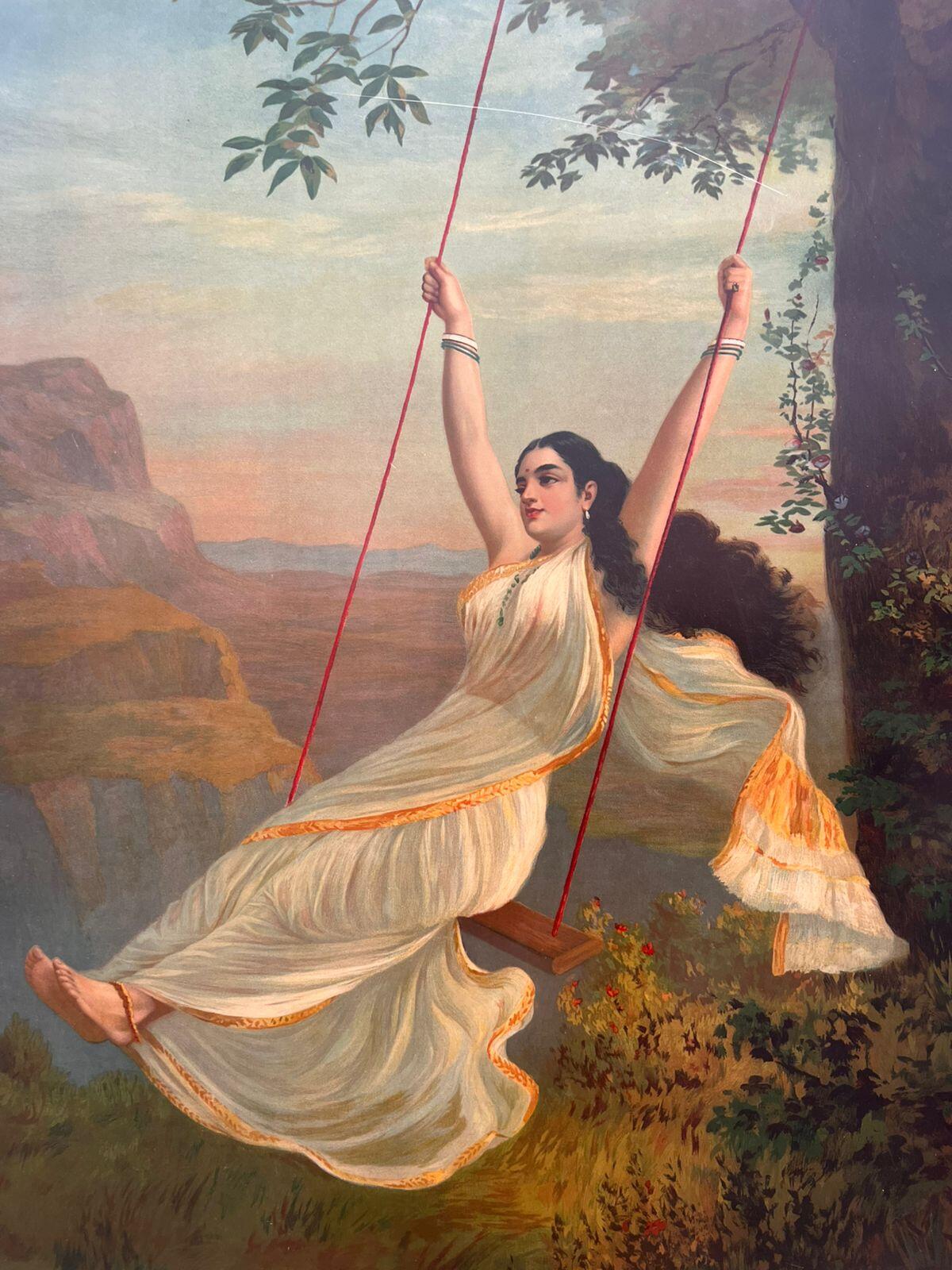
Looking at Ravi Varma’s oleographs is a delight. Not only does it serve as a flashback, but also an affirmation of his vision that became reality after his death when his oleographs were printed.
Amongst Raseel’s selection is an eclectic selection of oleographs by India’s first modernist, Raja Ravi Varma. According to art historian Ganesh Shivaswamy, Ravi Varma (1848-1906) is probably the first Indian artist to have mastered perspective and was the first to use human models to illustrate Hindu gods and goddesses.


The master artist’s biography in Malayalam by Balakrishnan Nair records an exchange between Ravi Varma and a Brahmin scholar at his studio in Kilimanoor, Kerala. The artist had asked a bystander for his opinion of a certain painting, and the scholar argued on the pretext of how the artist could expect a commoner to express an opinion on a work of art?
“True” said Ravi Varma, “these people do not have the means to get the pictures painted, but who knows if in the time of their children, these very pictures now painted for Maharajas and nobles will not become their property as well, and find their way into museums. I have heard that there are public galleries in Western countries.”
The goddesses Laxmi, Saraswati, and Mohni on the swing are all epic images that fill our senses with a sense of historicity.


The Pichwais hold you to the ground and make you gasp at their finesse and their fine detailing. Vintage golden reverence is a stellar creation in autumnal aura that makes you love the cows and at once think of the festival of Gopashtami. The Daanutsav Pichwai is a masterpiece in associations and the grandeur of worship.
According to Raseel, who is indeed a silent historian too, these large painted (pichwais) were made to hang behind the main image in temples. This textile was produced for (Gopashtami), which occurs in the late autumn to celebrate Krishna’s elevation from a herder of calves to a cowherd. The cows gaze at their kaanha, as they stand under the flower-strewn peacock laden trees in the field. This hued wonder is typical of pichhwais that were made for a community of Sri Nathji devotees. It is the warm tawny sunset that comes to our minds as we glimpse its intricate details and religiosity of rituals and faith.


This Pichwai painting captures more than a romantic anecdote; it embodies bhakti as lived emotion. Lord Krishna the flute player, is accompanied by four devotees, and it is the softness of forms that gently overlap, dissolving individuality into shared presence. The four feminine forms are dressed in subtle costumes. The cows at the bottom become both witness and symbol: a beacon of faith and adoration, and a poetic metaphor for divinity. Gopis pause in reverence, cows stand still in attentive calm, and nature itself seems to lean inward, holding the moment together as the kadamb is bedecked by flowers.
Every detail in the layered foliage, the contours of lithe lines, and the delicate gestures and poise remind us that the flute player belongs to a cosmic consciousness. Indeed, we are reminded that this is not a scene to be observed in haste; it asks to be entered, to be felt, and to be remembered as a silent reverie.

Catching attention for their hybrid gorgeousness are a trio of winged, human-faced lion sculptures created out of marble dust, resin and gold leaf accents. In terms of an evocative echo of mythic leanings and the stories that go back to antiquity, her pair of Devi’s and Damsel are a series that evoke the harkening of legends of yore. They belong to ‘ Three Faces of Eve,’ a series of terracotta and gold sculptures. The limited-edition triad, symbolising wisdom, strength and the divine feminine, has been brought to life by master craftsmen in Rajasthan.

History states that Purusha Mriga is a mythic being. Raseel’s recreation of them is a signature of the sacred and the profane. The human-headed winged lion attests to divinity as well as Persian mythology. And of course, one recalls from the ninth to the seventh century B.C., the kings of Assyria ruled over a vast empire centred in northern Iraq. Amongst the stone beasts created for the gateways of the palace were human-faced winged lions.
Disclaimer
Views expressed above are the author’s own.
END OF ARTICLE