Chetan-Ketan-Siya saga: Can Indian parents learn to handle a no?
Faith, cash and blind spots: Inside the Ram Mandir donation row
India’s economy is running hot but watch the skies
The New Cool War: Paris and Washington trade heated words over Acs
The GOAT Cup: Messi, Mbappe, Ronaldo and the battle to stand alone
The Chetan-Ketan-Siya saga: What happens when ‘Sab ne bana di jodi’
From TV studios to drawing rooms, the Lohagad Fort case has become a hot topic of national conversation. A young man, Ketan Agarwal, is dead. His fiancee, Siya Goyal, has been arrested. So has the man she was allegedly seeing, Chetan Chaudhary. Police say Siya took Ketan to Lohagad Fort near Pune. Chetan followed. And together, they allegedly pushed Ketan off a cliff.
The investigation is still going. The court will decide who’s guilty.
But there’s another question hanging over this whole saga: Who’s really to blame here?“
Sab ne bana di jodi”
Police briefings suggest Siya felt trapped. Calling off the wedding, she thought, would embarrass her family. And that’s not just her problem. In a lot of Indian homes, especially the status-obsessed ones, saying no isn’t simple.
What should be “Rab ne bana di jodi” quietly turns into “sab ne bana di jodi.” Everyone gets a say. Parents run through their checklist: Caste, community, religion, horoscope, family name, business standing. Relatives chime in somewhere along the way. And by the time it’s all done, the couple is just expected to go along with it.
So, Siya’s case isn’t a one-off. Pew found that most marriages in India are still arranged — usually by parents, sometimes with a nod from the bride and groom. NFHS-5 data tells a harder story. Among women aged 20 to 24, 43% were married by 20. 61% were married by 21. Turning 18 makes you an adult in the eyes of the law. It doesn’t always make you one in the eyes of your family.
In a lot of families, obedience is its own kind of status symbol. A “good” daughter doesn’t argue. A “good” son doesn’t push back. And a broken engagement? That’s not treated like a private decision between two adults. It’s treated like a scandal.
So maybe the real question is: Can parents learn how to actually hear the word “no” from their own kids?
Why Siya couldn’t say no to marriage
Chetan Bhagat made this point in The Times of India Op-ed, and it’s a fair one. Gen Z talks a lot about freedom and giving a damn to many social customs. But those words need to mean something at home too – not just online.
Saying no to your parents is really hard. There’s drama. Tears. Sometimes the silent treatment. None of that makes lying okay, though.
Old enough to fall in love? Old enough to get married? Then you’re old enough to say no to one, too.
Samosas, blind spots and a stash in the loo: How crores walked out of Ram Mandir’s counting room
Coins, gold, silver, notes and even foreign currency: Every day, thousands of devotees queue up at the Ram temple in Ayodhya and drop their offerings into donation boxes. All of it travels about 200 metres to a basement hall in the Pilgrim Facilitation Centre, where roughly 20 tellers per shift count it under CCTV cameras, before it’s sealed and banked. On paper, it’s a fail-safe system. In practice, as we are discovering, it leaked like a sieve.


The story broke on June 7. CM Yogi Adityanath set up a Special Investigation Team on June 13. Within ten days, it had filed a 50-page preliminary report. Eight men are now in judicial custody, around Rs 80 lakh has been seized, and two of the trust’s most prominent faces — Champat Rai and Anil Mishra— have resigned.
What the SIT found is almost comically brazen. Investigators who reviewed CCTV footage identified many instances of counting staff allegedly pocketing cash. And that’s only what the cameras caught. Footage was auto-deleted after 45 days, so nobody knows how long this had been going on.
The safeguards existed; they just weren’t enforced. Tellers were supposed to wear pocket-less clothes: A rule the trust had agreed with SBI. Nobody checked, so staff turned up with pockets, shoes and socks aplenty. Frisking at exits was cursory. Cameras had blind spots, and the accused allegedly knew about it.
Police say some men would form a huddle around a colleague to block the camera’s view while he palmed currency bundles. The group studied the layout of the counting centre: Camera positions, entry and exit routes, staff movement, etc. The stolen cash was stashed in washrooms inside the complex, then smuggled out in small amounts to avoid detection. The SIT found staff regularly threw samosa-and-kachori parties, allegedly paid for with money lifted straight from the donations.
At one level, the Ayodhya case is about a specific alleged scam and a specific set of accused. At another, it is a stress test for how India manages money in religious institutions that sit at the crossroads of faith, politics and big finances. Religious donations are not ordinary transactions. They carry emotion, sacrifice and public faith. That makes governance more important, not less. A temple that receives offerings from lakhs of devotees cannot run a cash process on goodwill, informal access and explanations after the fact.
So what now? The SIT’s deadline has been extended to July 15, with a second phase focused on reconstructing the entire chain of custody, from donation box to bank vault. The SIT has already recommended structural fixes: A professional CEO for the trust, tighter implementation of SOPs, more automation and digital tracking, and longer preservation of surveillance records.
War, weather & wallets: How India’s economy is powering through global turbulence
Picture early June: Drones and missiles flying over West Asia, crude prices spiking and the Strait of Hormuz looking wobbly. If you’d predicted then that India would close the first quarter of FY27 on a high, you’d have gotten sceptical looks. Yet, here we are.
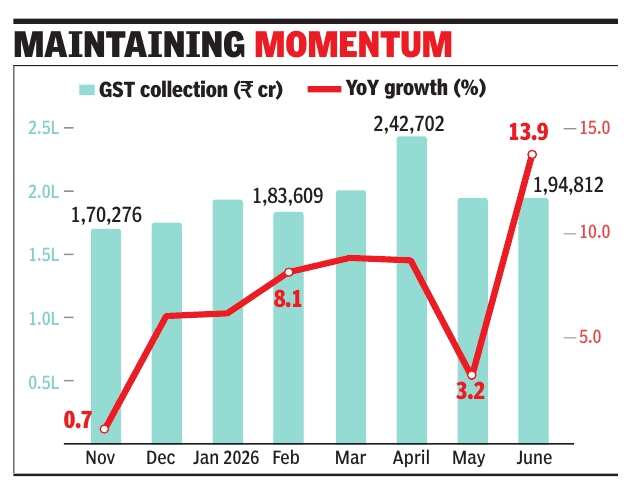
Start with the tax till. Gross GST collections jumped 13.9% in June to Rs 1.95 lakh crore, tantalisingly close to the Rs 2 lakh crore mark. What’s remarkable is that this happened after GST 2.0 slashed the average tax rate from 14.4% to 12.8%. Lower rates, higher collections: The classic sign that people are simply buying more.
Carmakers dispatched around 4 lakh passenger vehicles to dealerships in June, a 24% jump over last year. Add UPI transaction volumes up 23%, power consumption up 11.6% and healthy freight loading, and the picture is of an economy humming along nicely.
With crude cooling and Hormuz reopening, oil companies cut commercial LPG cylinder prices by Rs 183.5 (the first cut since December) and jet fuel by Rs 5 a litre. Nayara rolled back its wartime petrol and diesel hikes. But don’t expect your domestic cylinder or petrol bill to shrink soon.
No clouds on the horizon?
But let’s not pop the champagne just yet. The threat that could slow down India’s growth engine isn’t geopolitical. It’s meteorological.
A lack of actual clouds. June rainfall, at 99.5 mm, was the fifth-lowest since 1901, thanks largely to El Niño, and the countrywide deficit stands at a worrying 40%. The IMD expects a wet spell over the next 7-10 days that should help kharif sowing in central India’s rain-fed belt, but July overall is likely to stay below normal — and warmer than usual.
For an economy where rural demand is still largely dependent on a good monsoon, the next six weeks of rain may matter more than anything happening in the Gulf. A shaky monsoon means the ride ahead could still be bumpy, even if the engine today is humming.
The New Cool War: Paris and Washington trade heated words over Acs
Europe is enduring a brutal heatwave. Paris crossed 43C, roads melted, tram tracks buckled, schools shut, and more than 1,300 people have died across the continent in a matter of weeks. American journalists and influencers responded the way Americans abroad often do: By complaining loudly that nothing in France is air-conditioned.
That was too much for Audrey Pulvar, deputy mayor of Paris, who fired back on social media: “OMG, this is so rich!… Your cities, which are 90 per cent air conditioned, are not unrelated to this… So please, enough with the lecture. Just start doing your part.”
Her argument is simple: America’s love affair with cheap energy and ACs helped overheat the planet, and now Europe is paying with deadly heatwaves.
So why doesn’t Europe just install more ACs and move on?
Part of the answer is aesthetic and cultural. In cities like Paris, rows of humming outdoor units are treated as visual vandalism — “entire walls of convectors outside buildings that make an unbearable racket,” as Pulvar put it.
Then there is Europe’s self-image as a climate leader. Officials have spent years warning of a feedback loop: More heat leads to more ACs, which, if powered by fossil fuels, leads to more emissions and more heat.
Europe, in short, wasn’t built for this climate, and it shows. The more honest framing is this: Air conditioning is coming to Europe, just as it did to the US.
The GOAT Cup: Messi, Mbappe, Ronaldo and the battle to stand alone
Every World Cup gives us a story. This one has given us something rarer: A live, in-real-time referendum on who is the GOAT.
Start with the man who refuses to age out of the GOAT debate. Lionel Messi, who turned 39 during the group stage, has scored six goals in three matches. Along the way, he broke Miroslav Klose’s all-time World Cup scoring record of 16, and has since stretched his tally to 19 career goals, one of them coming off the bench as Argentina cruised to the top of their group. A missed penalty against Austria was a reminder he’s mortal. The 39th-minute finish that followed was a reminder he’s Messi.
But here’s the twist: He might not even win the Golden Boot. Kylian Mbappe has matched him with six goals and quietly rewritten the knockout-stage record books. At 27, he now sits on 18 career World Cup goals. One behind Messi. The race is delicately poised: Each can outscore the other by the end of the World Cup.
And Cristiano Ronaldo? The 41-year-old is still defying time. Ronaldo has become the oldest player to score in a World Cup knockout match, surpassing Messi, with his first-ever knockout-stage goal.
So who’s the GOAT of this World Cup and maybe forever? Right now, the romantic and statistical answers are the same: Messi. But watch Mbappe closely over the next two weeks. If France go deep and he keeps scoring at this rate, we may look back at the summer of 2026 as the exact moment the crown changed heads — with the old king still on the pitch to see it.
What a time to love this game.
Editor’s picks: Some of our most and must-read articles